Human Eyes Betray Hidden Secrets Even When You Try to Hide Them
Mobile eye tracking reveals that concealing information during face-to-face interactions triggers distinct gaze patterns and pupil dilations.

When human beings try to hide a secret from another person, their eyes give away the deception through a distinct pattern of fewer blinks and longer fixations. Researchers investigating how people lie during face-to-face interactions discovered that mobile eye-tracking glasses can successfully expose concealed information even when individuals are actively attempting to deceive an observer. The work was published in PLOS One on November 18, 2026, advancing deception detection beyond isolated computer screens and into realistic social environments.
Testing Lies Face-to-Face With Mobile Eye Tracking
Detecting deception reliably has long challenged psychologists and security professionals. Traditional lie detection methods mostly rely on screen-based laboratory tests where participants sit in isolation, staring at a monitor while interacting with a computer program. However, real-world lies happen during social exchanges involving other people, such as interviews or police interrogations. To bridge this gap, investigators Valentin Foucher and Anke Huckauf set out to test whether ocular metrics can expose hidden knowledge when a real human observer is sitting directly across from the participant.
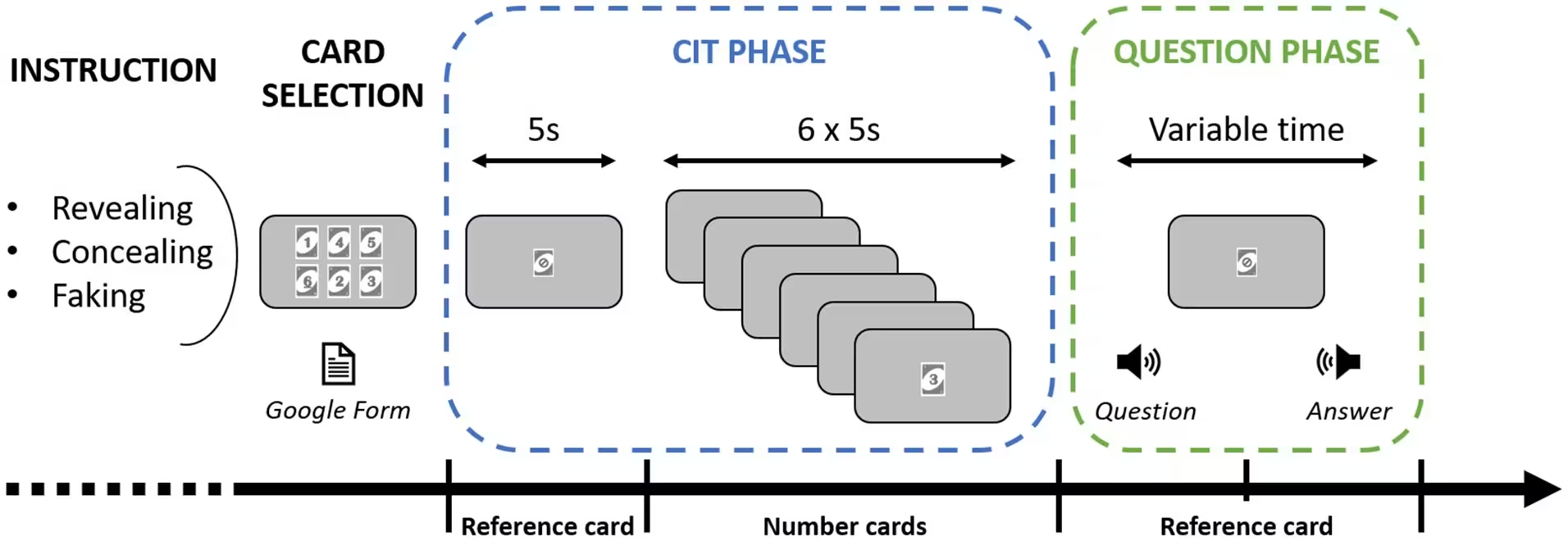
The study involved 36 adult participants who played a card game with a confederate introduced as a mentalist. At the start of each round, participants selected and memorized a number card ranging from 1 to 6, which served as the critical probe item. They were then instructed to complete three different types of interactions with the mentalist. In the revealing condition, they acted as cooperative partners and tried to help the mentalist guess the correct card. In the concealing condition, they acted as referees and tried to prevent the mentalist from guessing their secret. In the faking condition, they acted as opponents and tried to trick the mentalist into believing they chose a completely different card target.
How Pupil Dilation Betrays Secret Recognition
The experiment was divided into two distinct parts for every round. During the concealed information test phase, all six number cards were presented sequentially on a horizontal screen placed between the participant and the mentalist. Participants wore lightweight Pupil Labs Neon mobile eye-tracking glasses operating at a 200-hertz sampling frequency, which required no manual calibration. The research team analyzed pupil size, blink rates, fixation durations, and response times to see how the brain reacts to seeing a secret object.
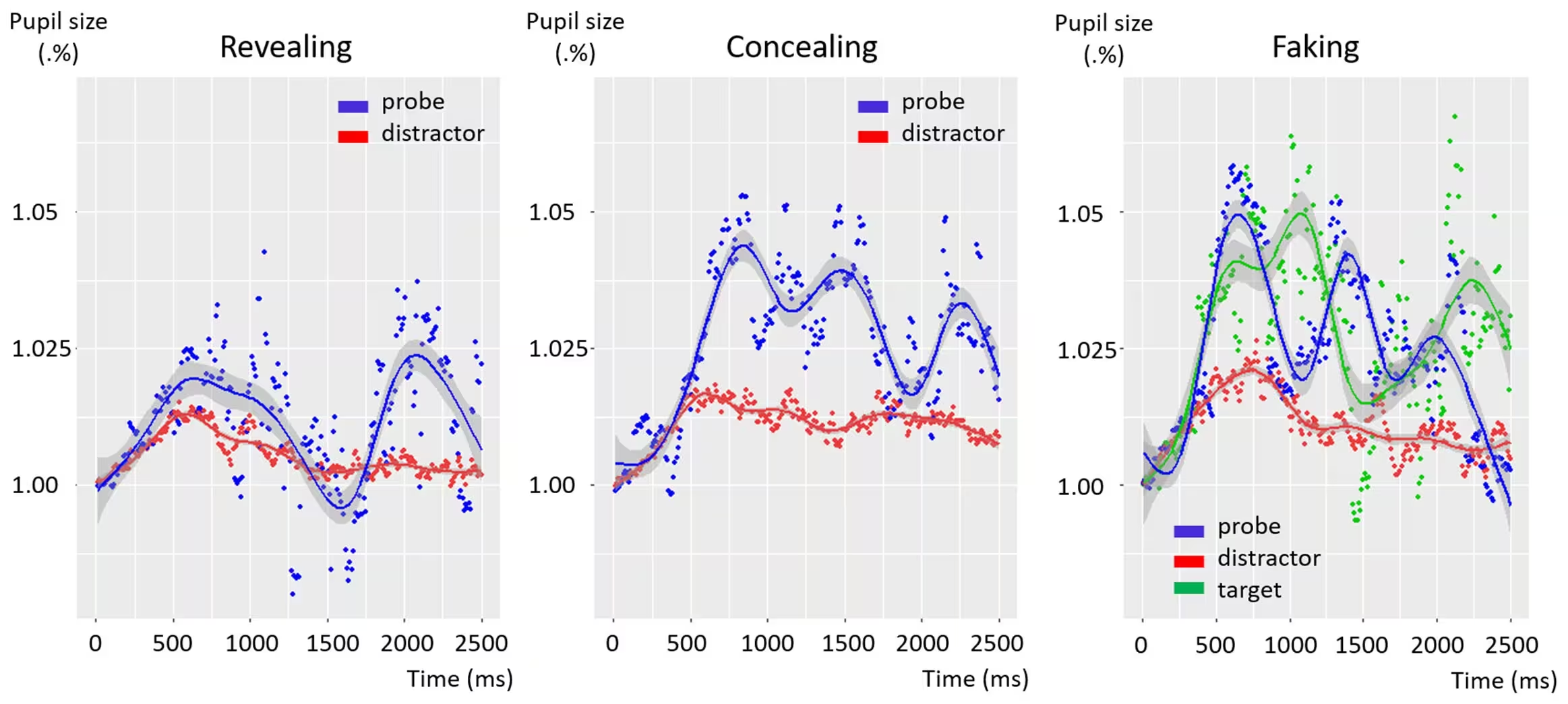
The analysis revealed that looking at the secretly chosen card consistently triggered a sharp pupil dilation across all conditions, regardless of whether the participant was telling the truth or trying to conceal the choice. For the revealing condition, a primary pupil size peak occurred 630 milliseconds after the card appeared. Similar early peaks emerged at 650 milliseconds during the faking condition and 850 milliseconds during the concealing condition. These reaction times match the classic orienting response, which is a natural physiological reaction to noticing something novel or highly significant in the environment.
Why Hiding Information Triggers Arousal Inhibition
Beyond pupil dilations, the way people moved their eyes changed dramatically depending on their deceptive intent. When participants were concealing or faking their card choice, they exhibited fewer overall fixations, but the fixations they did make lasted significantly longer. For example, fixation durations averaged 1,182 milliseconds during concealment compared to 933 milliseconds during truthful revelation. Participants also blinked much less frequently when hiding the truth.
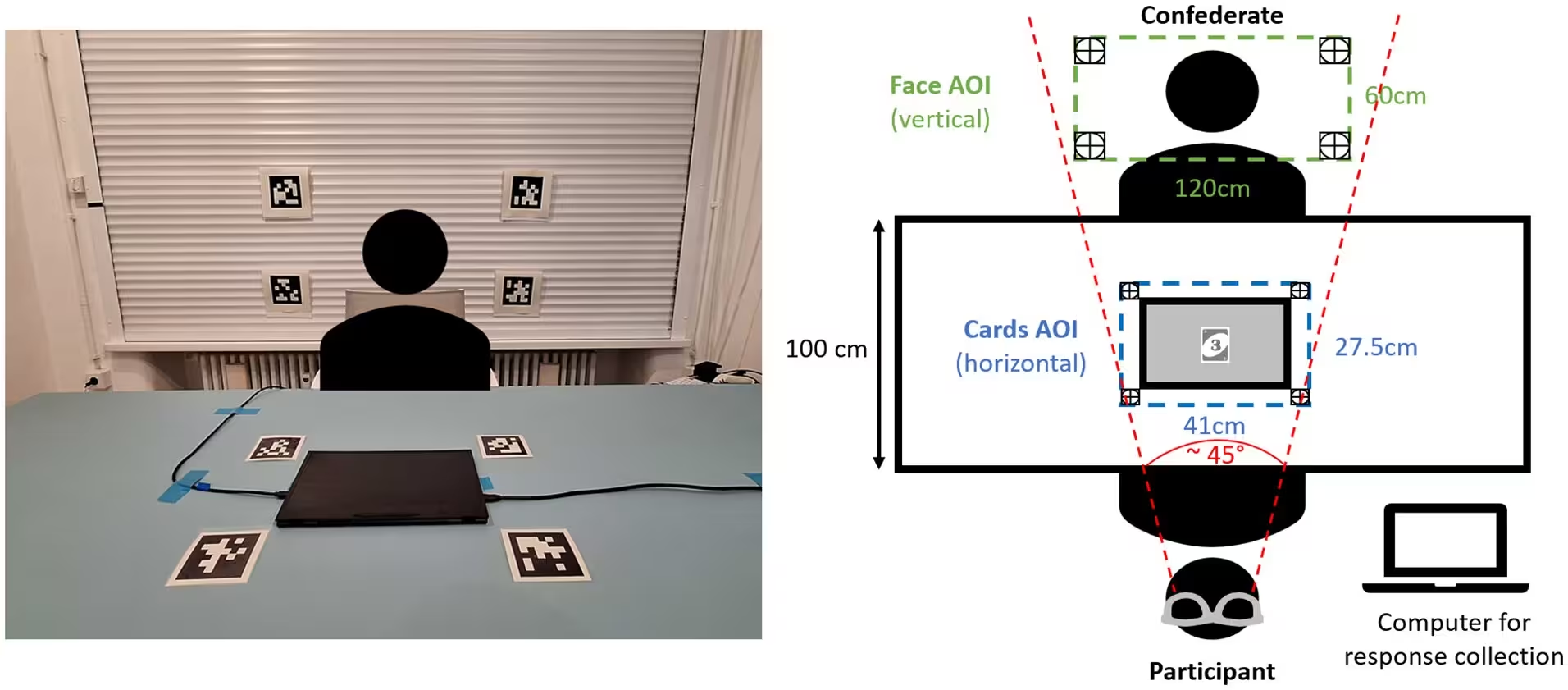
The authors note that these behavioral changes support an arousal inhibition account of deception. While the automatic orienting response causes the pupil to dilate upon seeing a familiar secret, individuals simultaneously attempt to suppress outward signs of recognition by freezing their eye movements and blinking less. Interestingly, when participants looked directly at the mentalist’s face rather than the card screen, these gaze-suppression patterns became even more pronounced. This suggests that interpersonal deception is not merely an internal cognitive process, but is physically directed toward the social partner.
Verbal Lies Slow Down Response Times Instead
Following the visual card presentation, the study incorporated a question phase where the mentalist asked a randomized yes-or-no question about the hidden card, such as whether the number was even or greater than 3. When participants had to formulate a spoken lie during this verbal exchange, their eye movement patterns no longer reliably exposed the deception. Fixation rates, fixation durations, and blink counts showed no significant variation across instructions during the interview-style questioning.
Instead, response latencies proved to be the most reliable indicator of verbal deception. Participants took significantly longer to answer the mentalist when they were lying, with average response times reaching 1,930 milliseconds in the faking condition and 2,134 milliseconds in the concealing condition, compared to just 1,112 milliseconds during honest responses. Furthermore, the concealing instruction produced a larger mean pupil size during the question phase, pointing to increased cognitive load when people must actively suppress thoughts of their secret card while constructing a false verbal reply.
Next Steps for Naturalistic Lie Detection
The authors acknowledge several limitations that should be addressed in future studies. The experiment used explicit instructions on when to lie or tell the truth in a low-stakes environment where getting caught carried no real consequences. In real-world scenarios, individuals decide autonomously whether to lie, and the stakes for being detected are much higher. Additionally, mobile eye-trackers can be more prone to minor tracking inaccuracies than stationary laboratory equipment, and analyzing pupil dynamics during free head movement remains technically challenging.
Despite these constraints, the findings demonstrate that mobile eye-tracking and pupillometry can successfully transition from isolated computer monitors to interactive social settings. Combining ocular metrics with response latency measures offers a promising path toward more robust, non-invasive deception detection tools that could eventually assist investigators in complex real-world environments.
The research was published in PLOS One on November 18, 2026.
This article has been fact checked for accuracy, with information verified against reputable sources. Learn more about us and our editorial process.
Last reviewed on .
Article history
- Latest version
- Posted by Hassan Raza