Egypt’s Whale Graveyard Uncovers Tiny Legs That Prove Whales Evolved From Land
A rare Egyptian desert fossil site reveals how land mammals transformed into the giant whales we know today.
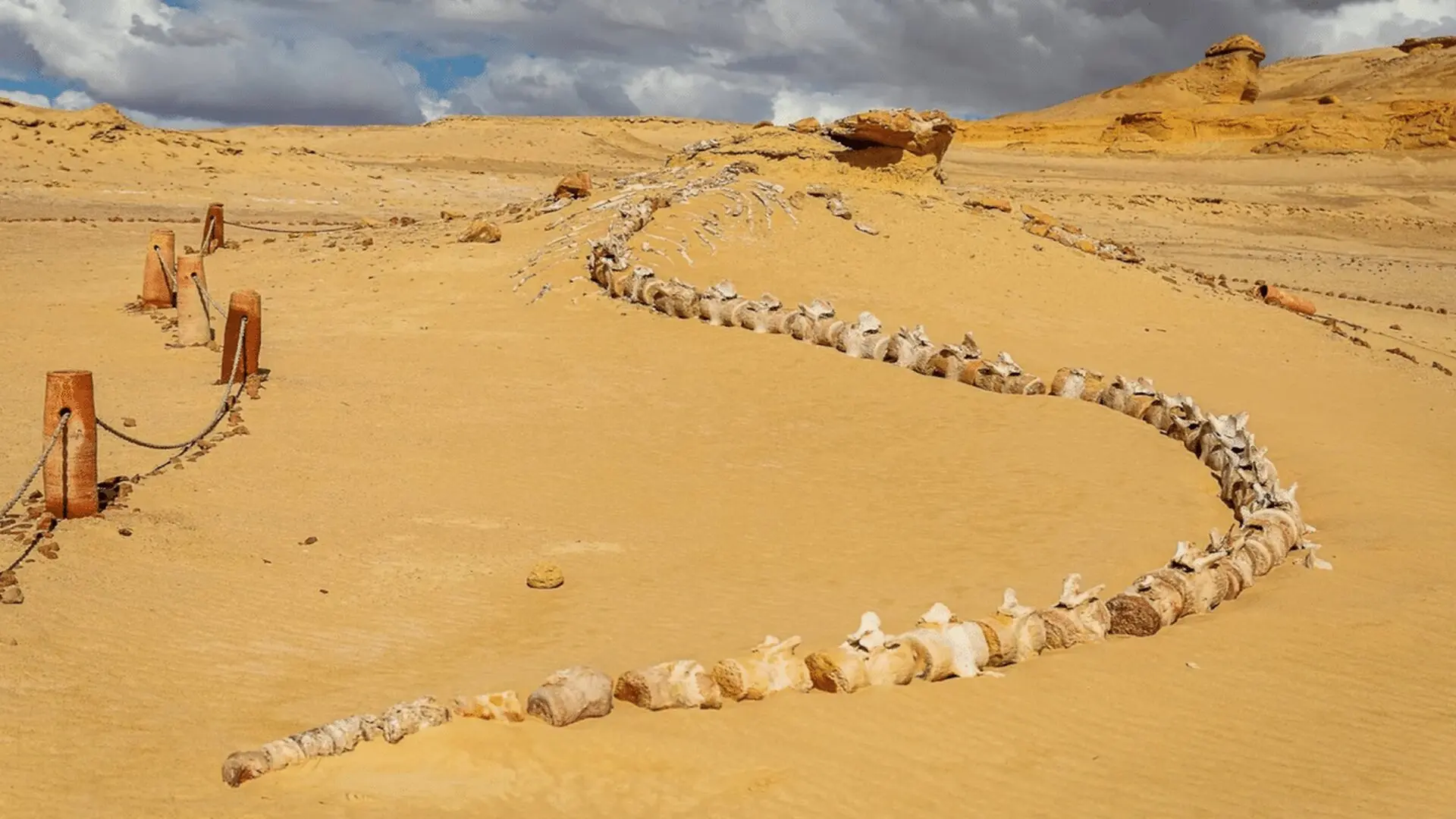
Deep within Egypt’s Western Desert lies a site that reads like a natural history manuscript. Wadi Al‑Hitan—often called the Valley of the Whales—hosts an extraordinary collection of ancient whale remains that illuminate the transition of mammals from land to sea. Designated a UNESCO World Heritage location, the area offers scientists and visitors a rare glimpse into a marine world that existed roughly 40 million years ago.
From Shallow Sea to Sun‑Baked Desert
At first glance the valley stretches as an endless tableau of sand dunes, weathered rocks and quiet horizons, far from any modern signs of life southwest of Cairo. Yet the ground is peppered with shells, shark teeth and colossal whale skeletons that betray a vastly different past. During the late Eocene, this segment of North Africa lay beneath the shallow waters of the Tethys Sea, a thriving marine ecosystem that later vanished as tectonic forces lifted the land and the sea retreated. Over time, sediments sealed the remains, and erosion eventually uncovered them, revealing a fossil field now recognized as the planet’s largest whale graveyard.
Scientists have catalogued about a thousand prehistoric whales in the region, allowing visitors to walk among partially exposed skeletons that stand as tangible evidence of an ancient oceanic landscape.
Fossil Finds That Redefined Whale Origins
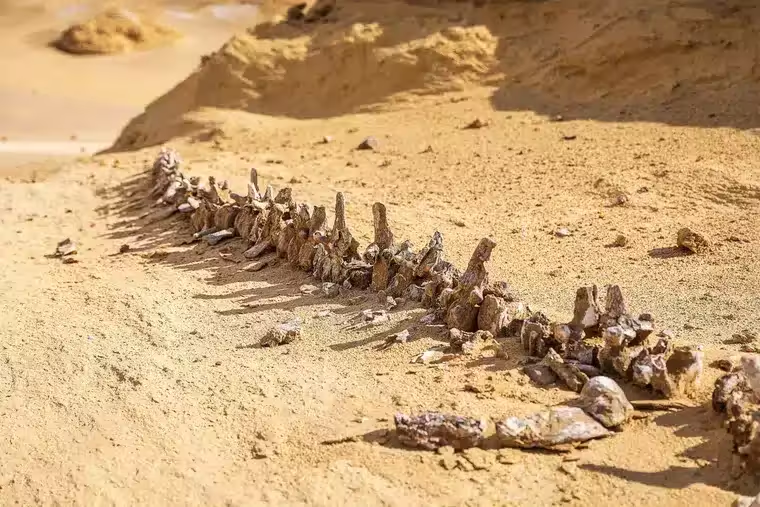
Among the most influential specimens are members of the genera Basilosaurus and Dorudon, dating from 37 to 40 million years ago. Their bones display a mix of terrestrial and aquatic traits, bridging the morphological gap between early land mammals and today’s fully marine whales. National Geographic highlights the significance of these discoveries, noting that the site has become a cornerstone for studying cetacean evolution.
Hesham Sallam, the lead palaeontologist at Wadi Al‑Hitan, recalls the early misinterpretation of one iconic fossil:
“When scientists first discovered this creature, they thought it was a gigantic marine reptile,” says Hesham Sallam, lead palaeontologist at Wadi al-Hitan. “So they named it Basilosaurus, which means ‘king lizard’.
Only later did researchers recognize it as an ancient whale, a revelation that reshaped the narrative of how these mammals entered the oceans.
Miniature Hind Limbs Reveal Evolutionary Step
A striking aspect of the site is the presence of diminutive hind limbs attached to massive Basilosaurus skeletons. Although these whales weighed several tons, the tiny legs were no longer functional for locomotion, representing an intermediate stage as cetaceans fully adapted to aquatic life. The discovery supplied the long‑sought physical proof of a theory that whales once walked on land before relinquishing their limbs.
Sallam explains why the find matters:
“When you think about it, it’s bizarre that whales are air‑breathing mammals, but they live in the ocean,” explains Sallam. “Scientists hypothesised that they must have originated on land, but later went into the water and evolved into the giants we know today, losing their legs in the process. But for decades they had no proof.”
The tiny limbs, uncovered in 1989, finally anchored the hypothesis in concrete evidence, allowing researchers to move beyond comparative anatomy and cite actual fossil records of the transition.
An Open‑Air Museum and Ongoing Research Hub
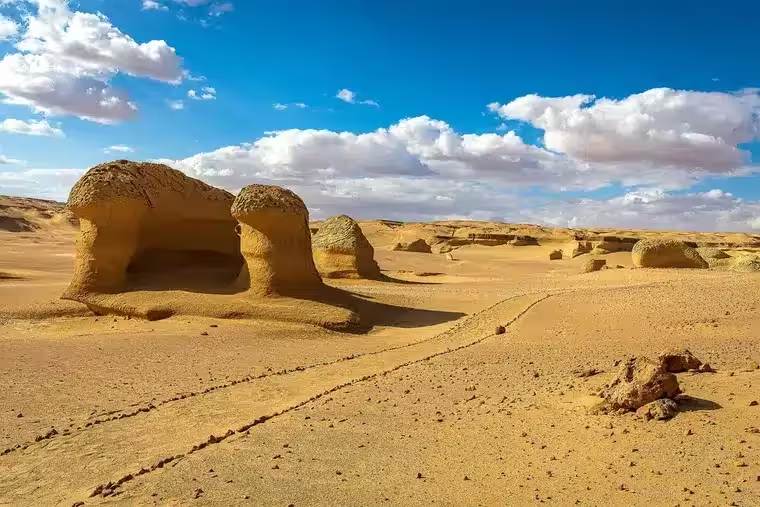
Today Wadi Al‑Hitan operates as both an outdoor exhibition and an active research site. Marked trails guide visitors past exposed whale bones, while a nearby museum showcases additional specimens recovered from the surrounding sands. Continuous erosion reveals new material, suggesting that many undiscovered fossils remain buried beneath the desert.
Sallam captures the experience:
“It’s like being able to see evolution with your naked eye and touch it with your hand,” Sallam says. “You have to be careful where you walk, because there are fossils everywhere and you never know what new discovery may be under your feet.”
The combination of unparalleled preservation, scientific relevance and the prospect of fresh finds makes Egypt’s Valley of the Whales one of the most vivid records of evolutionary change ever uncovered.
This article has been fact checked for accuracy, with information verified against reputable sources. Learn more about us and our editorial process.
Last reviewed on .
Article history
- Latest version
Cite this page:
- Posted by Hassan Raza