Scientists Build First Fully Synthetic Cell From Scratch That Grows, Copies DNA and Divides
Scientists attempt to build a living cell from scratch using only chemicals, exploring the ultimate challenge in biology.
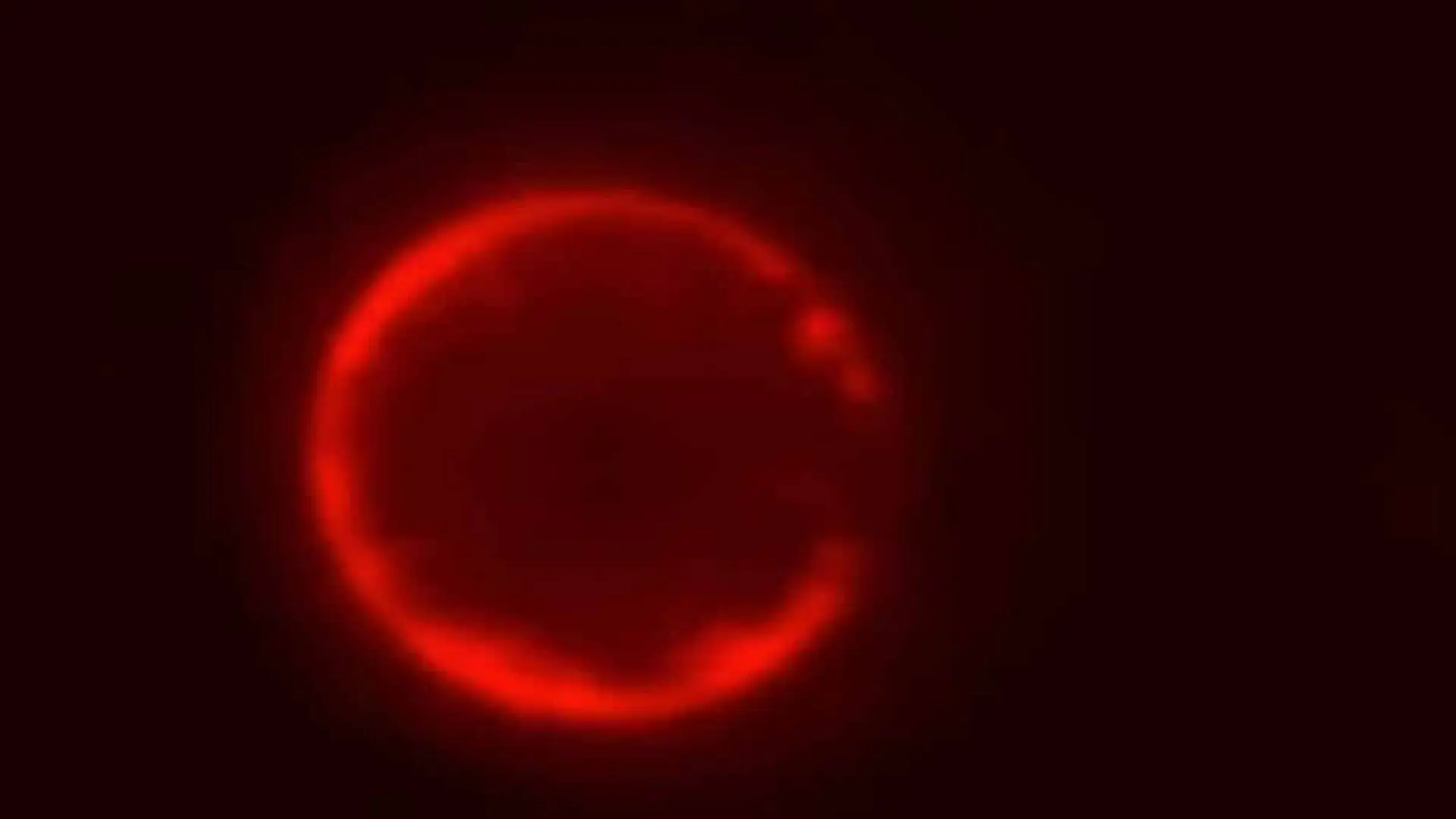
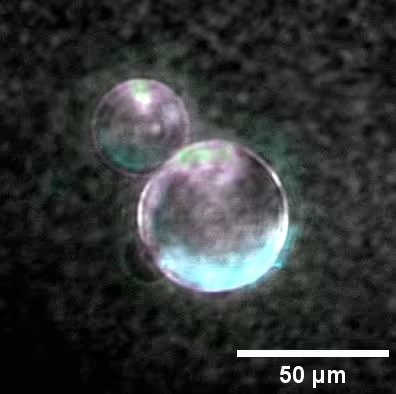
A team at the University of Minnesota reports the creation of the inaugural synthetic cell assembled solely from inert chemical parts that can enlarge, duplicate its DNA, and undergo division. Dubbed SpudCell, the construct marks a notable advance for synthetic biology, even though it does not meet the strict definition of a living entity.
The effort was directed by synthetic biologist Kate Adamala and collaborators, who set out to determine whether fundamental cellular activities could be reproduced using a fully engineered chemical toolkit.
Their findings appear as a preprint hosted by Biotic, a nonprofit co‑founded by Adamala, and have yet to undergo formal peer review. The authors view the work as a modular platform that can be refined and expanded by the broader scientific community.
Engineering a Cell From First Principles
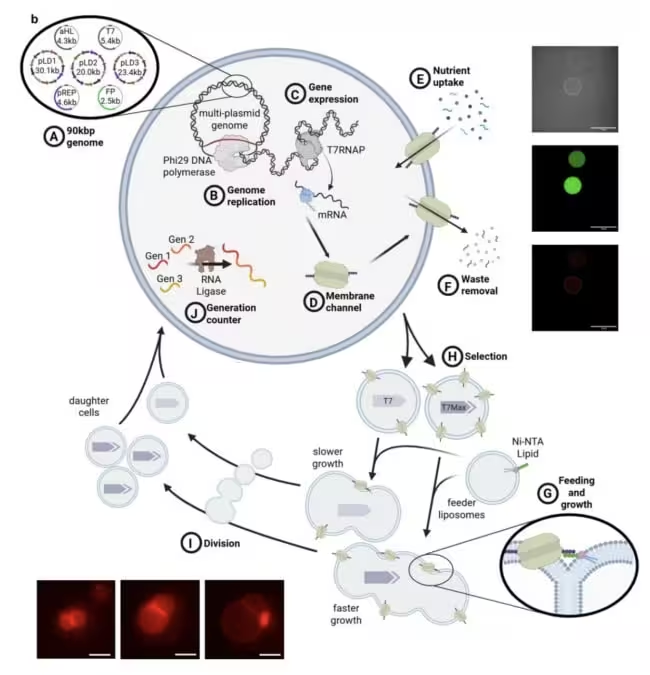
In contrast to conventional genetically altered microbes, SpudCell was not derived from an existing organism. Every element was fabricated de novo. The artificial cell consists of a liposome—a nanoscopic lipid sphere that mimics a membrane—and houses seven plasmids that encode its genetic instructions.
According to the Biotic project page, the plasmids together form a genome of roughly 90 kilobase pairs (kbp). The researchers also incorporated a protein‑production system, enabling the construct to translate its DNA into the proteins required for growth and fission.
The team reports that the system can execute selection, genome replication, growth, nutrient uptake, and genetically programmed division. Visual data accompanying the study show the artificial entity splitting after synthesizing the proteins that drive the process.
Kate Adamala acknowledged that the initial results felt almost unbelievable. In an interview with ScienceAlert, she remarked:
“I was very happy, relieved, and a bit suspicious because I’m always double- and triple-checking results.”
A Genome Smaller Than Anticipated
A striking aspect of the work is the compact size of the synthetic genome. At about 90 kilobase pairs, it falls short of the previously estimated threshold of 113 kilobase pairs thought necessary for a self‑sustaining cell. By contrast, the human genome spans roughly 3 million kilobase pairs. The new construct suggests that many essential cellular processes can be supported with considerably less genetic material than many scientists had assumed.
Nevertheless, the investigators refrain from labeling SpudCell as alive. Its inability to perpetuate across many generations precludes evolutionary dynamics. The study also sparked debate during review; as noted by Science, one referee described the work as “not real biology.”
Proof‑of‑Concept With Defined Constraints
The authors stress that the system still faces substantial shortcomings. It lacks the capacity to generate its own complete protein‑production apparatus, cannot autonomously regulate metabolism, and depends on externally supplied nutrients to persist.
In addition, the construct is missing a cytoskeleton, the internal scaffolding that endows natural cells with shape stability and intracellular transport. Without this framework, the synthetic entity remains rudimentary and only endures for a limited number of cycles. Adamala emphasized:
“Our goal is to have full operational ability to engineer biology. To do that, we need to know where every building block goes, we need a full blueprint. That is what SpudCell gives, and no other currently known cell. We have complete schematics of it, so we can engineer on that chassis.”
She added that she hopes peers will expand the platform by incorporating elements such as a cytoskeleton and more robust metabolic networks.
This article has been fact checked for accuracy, with information verified against reputable sources. Learn more about us and our editorial process.
Last reviewed on .
Article history
- Latest version
Reference(s)
- “Biotic | SpudCell.” <https://www.biotic.org/research/spudcell/>.
- <https://cbs.umn.edu/directory/kate-adamala>.
- Cockerill, Jess. “For The First Time, Scientists Say They've Built a Synthetic Cell From Scratch.”, July 2, 2026 ScienceAlert <https://www.sciencealert.com/for-the-first-time-scientists-say-theyve-built-a-synthetic-cell-from-scratch>.
- Forster, Anthony C., et al. “Towards synthesis of a minimal cell.” Molecular Systems Biology, vol. 2, no. 1, August 22, 2006 Springer Science and Business Media LLC, doi: 10.1038/msb4100090. <https://link.springer.com/article/10.1038/msb4100090>.
- <https://www.science.org/content/article/lab-created-spudcell-marks-major-step-toward-building-life-scratch>.
Cite this page:
- Posted by Hassan Raza