Australian Microfossils Reveal Complex Cells Living on an Ancient Seafloor 1.7 Billion Years Ago
Complex cells thrived in unexpected ancient ecosystems, new 1.5-billion-year-old fossils from Australian mudstone reveal.
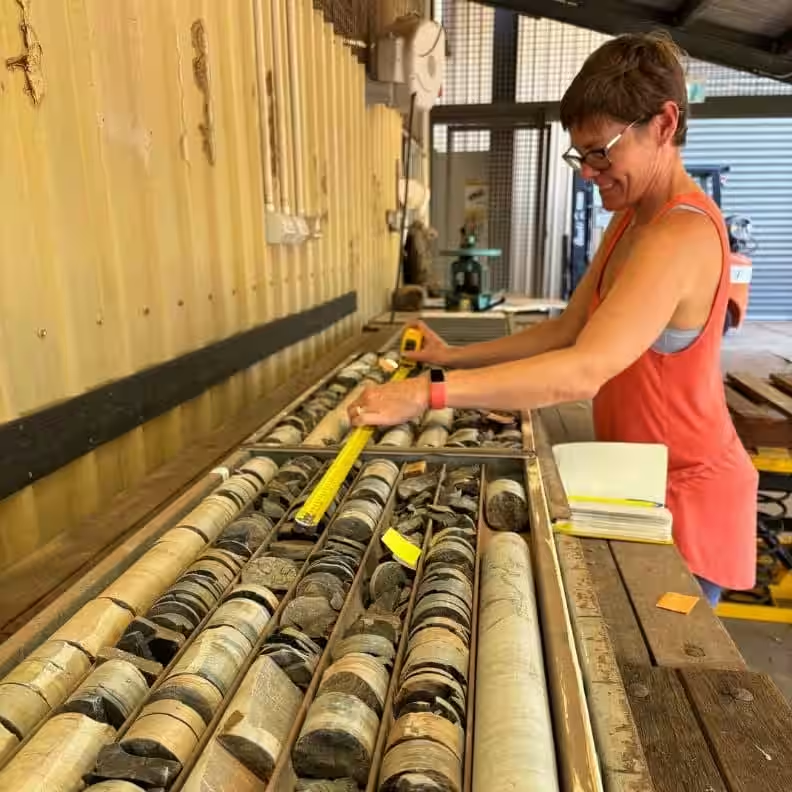
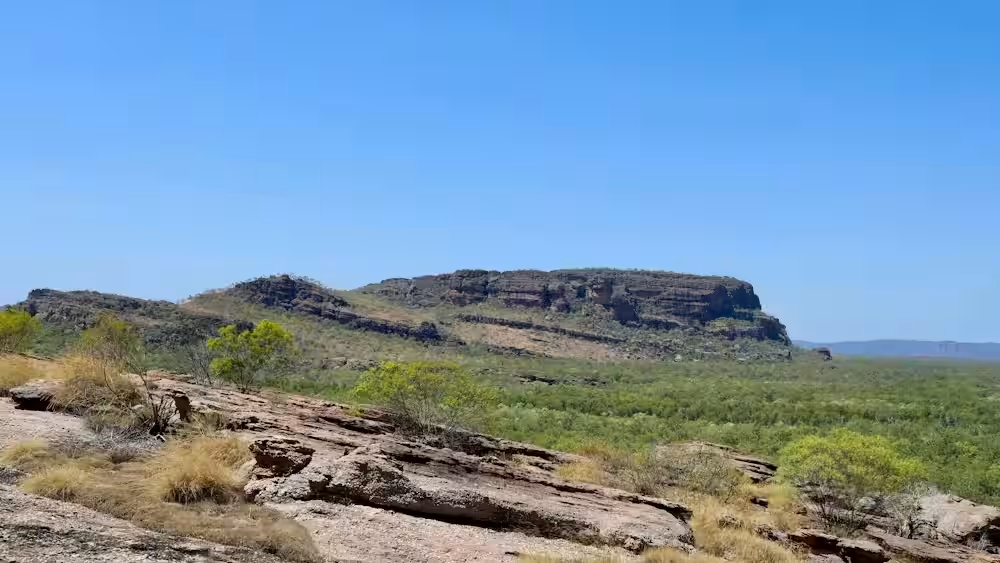
Deep inside a climate‑controlled warehouse in Darwin, Australia, rows of cylindrical rock cores lie awaiting study. These samples, extracted by mineral explorers decades ago, include mudstone – solidified seabed mud that formed when a vast inland sea once covered northern Australia.
When scientists examined the cores, they uncovered microscopic fossils that could illuminate the habitats of Earth’s earliest complex cells.
The fossils, detailed in a Nature paper, date from roughly 1.75 billion to 1.4 billion years ago. The researchers report that these primitive eukaryotes – the broad group that later gave rise to animals, plants, algae and fungi – occur almost exclusively in rocks deposited beneath oxygenated bottom waters.
This pattern suggests that, rather than drifting as free‑floating plankton, the organisms were anchored to or lived within the seafloor where oxygen was present.
Mudstone Cores Yield Tens of Thousands of Microfossils
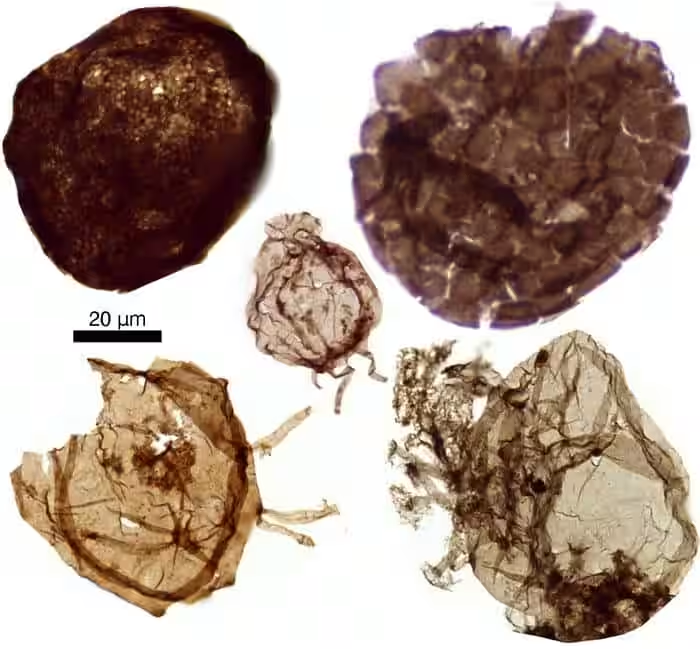
The study focused on mudstone cores stored in Darwin that originated from ancient marine settings in northern Australia. According to the University of Sydney, researchers ground the cores to powder, dissolved the mineral matrix, and inspected the remaining organic residue under a microscope.
More than 12,000 microfossils were identified, and the surrounding rocks were analyzed to reconstruct the depositional environment of the sediments.
The investigators were not merely confirming the presence of eukaryote fossils; they also asked what type of seafloor preserved them, whether the ancient waters contained oxygen, and whether the distribution of fossils matched a benthic or planktonic lifestyle.
Their analysis shows that eukaryote fossils appear in settings that range from coastal mudflats to open‑sea deposits, but only where oxygen was present. Samples formed under anoxic conditions contain only simpler prokaryotic forms, the university report notes.
Oxygen‑Rich Environments Linked to Early Eukaryotes
Eukaryotic cells possess a more intricate internal architecture than bacteria or archaea, including a nucleus and organelles such as mitochondria – the powerhouses used by virtually all modern eukaryotes.
The Nature article argues that the size and morphological sophistication of the fossils imply the organisms likely housed mitochondria. Their distribution also points to an aerobic metabolism, although the authors allow for variations ranging from obligate oxygen users to organisms tolerating low‑oxygen conditions.
Because oxygen was scarce on the early Earth, scientists have long debated whether the first eukaryotes required oxygen from the outset or only later adopted aerobic metabolism. This new fossil and sedimentary evidence bolsters the view that oxygen played a role for some of the oldest eukaryotes.
Seafloor Habitat Challenges the Plankton Assumption
The most striking claim of the research is that these organisms were probably benthic – living on or within the seafloor – rather than primarily planktonic. The conclusion rests on the absence of eukaryote fossils in anoxic samples that otherwise contain abundant prokaryotic remains. If the organisms had floated in surface waters, their remnants would be expected in both oxygenated and oxygen‑free sediments.
A UC Santa Barbara summary quotes co‑lead author Leigh Anne Riedman, who says the team found that the oldest eukaryotes “already needed oxygen in some capacity” and were “on or within the seafloor” based on their sample distribution.
While some of the fossils resemble modern plankton in shape, the geological pattern suggests a different ecological niche.
Limited Oxygenated Zones May Have Slowed Early Evolution
One lingering puzzle is why complex cells appear early in the fossil record yet remain relatively scarce until later. The authors propose that early eukaryotes were largely confined to oxygenated seafloor habitats throughout much of the Proterozoic. Such habitats would have been patchy, restricting the organisms to specific zones.
This constraint could explain the long gap between the first eukaryote fossils and the subsequent burst of diversity during the Neoproterozoic era, roughly 1 billion to 540 million years ago.
This article has been fact checked for accuracy, with information verified against reputable sources. Learn more about us and our editorial process.
Last reviewed on .
Article history
- Latest version
Reference(s)
- Lechte, Maxwell. “Early fossil eukaryotes were benthic aerobes - Nature.”, May 20, 2026, pp. 1-6. Nature, doi: 10.1038/s41586-026-10533-4. <https://www.nature.com/articles/s41586-026-10533-4>.
- “Tiny fossils found in ancient Australian mud give clues to the rise of complex life.” The University of Sydney <https://www.sydney.edu.au/news-opinion/news/2026/05/21/tiny-fossils-found-in-ancient-australian-mud-give-clues-to-the-r.html>.
- “Early complex life clung to oxygenated seafloors for hundreds of millions of years.”, May 20, 2026 The Current <https://news.ucsb.edu/2026/022580/early-complex-life-clung-oxygenated-seafloors-hundreds-millions-years>.
Cite this page:
- Posted by Hassan Raza