Buried in New Mexico for Over 200 Million Years, Researchers Found the Fossil of an Ancient Reptile That Looked Like an Ostrich
Meet the newly discovered 200-million-year-old reptile from New Mexico that defies expectations
A newly identified reptile from New Mexico is reshaping scientists’ view of the evolutionary experiments that preceded the dinosaur era. The creature, dubbed Labrujasuchus expectatus, lived roughly 212 million years ago in the Late Triassic.
The description, published in the Journal of Vertebrate Paleontology, places the fossil within the scarce shuvosaurid clade. Researchers say the specimen bridges a notable gap in the record and clarifies a little‑known branch of reptile evolution.
During the Triassic, more than 200 million years ago, life on Earth was undergoing a rapid burst of diversification. Dinosaurs were just beginning to appear, while a multitude of reptile groups were exploiting new ecological roles and experimenting with diverse body plans.
Shuvosaurids, part of the crocodile lineage, exemplify this experimentation. Their long hind limbs, lightweight skeletons, and toothless beaks gave them a superficial resemblance to small theropod dinosaurs, despite belonging to an entirely separate reptilian branch.
A Croc‑Like Predator That Walked on Two Legs
According to the study in the Journal of Vertebrate Paleontology, Labrujasuchus is a member of the extinct Shuvosauridae family, known for its unconventional anatomy. At first glance, the animal would not be recognized as a crocodile relative; it was bipedal, possessed diminutive forelimbs, and sported a beak instead of teeth. Its overall silhouette mirrors that of ornithomimosaurs—fast‑running, ostrich‑like dinosaurs that would not appear until the Cretaceous.
These parallels arose independently through convergent evolution, a process where unrelated lineages develop similar traits in response to comparable ecological pressures.
“We see a lot of the successful strategies for modern animals and non‑avian dinosaurs first arise in the Triassic, and shuvosaurs are a great example of that convergent evolution,” said lead author Dr. Alan Turner.
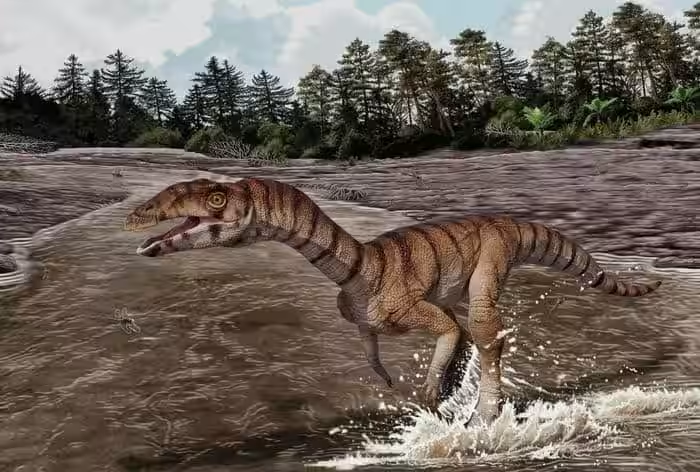
Turner noted that bipedal locomotion, while unusual for a croc‑related animal, proved to be an effective strategy adopted by several lineages over geological time.
Filling a Long‑Standing Gap in the Shuvosaurid Record
Only five shuvosaur species have been documented so far, making each new find critical for reconstructing the group’s evolutionary story. Labrujasuchus expectatus is especially noteworthy because of its placement within the timeline.
Previous work had uncovered one shuvosaur from an earlier Triassic horizon and another from a later interval in the same region, leaving an apparent missing link. The new specimen occupies that intermediate slot, confirming predictions about an undiscovered species.
The researchers chose the specific epithet expectatus to reflect the anticipation of finding a transitional form. The fossil turned out to be precisely the missing piece paleontologists had been looking for.
The genus name also nods to local heritage. “Labrujasuchus” merges “Ranchos de los Brujos,” the historic Spanish name for the Ghost Ranch area (literally “Ranch of the Witches”), with the Greek suffix suchus meaning crocodile.
“We wanted to give a nod to that colorful history,” said co‑author Dr. Nate Smith. “We also wanted to highlight how the fossil record works—finding one shuvosaur from earlier in the Triassic and one from later meant that we paleontologists knew there were probably more from in‑between waiting to be discovered and described.”
Ghost Ranch Yields Yet Another Triassic Treasure
The specimen emerged from Hayden Quarry at Ghost Ranch, New Mexico—one of North America’s premier Late Triassic sites. According to the study’s press release, paleontologists have been excavating the area’s quarries for decades, retrieving exceptionally preserved fossils that document a time when reptiles were experimenting with an extraordinary array of body plans.
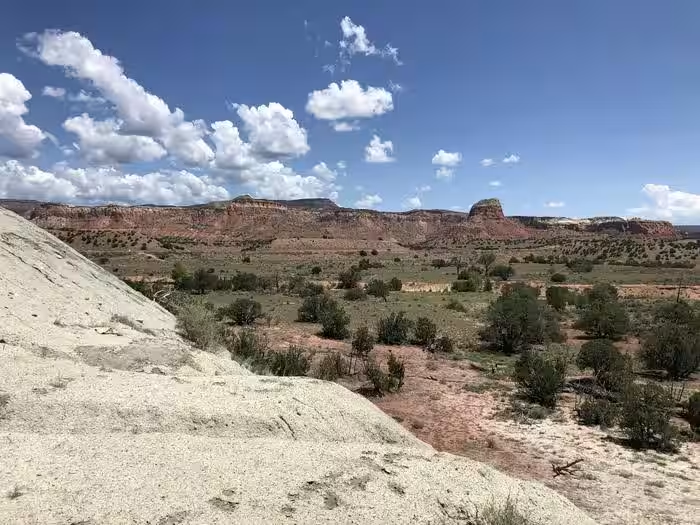
The discovery coincides with the 20th anniversary of collaborative digs at Ghost Ranch. Teams from the Natural History Museum of Los Angeles County and partner institutions continue to probe the site, which remains a crucial window into Late Triassic ecosystems.
“Whether visitors are seeking its iconic landscape and spiritual healing or digging into ancient history, Ghost Ranch is a place like nowhere else on the planet. We’re looking forward to collaborating with Dr. Turner, Dr. Smith, and all their colleagues to continue sharing this extraordinary place for years to come,” Joanne Lefrak, Director of Experience and Social Impact at the Ghost Ranch Education and Retreat Center, noted.
This article has been fact checked for accuracy, with information verified against reputable sources. Learn more about us and our editorial process.
Last reviewed on .
Article history
- Latest version
Reference(s)
- Turner, Alan H.., et al. “A new shuvosaurid (Archosauria, Poposauroidea) from the Late Triassic (Norian) Hayden Quarry of New Mexico, U.S.A..” Journal of Vertebrate Paleontology, May 26, 2026 Informa UK Limited, doi: 10.1080/02724634.2026.2618182. <https://www.tandfonline.com/doi/full/10.1080/02724634.2026.2618182>.
- <https://www.tandfonline.com/author/Turner%2C+Alan+H>.
- “Nathan Smith.” Natural History Museum <https://nhm.org/person/smith-nathan>.
- <https://www.eurekalert.org/news-releases/1129063>.
Cite this page:
- Posted by Hassan Raza