Astronomers Just Captured a Young Planet Actively Stirring Its Birthplace Disk
Astronomers have used ALMA to capture a rare, direct image of a forming planet interacting with gas, revealing how giant worlds grow in distant systems.
New ALMA Data Captures Planets Sculpting Their Birth Disk in Real Time
Astronomers have gained a rare, detailed look at the formative stages of planetary systems by observing the WISPIT 2 system. Using the Atacama Large Millimeter/submillimeter Array (ALMA), researchers have successfully mapped how two massive, young planets are actively reshaping the surrounding reservoir of gas and dust from which they emerged.
The WISPIT 2 system contains two confirmed planetary bodies embedded within a protoplanetary disk. The inner planet, WISPIT 2c, is a massive world estimated at 8 to 12 Jupiter masses, orbiting roughly 15 astronomical units (AU) from the central stars. Further out, at a distance of 57 AU, resides WISPIT 2b, a giant with a mass approximately five times that of Jupiter. As detailed by the Max Planck Institute for Astronomy, the presence of these planets has created distinct structural changes in the disk, including clear gaps and cavity formations.
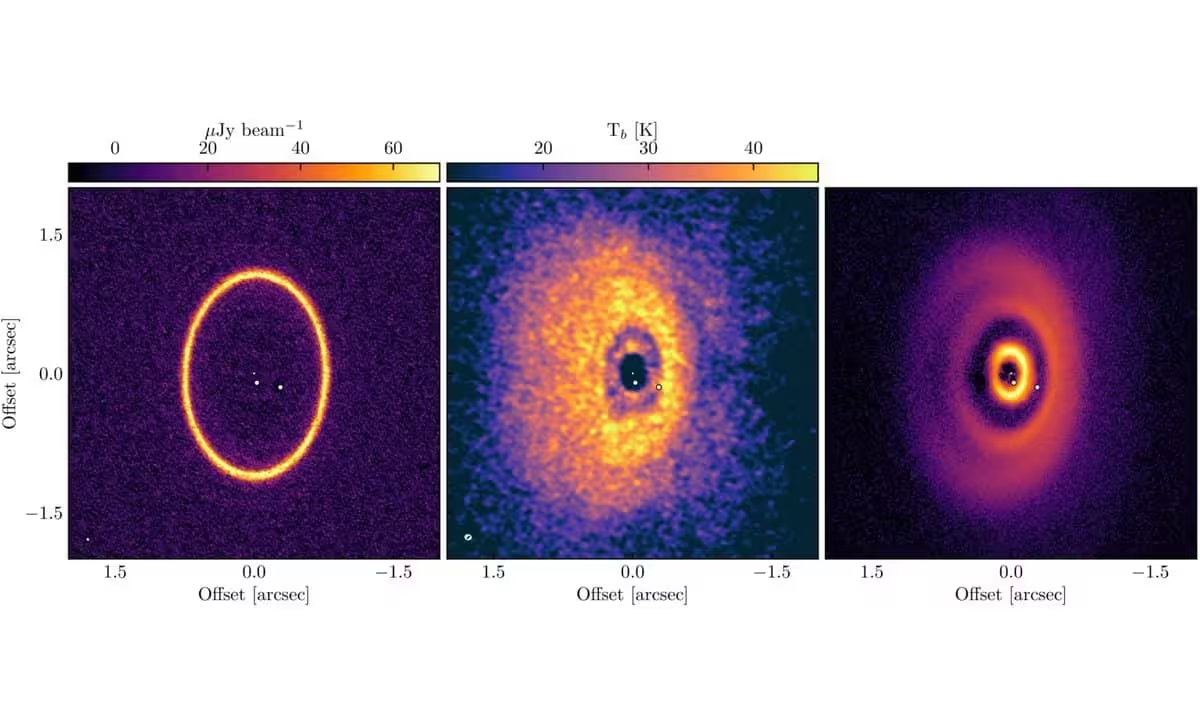
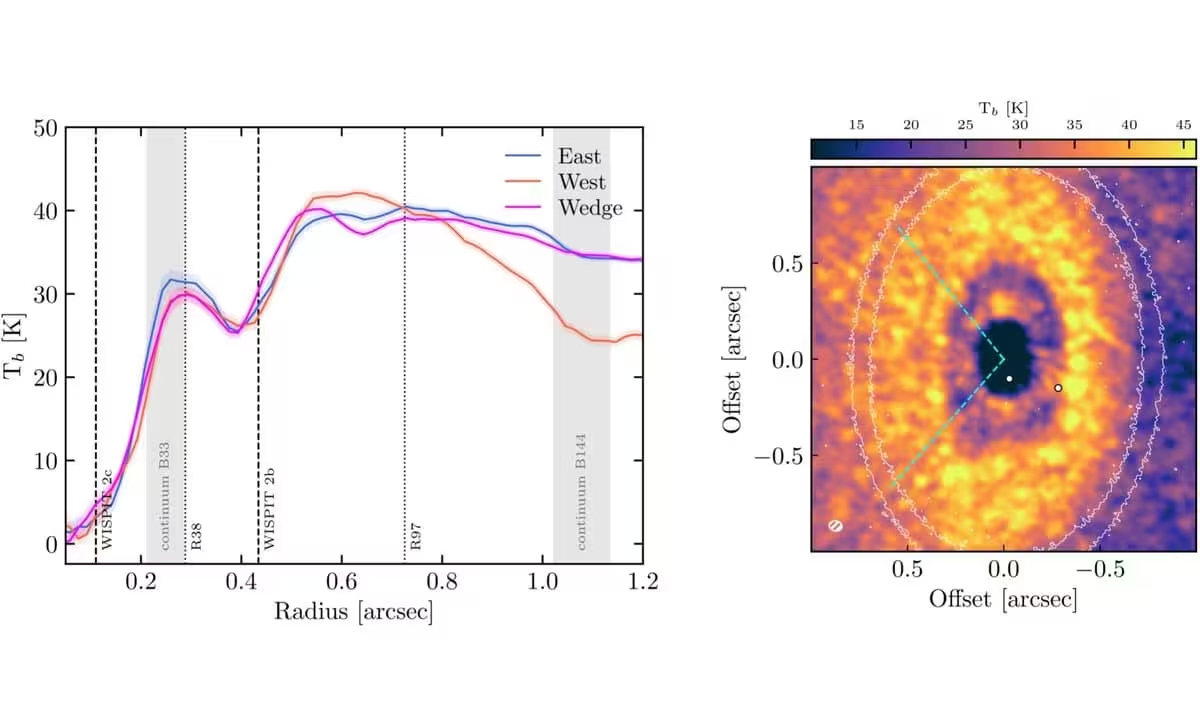
The observations reveal a complex architecture. WISPIT 2c is linked to a significant cavity where material has been heavily depleted, while WISPIT 2b occupies a gap that appears more porous, allowing some material to circulate. A faint dust ring, peaking at 33.2 AU, sits between the two orbits, while a much larger outer ring is located at 143.8 AU. Beyond the orbit of WISPIT 2b, the gas disk transitions from a relatively flat profile to a strongly flared structure, offering new insights into how planetary gravity influences disk geometry.
Unprecedented Detection of a Kinematic Planetary Signature
Perhaps the most significant finding, published in The Astrophysical Journal Letters, is the detection of a kinematic planetary signature (KPS) in the gas surrounding WISPIT 2b. By analyzing carbon monoxide emissions, researchers identified a distinct, localized disturbance in the gas that deviates from the system’s otherwise uniform rotation.
This signal extends beyond the planet’s Hill radius—the zone where its gravitational influence is supreme—suggesting that the observed disturbance is not merely caused by a circumplanetary disk, but by a combination of factors. These include spiral wakes trailing from the planet and localized heating effects. Lead author Myriam Benisty noted that while simulations have long predicted these types of swirling gas interactions, this marks the first time such a signature has been directly associated with a confirmed, imaged planet.
The WISPIT 2 system now stands as a primary laboratory for studying planet formation. Because the team can see both the planets and the specific ways they manipulate their immediate environment, the system provides a rare, clear view of the mechanics of solar system development. Future studies with even higher spectral resolution are expected to further refine our understanding of these interactions and the precise velocity of the gas flows involved.
This article has been fact checked for accuracy, with information verified against reputable sources. Learn more about us and our editorial process.
Last reviewed on .
Article history
- Latest version
Reference(s)
- “Astronomers produce the first complete picture of (gas) planet formation in action.” <https://www.mpia.de/news/science/2026-09-wispit2>.
- Benisty, Myriam., et al. “Mapping the WISPIT 2 Planet-hosting Cavity at Sub-Hill-radius Scales.” The Astrophysical Journal Letters, vol. 1009, no. 2, September 24, 2026, pp. L32 American Astronomical Society, doi: 10.3847/2041-8213/aea214. <https://iopscience.iop.org/article/10.3847/2041-8213/aea214>.
Cite this page:
- Posted by Aisha Ahmed