Smartphone Cameras Leak Private Audio Through Unrestricted Gyroscope Metadata
A newly identified vulnerability shows that camera stabilization systems stream unthrottled motion data that bypasses system-wide microphone kill switches.

Your smartphone camera can inadvertently eavesdrop on your private conversations by recording sound vibrations through its stabilization system, even when system privacy lights and microphone switches are fully disabled. A security team discovered that unthrottled motion data exported by image stabilization software allows background applications to capture speech audio at high rates.
How Phone Stabilization Exposes Private Audio Streams
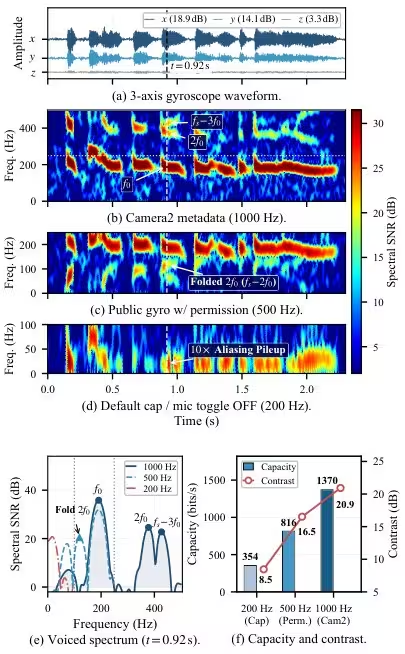
Modern mobile operating systems employ optical and electronic image stabilization to smooth out hand tremors during video recording. These stabilization mechanisms rely on internal gyroscope sensors that sample physical motion hundreds of times per second. When someone speaks near the device, sound waves travel through the chassis and alter the gyroscope readings. While operating systems typically restrict direct access to motion sensors to protect user privacy, researchers found that camera software pipelines package these high-rate gyroscope measurements into metadata fields and export them directly to user applications.
The findings, available on the arXiv preprint server, reveal that thirty-seven out of fifty tested smartphones leak continuous gyroscope metadata through their camera interfaces. Twenty-six of these devices exceed standard safety thresholds, with six recent flagship models streaming data at rates between eight hundred and one thousand hertz. This performance level doubles the standard hardware ceiling typically enforced by platform safety controls and provides enough bandwidth to resolve spoken words.
Why System Privacy Switches Fail to Block the Flaw
Operating system creators built multiple layers of defense to prevent motion sensors from acting as hidden microphones, including default rate caps and system-wide kill switches. However, the camera metadata bypass sidesteps all of these protective boundaries. When users turn off the microphone privacy toggle, platform controls successfully throttle standard sensor managers, but they fail to interrupt the high-rate metadata streaming through the camera subsystem. Similarly, disabling camera access turns off video frames, yet the gyroscope metadata continues transmitting uninterrupted.
The study, led by Guangyuan Ji and colleagues at Zhejiang University, demonstrates that untrusted applications holding basic camera permissions can harvest these motion traces without requesting restricted microphone permissions. Because the underlying hardware lacks per-client rate isolation, opening an active camera session globally elevates the shared gyroscope rate for any concurrent background application listening to the sensor pipeline.
Overcoming Hardware Variations With Simulation Learning
Extracting intelligible speech from raw physical vibrations usually requires extensive training data collected directly from each target phone model to account for different mechanical resonances. To eliminate this barrier, the authors introduced a technique called Source-to-Leakage Learning. Instead of gathering real sensor traces from target handsets, the system models the physical acquisition pipeline through a physics-constrained forward simulator that accounts for chassis vibrations, sensor damping, and sampling rate variations.
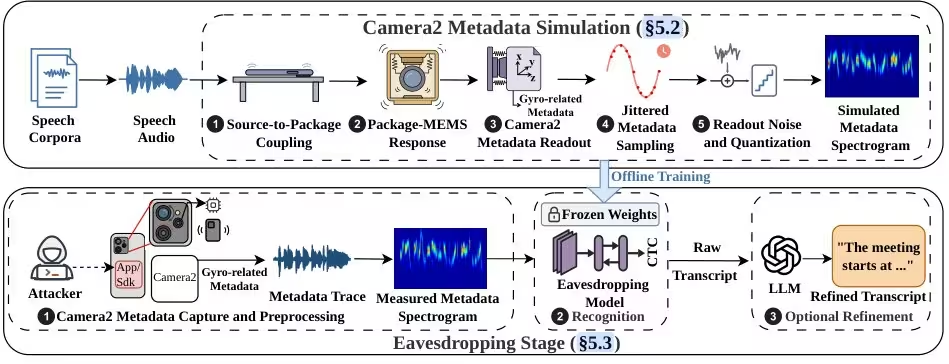
Trained entirely on simulated leakage without any prior access to the target devices, the universal speech recognizer achieved a mean word accuracy of fifty-two percent across the fastest tested phones. This simulation-trained approach outperformed traditional models that relied on twenty-four hours of real device fine-tuning, proving that physics-based simulation can successfully generalize physical side channels across entirely unfamiliar hardware.
Potential Remedies and Future Protection Steps
Addressing this architectural blind spot requires stricter governance across software boundaries and interface permissions. Platform developers must audit secondary metadata streams based on their physical sensing fidelity rather than categorizing them solely by their primary media type. Restricting vendor stabilization tags to internal system processes and ensuring that all user-space motion data respects platform rate caps can effectively close the acoustic leakage channel.
The study was posted to the arXiv preprint server on November 20, 2026.
This article has been fact checked for accuracy, with information verified against reputable sources. Learn more about us and our editorial process.
Last reviewed on .
Article history
- Latest version
Reference(s)
- Ji, Guangyuan. “Your Camera Can Hear You: Side-Channel Acoustic Eavesdropping via Android Camera2 Metadata.” arXiv.org <http://arxiv.org/abs/2611.27964v1>.
Cite this page:
- Posted by Asif Iqbal