Physicists Propose Using Laser Light to Actively Steer Energy Into Gravitational Waves
A new proposal suggests laser light could transfer energy to gravitational waves, potentially revealing tiny shifts that hint at the elusive graviton.
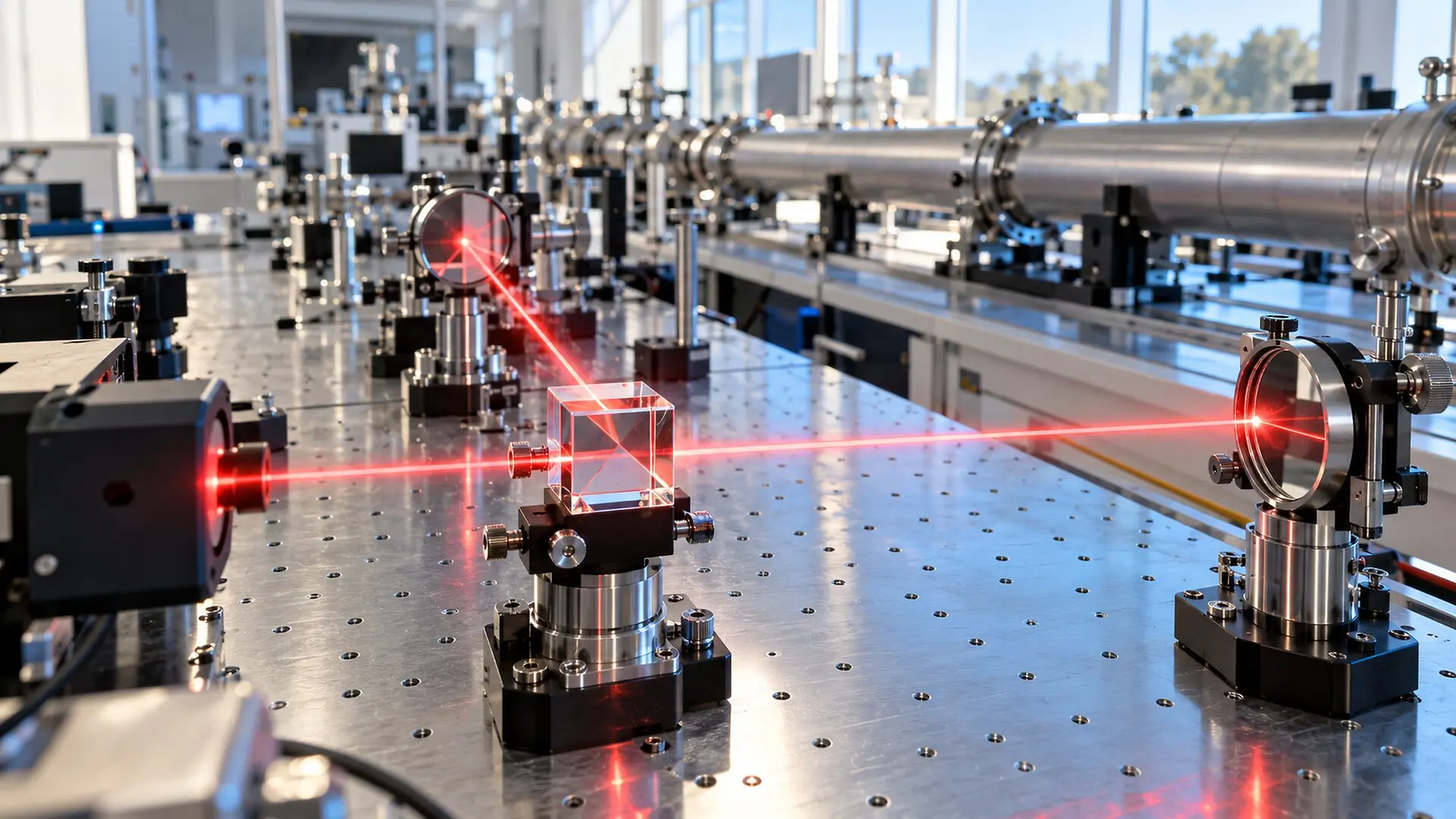
A bold new theoretical framework suggests that laser light could be used to actively manipulate gravitational waves, potentially allowing researchers to transfer tiny packets of energy to or from the ripples in spacetime. While gravitational wave detectors like LIGO currently act as passive listeners to cosmic events, this proposal describes an experimental path toward interacting with these waves in a controlled, laboratory setting.
The concept, detailed in Physical Review Letters by theoretical physicist Ralf Schützhold of Helmholtz-Zentrum Dresden-Rossendorf and Technische Universität Dresden, outlines an interferometric approach to measure the physical exchange of energy between light and gravity.
Harnessing Existing Spacetime Ripples
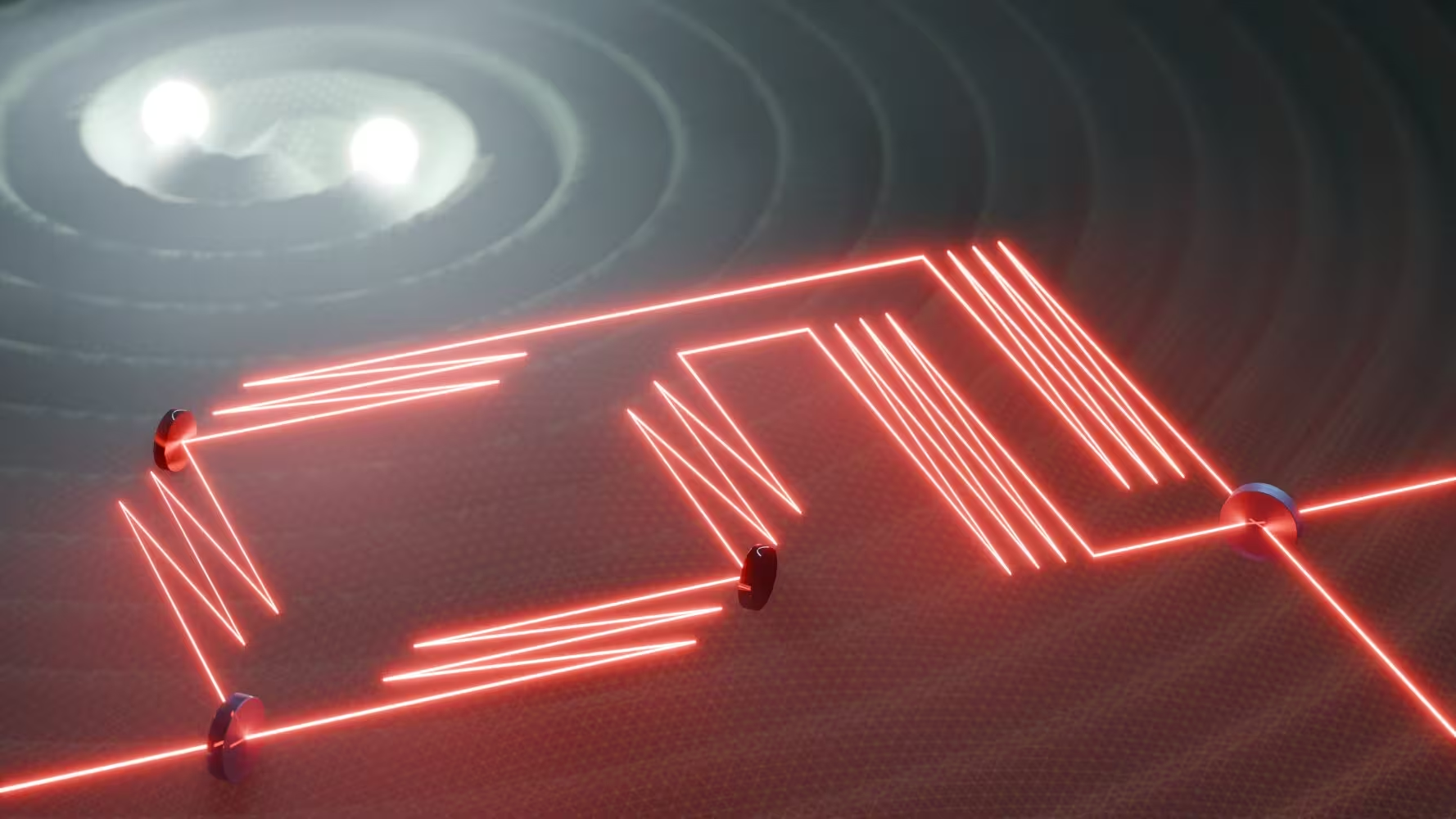
Gravitational waves, which are essentially distortions in the fabric of spacetime, are typically generated by cataclysmic events such as merging black holes. Because gravity is inherently weak, generating detectable waves in a terrestrial lab remains an extreme engineering challenge. Schützhold’s proposal bypasses the need for artificial generation by targeting gravitational waves that are already propagating through the universe.
Under a quantum mechanical interpretation, gravitational waves are composed of individual energy packets known as gravitons. Schützhold theorizes that a high-intensity laser pulse could interact with these waves, either by donating energy to them—thereby increasing their intensity—or by absorbing energy from them. This subtle energy transfer would manifest as a minute frequency shift in the laser light, providing a measurable signal for researchers.
Precision Interferometry at Scale
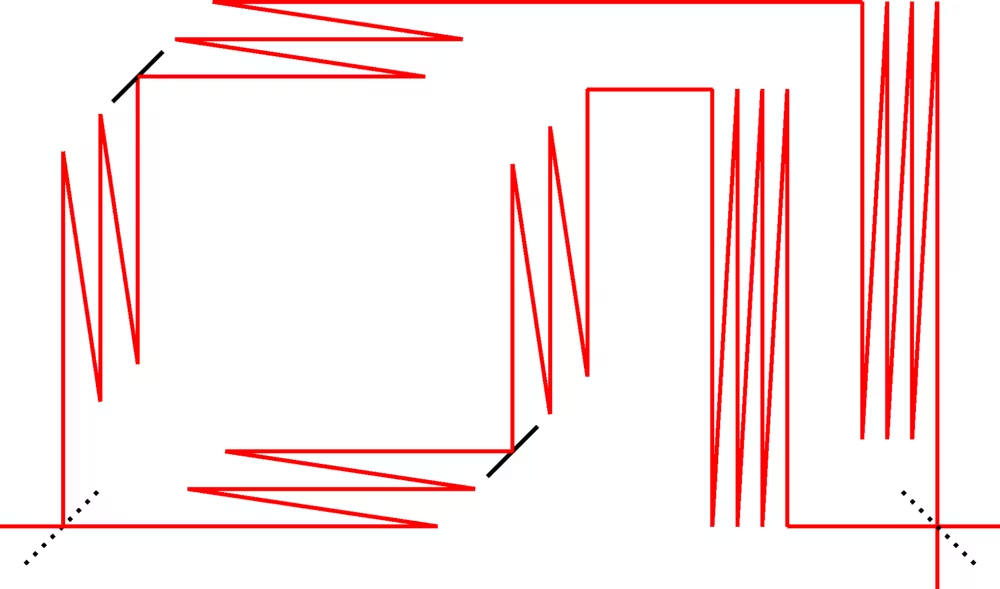
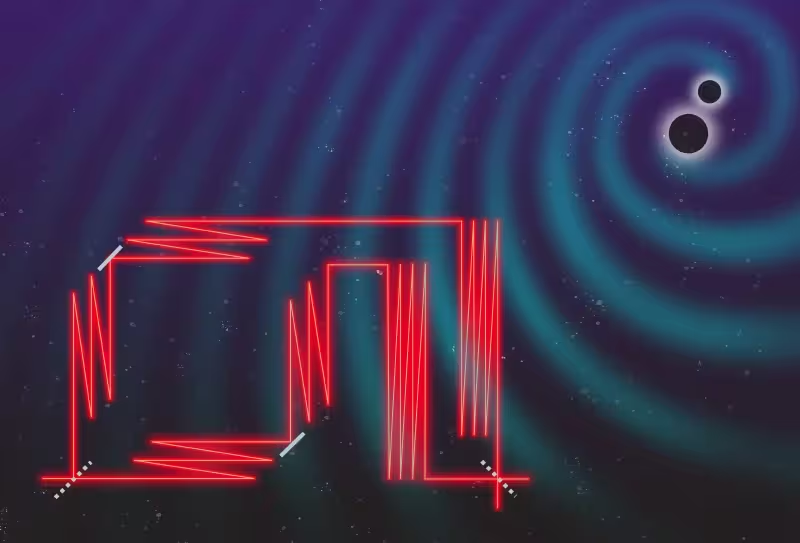
To detect such a subtle effect, the proposal utilizes an interferometer where a laser pulse is split into two beams traveling in perpendicular paths. As these beams encounter a gravitational wave, the wave’s influence on the energy exchange differs based on the orientation of the light’s path. By redirecting these beams through a series of mirrors, the setup can accumulate these minute frequency shifts over an effective path of roughly one million kilometers.
Achieving this without an impossibly large structure would require light to bounce between mirrors millions of times. The resulting phase difference between the two pulses would reveal the interaction when they finally recombine. According to Schützhold, using millijoule-scale pulses containing roughly 10 quadrillion photons could bring this interaction within the realm of detection.
Probing the Quantum Nature of Gravity
While the prospect of interacting with gravitational waves is exciting, the researcher cautions that even a successful detection of energy transfer would not serve as definitive proof of gravitons. The experiment would provide empirical data on how light and gravity exchange energy, but the fundamental question of whether gravity is quantized remains separate.
To further refine the sensitivity, the proposal suggests the potential use of highly entangled states of light, such as NOON states, which could theoretically offer higher precision than standard coherent laser pulses. However, such technology is currently in its infancy. As the field looks toward the next generation of experiments, this theoretical work provides a critical roadmap for exploring the intersection of quantum mechanics and general relativity, even if the practical implementation remains decades away.
Further Scientific Context
- Stimulated absorption of single gravitons: First light on quantum gravity(Annals of Physics, 2026)
- Detecting kHz gravitons from a neutron star merger with a multi-mode resonant mass detector(Classical and Quantum Gravity, 2025)
- Detecting single gravitons with quantum sensing(Nature Communications, 2024)
- Broadband Quantum Enhancement of the LIGO Detectors with Frequency-Dependent Squeezing(Physical Review X, 2023)
- Energy transfer between gravitational waves and quantum matter(Physical Review D, 2023)
This article has been fact checked for accuracy, with information verified against reputable sources. Learn more about us and our editorial process.
Last reviewed on .
Article history
- Latest version
Reference(s)
- Schützhold, Ralf. “Stimulated Emission or Absorption of Gravitons by Light.” Physical Review Letters, vol. 135, no. 17, October 22, 2025 American Physical Society (APS), doi: 10.1103/xd97-c6d7. <https://journals.aps.org/prl/abstract/10.1103/xd97-c6d7>.
- Shenderov, Victoria., et al. “Stimulated absorption of single gravitons: First light on quantum gravity.” Annals of Physics, vol. 489, June 1, 2026, pp. 170448 Elsevier BV, doi: 10.1016/j.aop.2026.170448. <https://doi.org/10.1016/j.aop.2026.170448>.
- Tobar, Germain., et al. “Detecting kHz gravitons from a neutron star merger with a multi-mode resonant mass detector.” Classical and Quantum Gravity, vol. 42, no. 5, February 14, 2025, pp. 055017 IOP Publishing, doi: 10.1088/1361-6382/adae4a. <https://doi.org/10.1088/1361-6382/adae4a>.
- Tobar, Germain., et al. “Detecting single gravitons with quantum sensing.” Nature Communications, vol. 15, no. 1, August 22, 2024 Springer Science and Business Media LLC, doi: 10.1038/s41467-024-51420-8. <https://doi.org/10.1038/s41467-024-51420-8>.
- Ganapathy, D.., et al. “Broadband Quantum Enhancement of the LIGO Detectors with Frequency-Dependent Squeezing.” Physical Review X, vol. 13, no. 4, October 30, 2023 American Physical Society (APS), doi: 10.1103/PhysRevX.13.041021. <https://doi.org/10.1103/PhysRevX.13.041021>.
- Gräfe, Jonathan., et al. “Energy transfer between gravitational waves and quantum matter.” Physical Review D, vol. 108, no. 6, September 28, 2023 American Physical Society (APS), doi: 10.1103/PhysRevD.108.064056. <https://doi.org/10.1103/PhysRevD.108.064056>.
Cite this page:
- Posted by Aisha Ahmed