Hidden Dark Sector Particles May Explain Mysterious Antarctic Air Showers
A proposed mass flip-flop mechanism reconciles contradictory observations between the ANITA-IV and IceCube detectors.
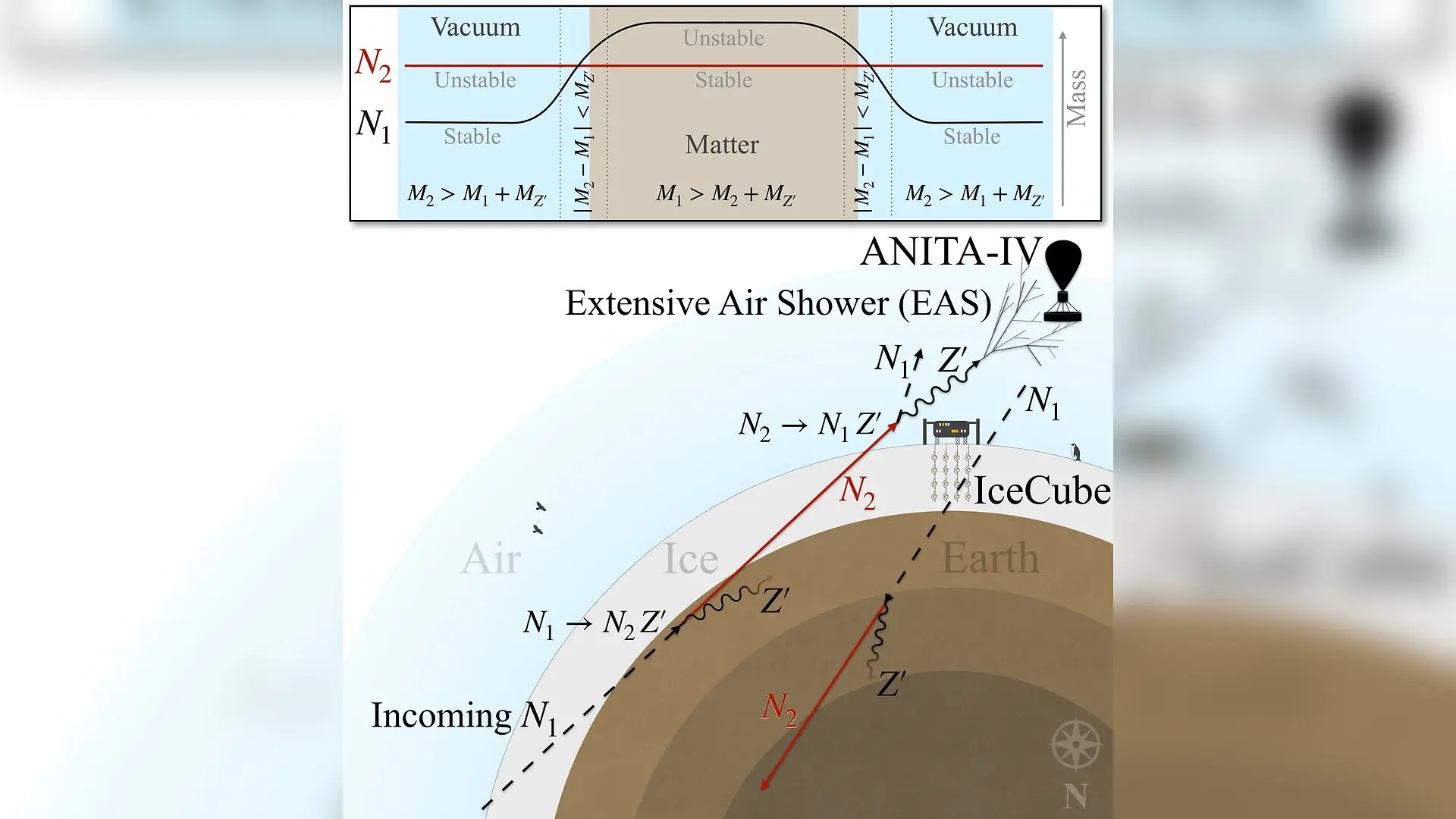
Four mysterious upward-going particle signals spotted by a balloon-borne antenna over Antarctica have long baffled physicists because much larger underground detectors saw nothing. Now, a study published in arXiv proposes a radical solution involving a hidden particle realm, suggesting that Earth itself flips the mass properties of invisible dark fermions as they plunge through our planet.
The puzzle centers on the fourth flight of the Antarctic Impulsive Transient Antenna (ANITA-IV), which detected four anomalous air-shower events arriving from just below the horizon. These signals mimic tau neutrinos with energies in the exaelectronvolt range, carrying quintillions of electronvolts of energy. However, the IceCube Neutrino Observatory at the South Pole, despite monitoring a much larger volume of ice over many years, has never recorded a single neutrino event at these extreme energies. Comparing the two datasets reveals a staggering statistical tension exceeding 7 standard deviations.
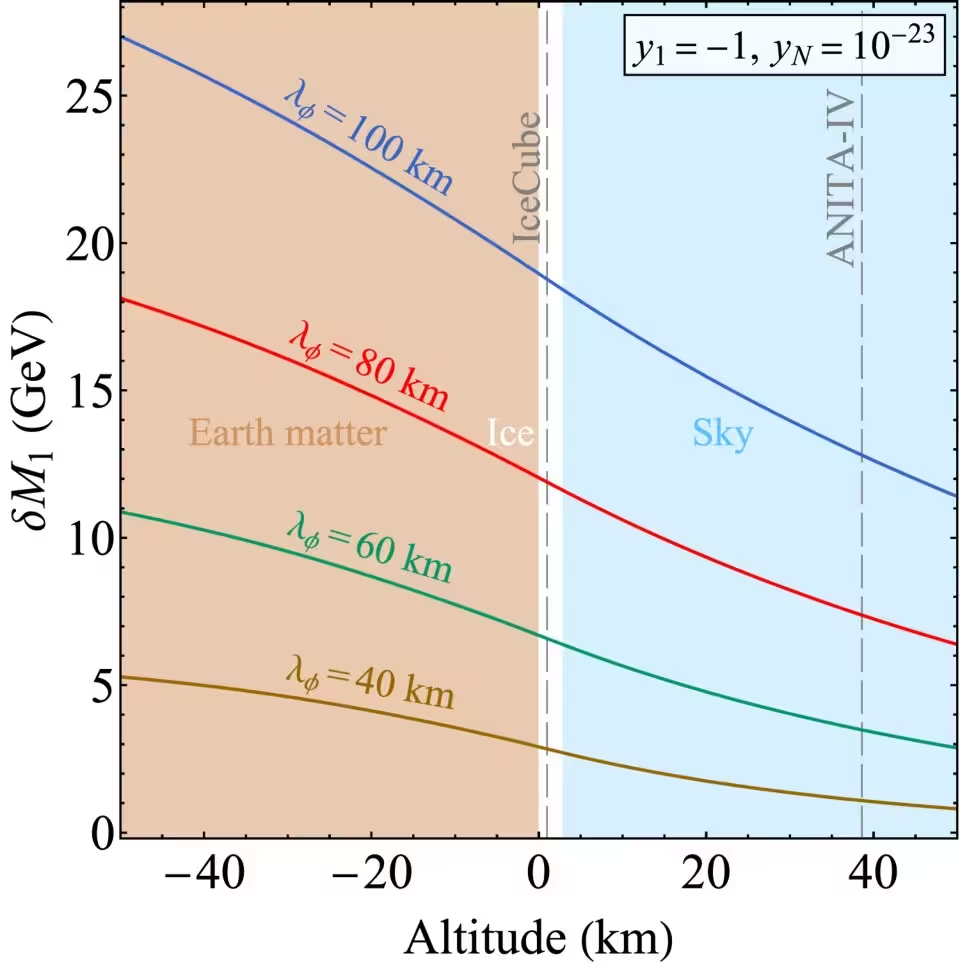
To bridge this vast observational gap, the authors Dibya S. Chattopadhyay, Carlos A. Argüelles, and Vedran Brdar turned to physics beyond the Standard Model. They introduced a framework where two dark fermions, labeled $N_1$ and $N_2$, interact with ordinary matter through an ultralight scalar field. In the vacuum of space, $N_1$ is lighter and stable, while $N_2$ is heavier. But as an incoming flux of ultra-high-energy $N_1$ particles enters the Earth, interactions with nucleons inside the planet increase the effective mass of $N_1$ beyond that of $N_2$. This process reverses the mass hierarchy, a phenomenon the researchers call the mass flip-flop.
How Deep Earth Conversions Silence Underground Detectors
Once the mass ordering flips deep underground, the incident $N_1$ particle decays into an $N_2$ particle. This newly formed $N_2$ particle then travels straight through the remaining Earth matter and emerges into the atmosphere on the opposite side. Once back in the thin air, the decay process reverses, converting $N_2$ back into $N_1$ alongside a vector boson called $Z’$. This secondary boson then decays hadronically, triggering the extensive air shower that ANITA-IV detects as a radio pulse.
The genius of this mechanism lies in why IceCube remains completely silent. The mass of the $Z’$ vector boson creates a forbidden intermediate zone where both decay channels are kinematically blocked. By design, this decay-blocked layer encompasses the depths where IceCube operates. Any particles passing through the instrumented ice cannot undergo the necessary decays to produce a cascade signal, explaining the total absence of IceCube events.
Testing the Dark Sector Hypothesis with Upcoming Flights
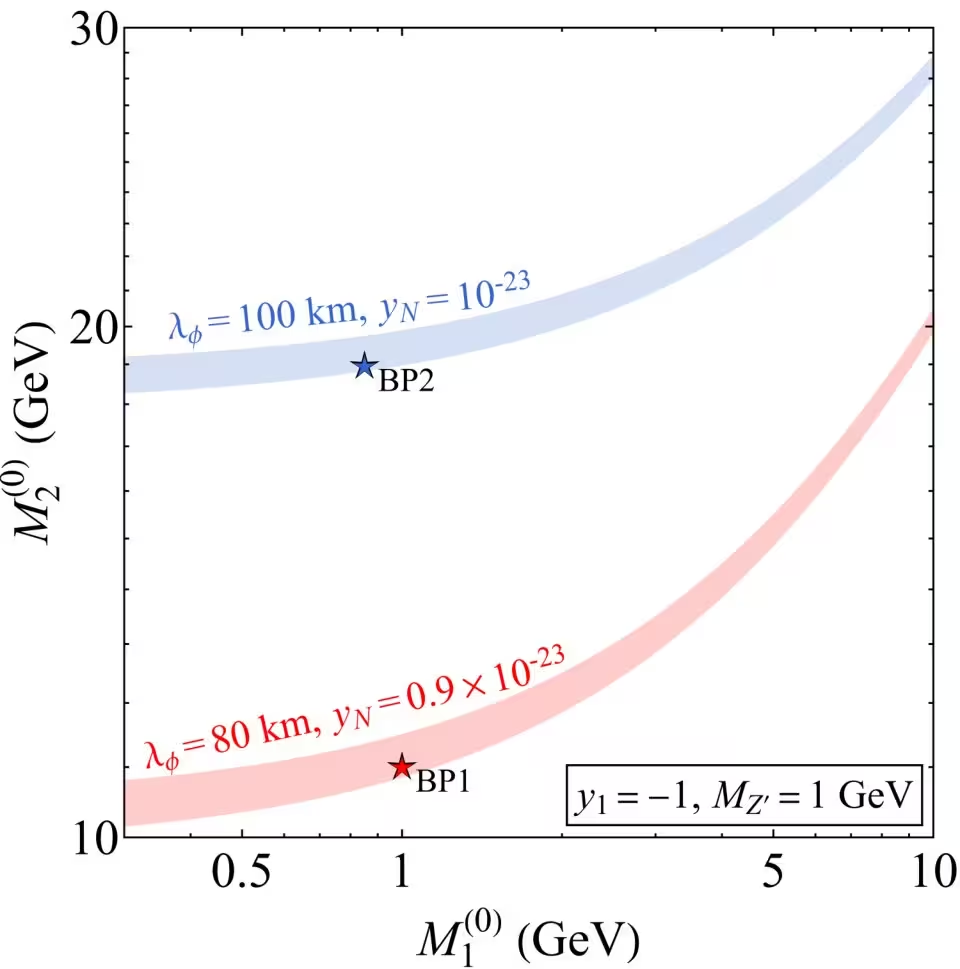
The researchers calculated effective areas for two specific benchmark points in their parameter space, designated as BP1 and BP2, incorporating realistic density profiles for Earth, ice, and the atmosphere. By normalizing their incoming dark fermion flux to match the four observed ANITA-IV events, they evaluated how well their model reproduces the exact arrival angles. The analysis indicates that benchmark BP1 agrees well with the observed angular distribution, easing tensions that plagued previous interpretations.
Looking ahead, the team applied their calculations to the upcoming Payload for Ultrahigh Energy Observations (PUEO) balloon mission, which features improved sensitivity and a planned flight duration of nearly 13 days. Accounting for PUEO’s altitude and instrument response, the authors predict that its first flight will record approximately three near-horizon events under this dark-sector scenario. This forthcoming data collection will provide an immediate experimental test of the mass flip-flop mechanism, potentially confirming whether hidden particle physics is reshaping our understanding of cosmic messengers.
The study was posted to the arXiv preprint server on November 12, 2026.
This article has been fact checked for accuracy, with information verified against reputable sources. Learn more about us and our editorial process.
Last reviewed on .
Article history
- Latest version
Reference(s)
- Chattopadhyay, Dibya. “A Dark-Sector Mass Flip-Flop Mechanism for the ANITA-IV Events.” arXiv.org <http://arxiv.org/abs/2611.17328v1>.
Cite this page:
- Posted by Karan Das