Time-Resolved Gamma-Ray Bursts Reveal Surprising Neutrino Shifts
Flickering snapshots of cosmic explosions change how astrophysicists constrain the extreme physics of relativistic particle jets.
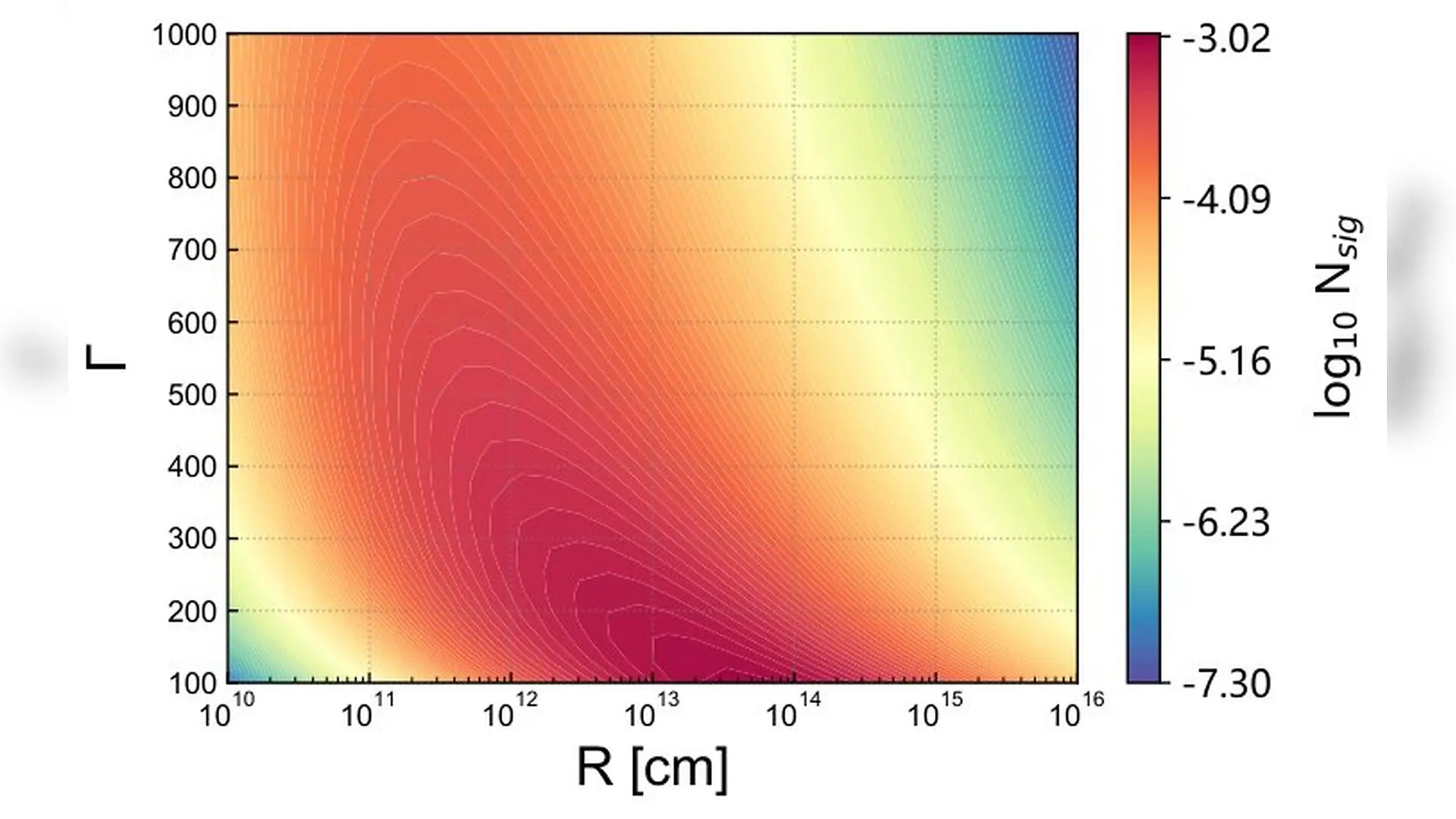
High-energy neutrino signals from cosmic explosions known as gamma-ray bursts reveal unexpected variations when researchers examine the flashes in fine slices of time rather than averaging them out. A team of astrophysicists found that resolving the rapid flickering of these high-energy blasts changes how scientists test the fundamental physics of particle jets.
Gamma-ray bursts are among the most energetic events in the universe, releasing intense beams of radiation as massive stars collapse or neutron stars merge. For decades, researchers have hunted for high-energy neutrinos that theoretical models predict should accompany these flashes. Although observatories have yet to detect any neutrinos linked directly to gamma-ray bursts, these non-detections are valuable because they place strict limits on the physical parameters of the jet models, such as how fast the material expands and where the radiation originates.
Until now, almost all of these constraint calculations relied on time-integrated spectra, which average the photon emissions across the entire duration of the burst. To test whether this averaging hides crucial details, the authors of a recent study available on the arXiv preprint server examined both time-resolved and time-integrated data for four prominent gamma-ray bursts.
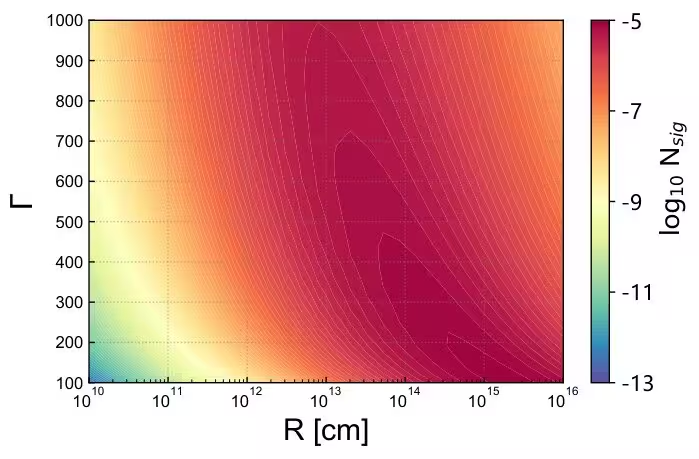
The researchers investigated GRB 080916C, which is dominated by non-thermal radiation, GRB 110721A, which features a mixed thermal and non-thermal spectrum, and GRB 090902B, which is dominated by thermal emission from a glowing photosphere. They also analyzed the exceptionally bright blast known as GRB 221009A, utilizing undistorted data from the GECAM-C satellite to bypass the instrumental saturation issues that affected other detectors.
When the team calculated the expected neutrino event numbers using time-resolved spectra and summed them together, they discovered a distinct divergence compared to the traditional time-integrated approach. In regions with a relatively low dissipation radius and a low bulk Lorentz factor, which describes how close to the speed of light the jet expands, the time-resolved spectra yielded fewer expected neutrino events. Conversely, in regions with a high dissipation radius and high Lorentz factor, the time-resolved approach predicted significantly more neutrino events.
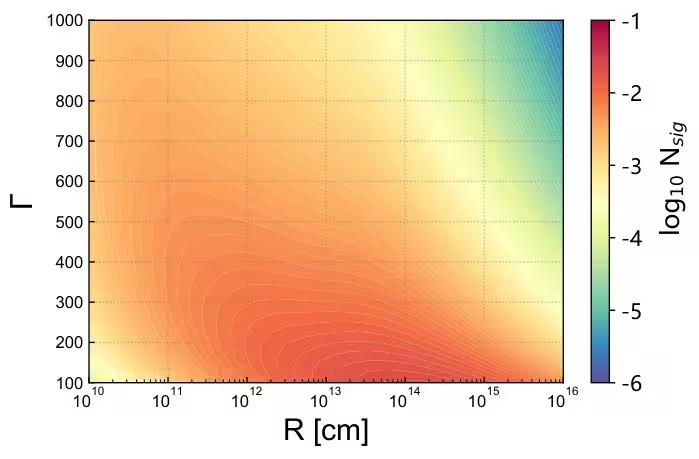
For the extraordinarily bright GRB 221009A, the expected number of neutrino events calculated from summed time-resolved spectra was roughly three times higher than the estimate from time-integrated spectra in the high-speed and large-radius regime. The authors attribute this trend to competing physical mechanisms. At smaller radii and lower speeds, stronger magnetic fields trigger efficient synchrotron cooling of charged pions and muons, which suppresses neutrino production before the particles can decay. At larger radii and higher speeds, cooling loses its dominance, and the higher photon densities captured in time-resolved slices enhance the efficiency of photomeson interactions, boosting neutrino output.
These findings demonstrate that time-resolved spectroscopy provides a more realistic framework for estimating high-energy neutrino emission from cosmic explosions. The authors suggest that future studies of gamma-ray burst neutrinos should prioritize time-resolved data whenever observation quality permits.
The study was posted to the arXiv preprint server on November 11, 2026.
This article has been fact checked for accuracy, with information verified against reputable sources. Learn more about us and our editorial process.
Last reviewed on .
Article history
- Latest version
Reference(s)
- Ou, Yang-Dong-Jun. “Revisiting the Neutrino Emission and Physical Parameter Constraints from Time-Resolved Spectra of Gamma-Ray Bursts.” arXiv.org <http://arxiv.org/abs/2611.14902v1>.
Cite this page:
- Posted by Karan Das