Why Magnetic Waves Make M-Dwarf Star Winds Surprisingly Weak
Simulations suggest chromospheric wave dissipation chokes off particle outflows in cool stars, falling short of observational estimates.
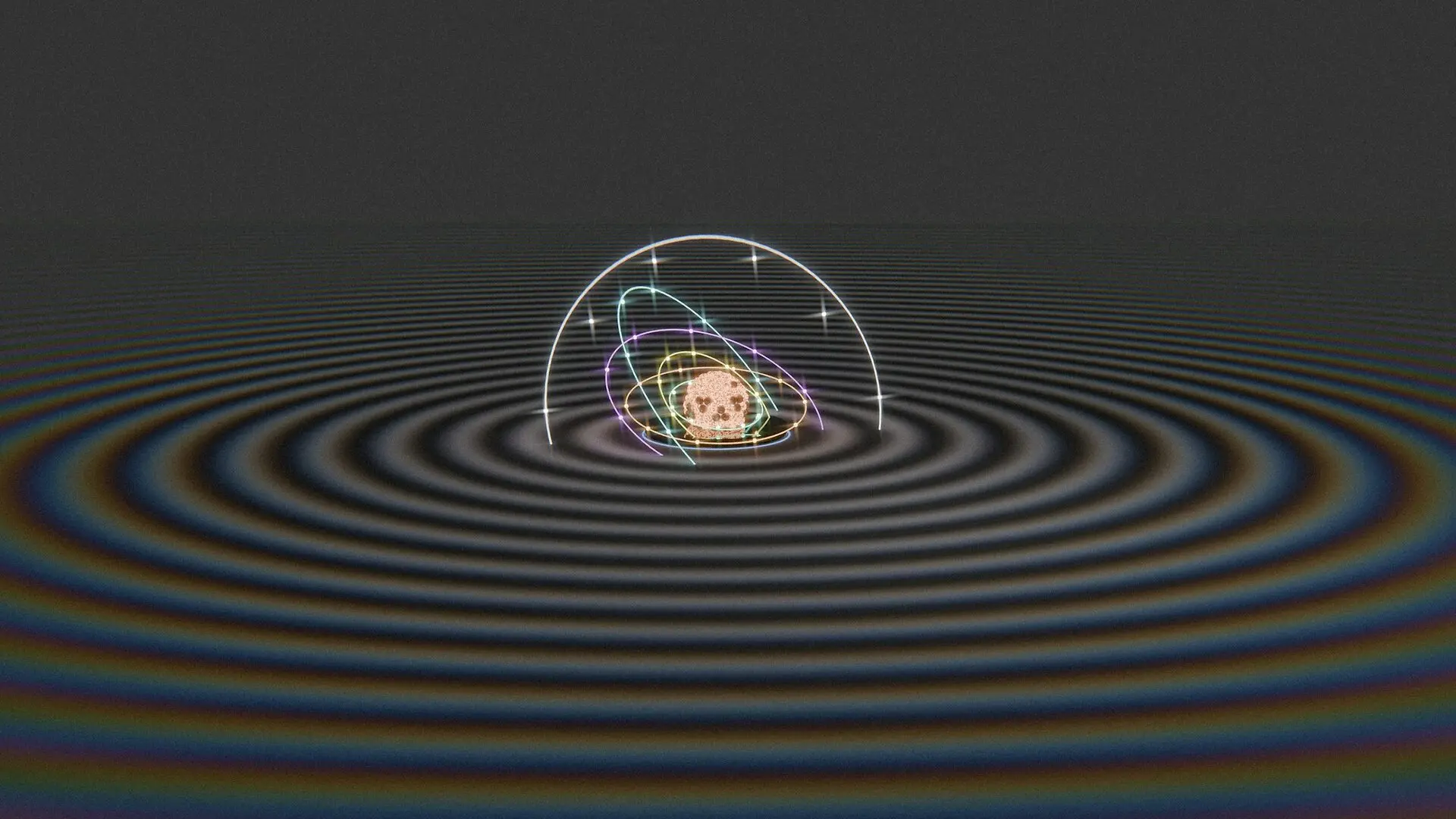
A new theoretical study reveals that plasma winds blowing away from cool, low-mass stars are drastically weaker than previously believed, challenging long-standing astrophysical models. Stellar winds are continuous outflows of charged particles that stream into interstellar space, carrying away angular momentum and shaping the evolution of orbiting planets.
While researchers understand how the Sun drives its own wind, modeling the winds of smaller, magnetically active stars known as M dwarfs has proven remarkably difficult. To solve this puzzle, a team of astrophysicists performed detailed computer simulations to examine how wave energy travels from the stellar surface into the outer atmosphere. The authors report their findings in a paper published in the arXiv preprint server, detailing how magnetic wave turbulence reshapes stellar mass loss.
How Magnetic Waves Heat and Drive Stellar Atmospheres
Stellar winds are largely driven by magnetic waves generated by churning, convective motions at a star surface. These disturbances, known as Alfven waves, travel upward along open magnetic field lines and deposit energy into the plasma. In the solar wind, this wave energy evolves into Alfven-wave turbulence, a chaotic state that heats the corona and accelerates particles outward into space.
To test how this turbulence affects different stars, the researchers constructed one-dimensional magnetohydrodynamic simulations, which model the behavior of electrically conducting fluids in magnetic fields. Their framework tracked the flow of energy from the photosphere, the visible surface of the star, all the way out to the distant heliosphere. For the Sun, the team validated their computer model directly against measurements from NASA’s Parker Solar Probe, confirming that including wave turbulence accurately reproduces the properties of fast solar wind.
The Unexpected Choke Point in M-Dwarf Atmospheres
When the researchers applied the same physical model to an M-dwarf star designated GJ 436, the results took an unexpected turn. GJ 436 is a relatively quiet, low-mass star with a mass about half that of the Sun and an effective temperature of 3,416 Kelvin, roughly 2,300 degrees cooler than solar temperatures. In simulations that included chromospheric turbulence, wave energy dissipated intensely in the lower atmosphere, known as the chromosphere.
This heavy dissipation choked off the upward-flowing wave energy before it could reach the corona, sharply reducing the outward pressure that drives the wind. As a result, the simulated mass-loss rate for the M dwarf dropped by over an order of magnitude compared to traditional models that ignored chromospheric turbulence. The resulting mass-loss rate fell significantly short of observational estimates derived from astrospheric absorption measurements.
What Happens Next for Stellar Wind Physics
The discrepancy highlights a major blind spot in current stellar physics, suggesting that wave dissipation in cool star chromospheres may be severely overestimated in current models. The authors note that real stars may transport energy differently, perhaps through magnetic tornadoes or rotational dynamics that suppress turbulent cascades in the lower atmosphere. Resolving this tension will require advanced three-dimensional simulations and refined observational constraints to understand how smaller stars truly bleed mass into the cosmos.
The study was posted to the arXiv preprint server on November 11, 2026.
This article has been fact checked for accuracy, with information verified against reputable sources. Learn more about us and our editorial process.
Last reviewed on .
Article history
- Latest version
Cite this page:
- Posted by Aisha Ahmed