AI Ensemble Masters Night-Sky Monitoring for Remote Observatories
A new machine learning pipeline classifies observatory sky conditions with high accuracy while overcoming the challenges of moonlight glare and dome condensation.
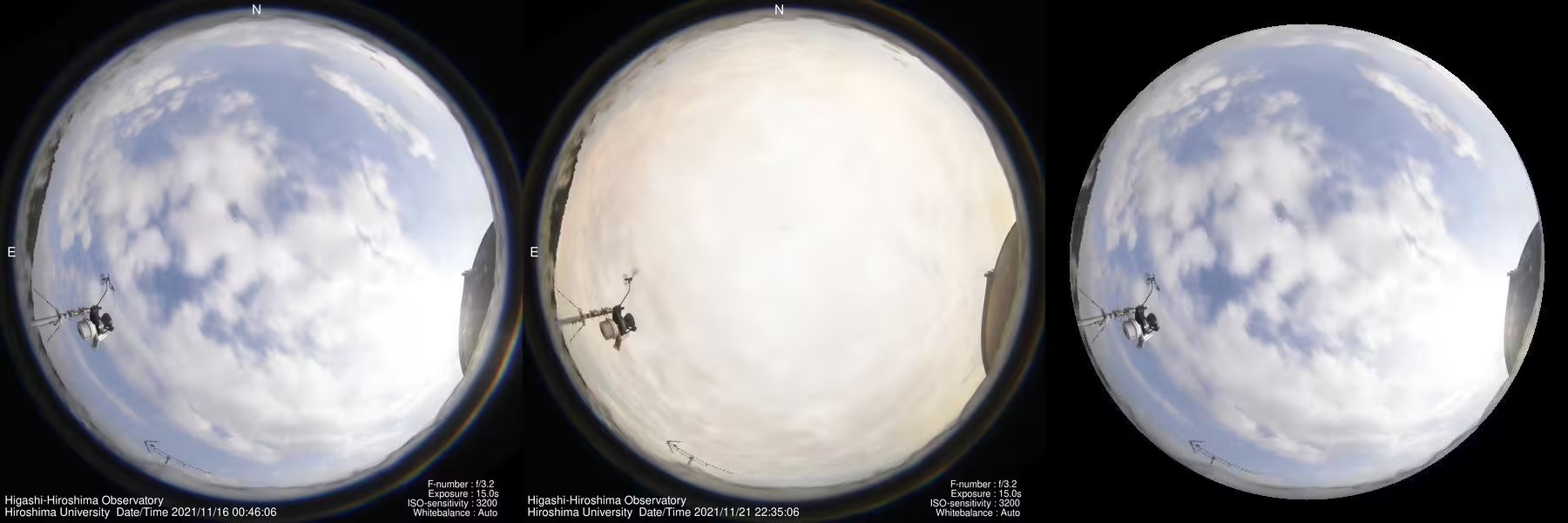
Small, remote astronomical facilities face the nightly gamble of deciding whether the sky is clear enough for observations without on-site staff to check the weather. Researcher Muhammad Waqas tackled this challenge by developing an automated analysis pipeline for the auxiliary all-sky camera at the Higashi-Hiroshima Observatory, relying on a dataset of 8,806 frames gathered across 32 nights in late 2021.
By removing printed date stamps that otherwise functioned as computational shortcuts, the author evaluated hand-crafted meteorological metrics alongside convolutional neural network models, as available on the arXiv preprint server. The investigation reveals how artificial intelligence can reliably judge cloud cover while handling the tricky glare of moonlight.
How Artificial Intelligence Outperforms Traditional Weather Statistics
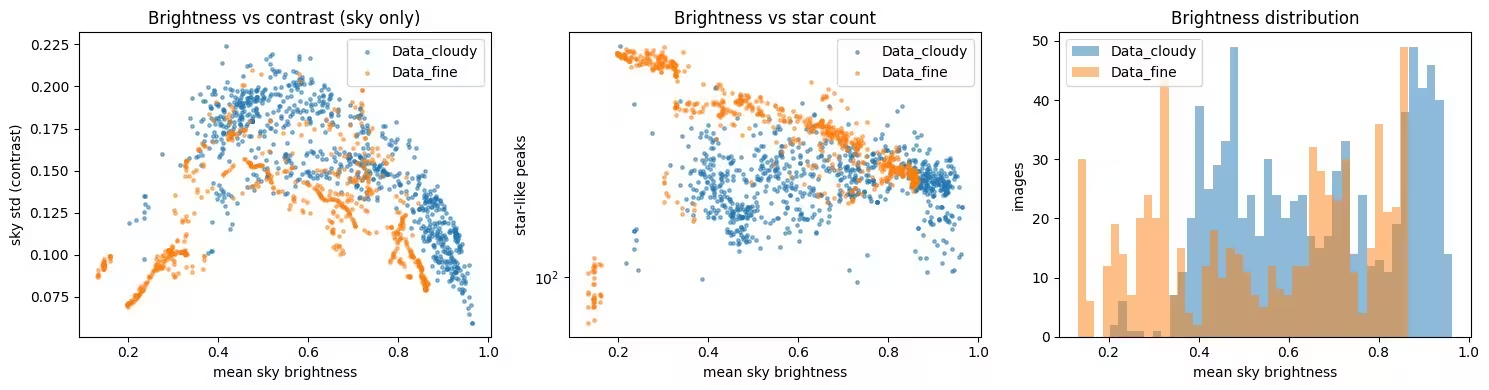
To establish a benchmark, the author first tested four physically motivated features extracted directly from grey-scale sky pixels, including mean brightness, contrast, texture gradient, and the number of star-like peaks. While star counts proved effective, a gradient-boosting classifier using these traditional features achieved an accuracy of 77.1 percent when tested on six entirely separate nights.
In comparison, a small convolutional neural network trained from scratch reached 84.3 percent accuracy on the same test set. Furthermore, a validation-selected ensemble combining the small neural network with two pretrained ResNet-18 variants reached an overall accuracy of 86.7 percent. This ensemble approach also minimized night-to-night performance scatter, proving more robust than single-model architectures when facing unpredictable atmospheric shifts.
Overcoming the Major Obstacle of Moonlight and Glare
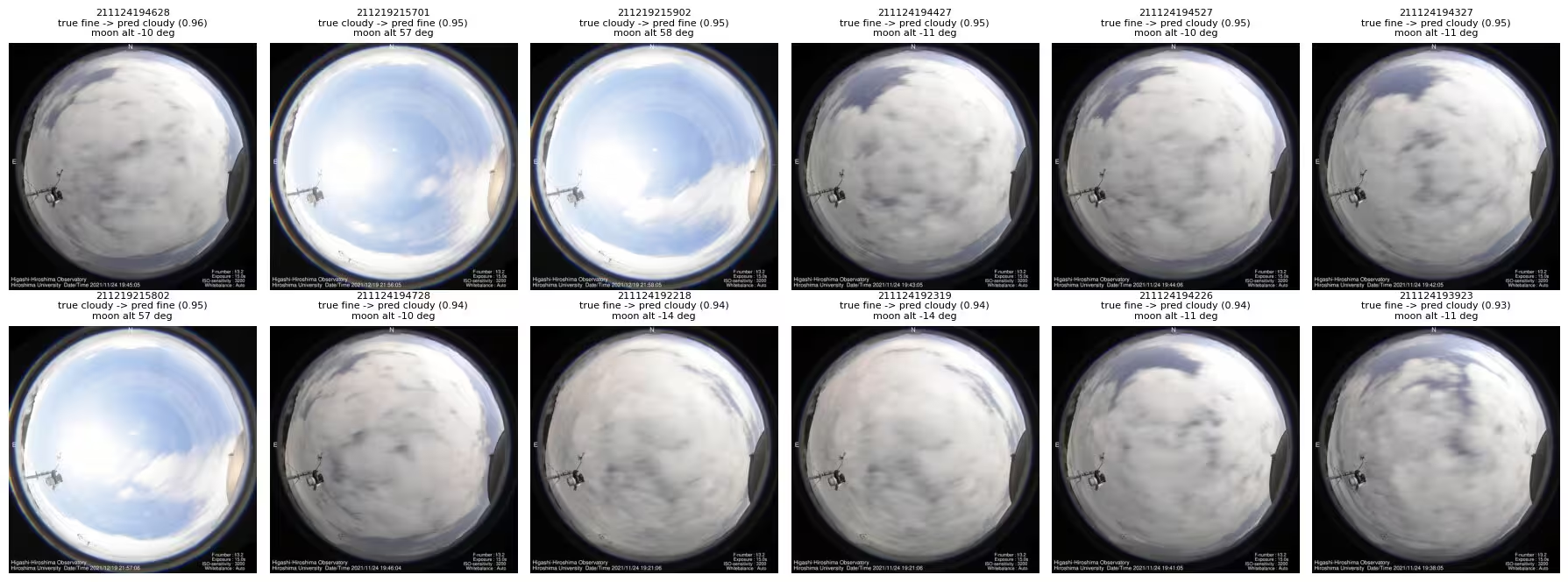
A primary difficulty in automated night-sky monitoring is accounting for the Moon, whose light scatters through clear air and mimics the brightness of thin clouds. Using ephemeris calculations to track the Moon’s altitude for every frame, the author discovered that simpler models experienced severe performance drops of up to 20 percentage points across varying lunar conditions.
In contrast, the ensemble model limited its accuracy variation to just 5 percentage points across different Moon altitudes. The hardest evaluation period occurred on the night of December 19, 2021, which coincided with a full Moon reaching an altitude of 80 degrees. The research indicates that partial cloud breaks under intense moonlight often confuse binary classification labels, pointing to the need for probabilistic outputs rather than rigid clear-or-cloudy designations.
Discovering Hidden Sky Types Without Human Labels
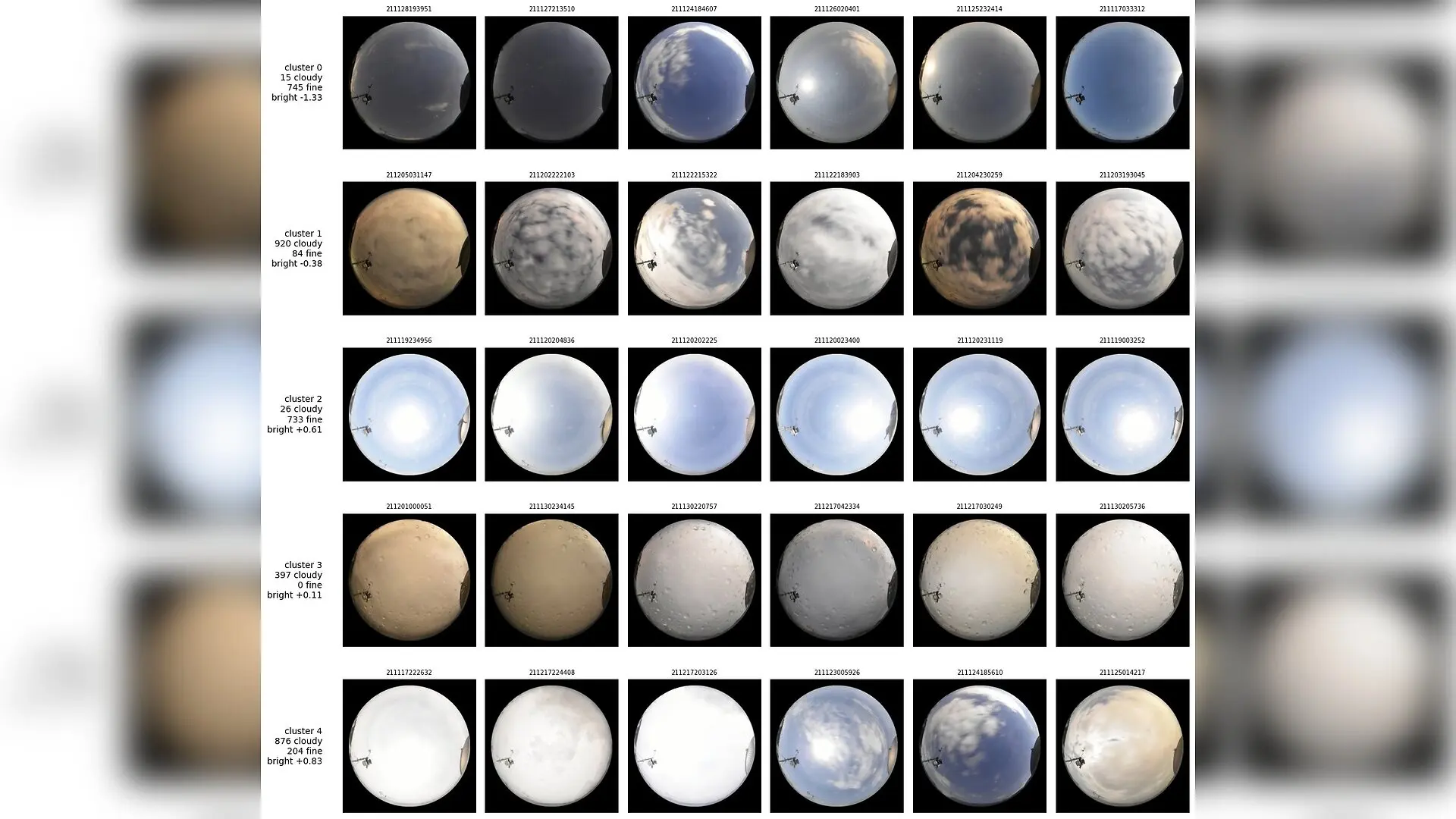
Beyond supervised classification, the author applied unsupervised machine learning to 4,000 random frames without relying on pre-existing labels. Gaussian-mixture clustering of pretrained embeddings successfully recovered the clear and cloudy split with 87 percent purity. More importantly, using k-means clustering with five groups uncovered a distinct category consisting of frames covered in small round spots.
These spots represent water droplets and condensation on the camera dome from humid or rainy nights. Traditional dataset labels had previously lumped these wet-dome frames into ordinary cloudy categories, even though condensation demands closing the observatory dome rather than simply waiting for skies to clear. Unsupervised clustering thus exposes operational hazards that binary human labels miss.
Visualizing Network Reasoning for Observatory Operators
To ensure human operators can trust automated decisions, the author implemented exact, gradient-free evidence maps. Because the classifiers end with global average pooling and a linear layer, the decision process decomposes directly into a map of local logits. This provides exact evidence maps and cloud-cover estimates without requiring complex gradient calculations.
These findings culminated in an open-source tool named Sky Monitor AI, designed to process single frames, whole nights, or live camera streams. While the current system requires further field testing alongside human observers before it can safely control observatory equipment unattended, the pipeline offers a scalable framework for automating remote astronomical facilities.
The study was posted to the arXiv preprint server on November 11, 2026.
This article has been fact checked for accuracy, with information verified against reputable sources. Learn more about us and our editorial process.
Last reviewed on .
Article history
- Latest version
Reference(s)
- Waqas, Muhammad. “Sky Monitor AI: classifying night-sky conditions from an observatory all-sky camera with a CNN ensemble, label-free sky types and exact evidence maps.” arXiv.org <http://arxiv.org/abs/2611.14987v1>.
Cite this page:
- Posted by Nida Rehman