Hidden Object 1,465 Light-Years Away Defies Stellar Evolution Models
A red giant is orbiting an invisible companion weighing over twice our Sun, challenging theories of how massive remnants form in wide pairs.
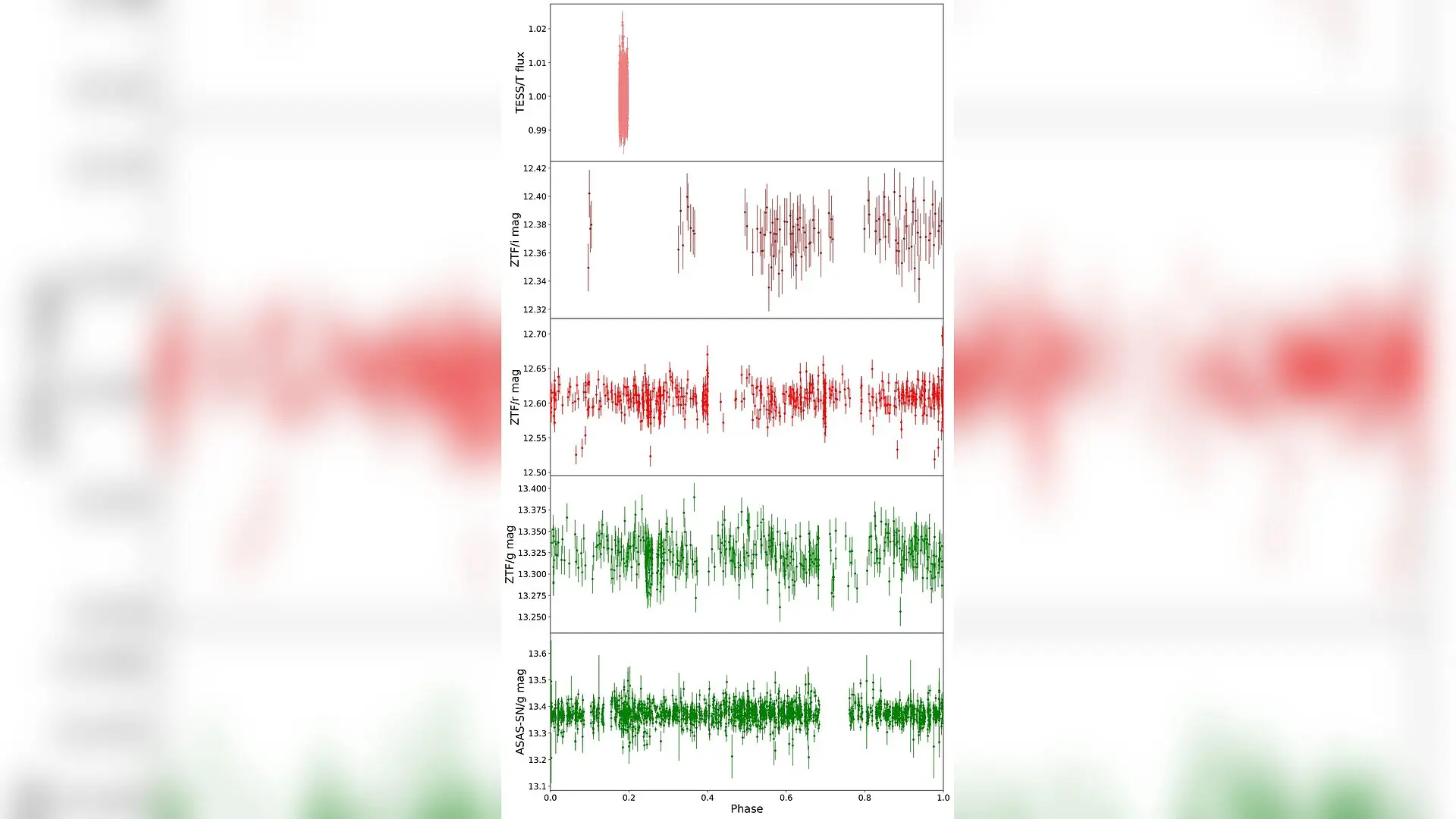
Astronomers have uncovered a quiet astronomical mystery sitting roughly 1,465 light-years from Earth, featuring a red giant star waltzing around a completely invisible partner. This distant binary system, officially designated as Gaia ID 2546630699873483008 or J0008+0128, defies standard theories of stellar evolution because of its wide orbit and unusual companion mass. The research team behind the discovery published their findings on the arXiv preprint server, detailing measurements that point to either an exceptionally heavy neutron star or a lightweight black hole.
How Astronomers Tracked Down the Invisible Companion
To find the hidden object, the researchers combined stellar velocities from the Large Sky Area Multi-Object Fiber Spectroscopic Telescope and the Apache Point Observatory Galactic Evolution Experiment (APOGEE) with precise position data from the European Space Agency spacecraft Gaia. They also gathered extra optical observations using the Nordic Optical Telescope. By tracking how the visible red giant wobbled back and forth, the team calculated the gravitational pull of the unseen body.
The resulting orbit stretches across approximately 1,218 days, meaning the two stars complete one full circuit every three and a half years. Unlike many stellar pairs that loop around each other in extreme egg-shaped paths, this system maintains a remarkably circular orbit with an eccentricity of just 0.09. Through complex modeling of the red giant’s motion, the authors determined that the dark companion possesses a mass ranging between 1.8 and 2.8 times the mass of our Sun, with a best-fit value sitting right around 2.20 solar masses.
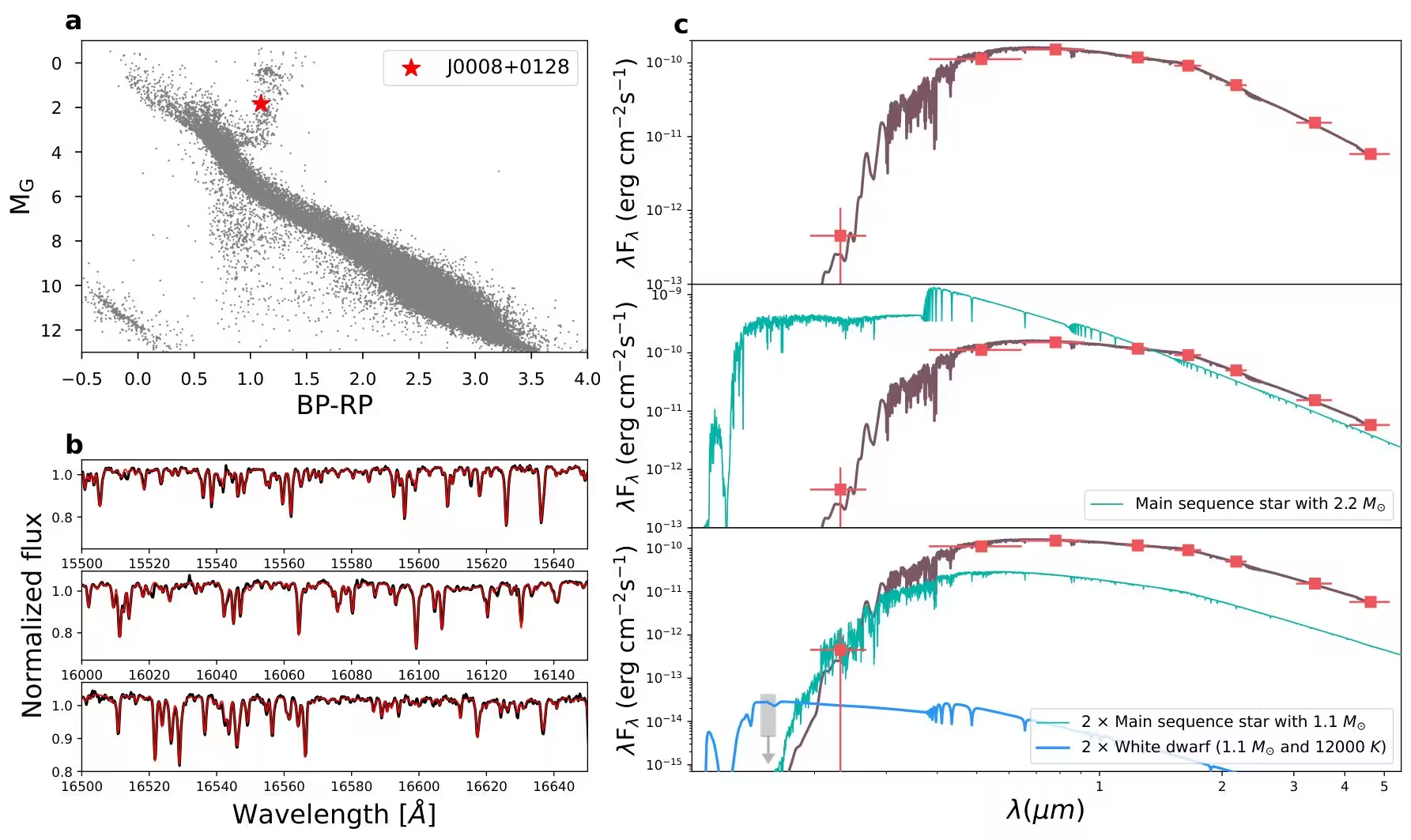
Ruling Out Normal Stars and Unraveling the Mass Gap
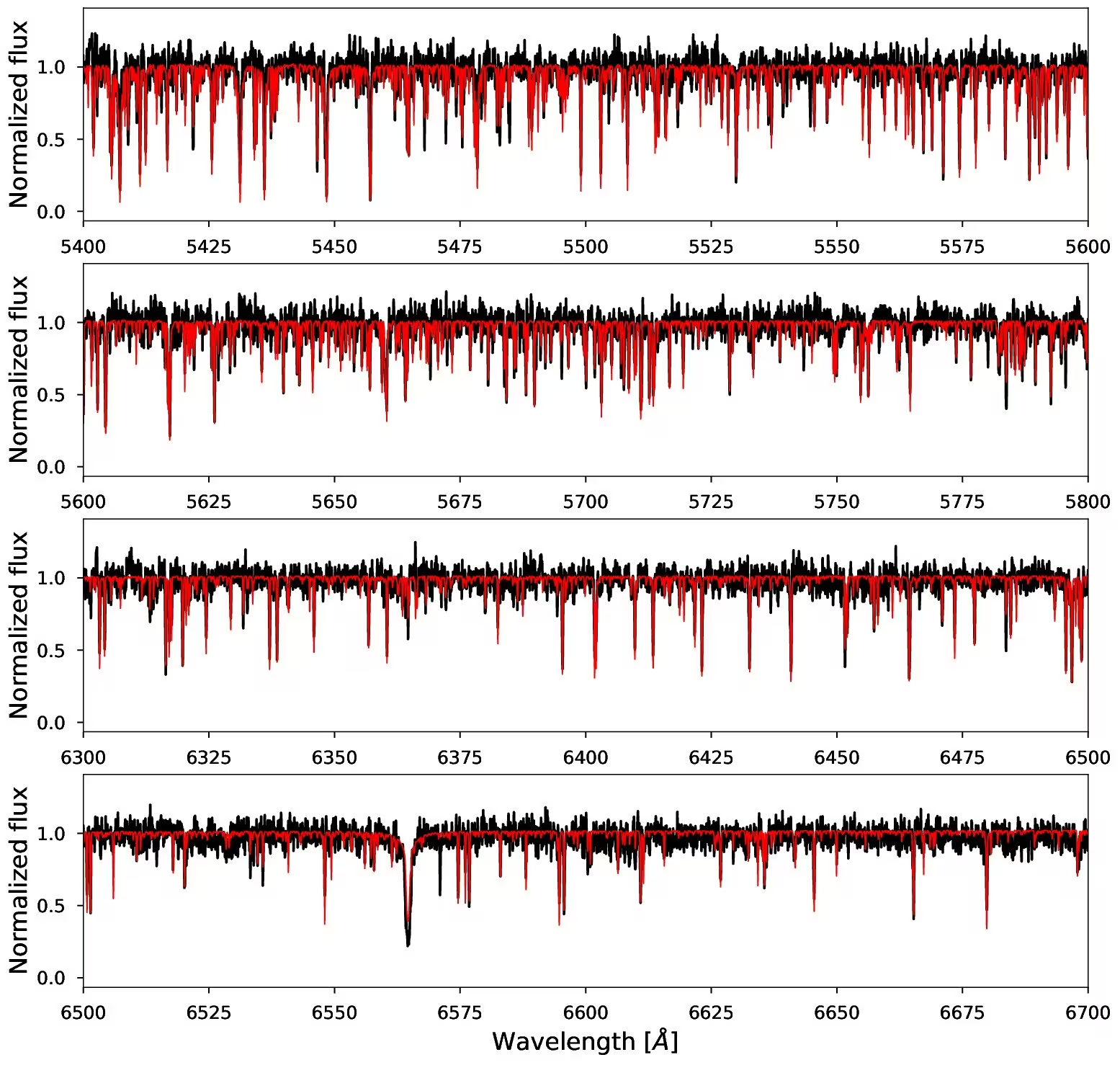
The crucial question for the research team was whether the hidden partner could simply be an ordinary star that happens to be faint. If a normal star of 2.2 solar masses were present, its luminosity would range between 11 and 81 times that of the Sun, completely overpowering or heavily distorting the light signature of the red giant. However, detailed spectral analysis and spectral energy distribution fitting revealed no extra light or secondary absorption lines.
Follow-up searches using the Einstein Probe X-ray telescope and the Five-hundred-meter Aperture Spherical radio Telescope (FAST) detected no strong high-energy radiation or pulsed radio signals. This silence fits well with a quiet, non-accreting compact object. Because a mass of 2.2 solar masses sits right on the edge of the theoretical limit for neutron stars, this mysterious companion potentially resides within the elusive mass gap that separates the heaviest neutron stars from the lightest black holes.
Why This Wide Binary Challenges Current Theories
Standard computer simulations of binary star evolution struggle to explain how such a system could form. When the team scanned hundreds of thousands of simulated binaries using the POSYDON population synthesis framework, they found zero systems matching the specific combination of a wide, low-eccentricity orbit and a heavy compact remnant. Creating J0008+0128 likely requires rare physical conditions, such as an extremely efficient common envelope ejection phase during the progenitor star’s life and a very weak supernova kick.
Alternatively, the system might have started as a hierarchical triple, where an inner pair of massive stars merged into a single heavy neutron star before interacting with the outer red giant. While further observations are needed to fully confirm the nature of the dark component, the discovery provides a valuable laboratory for testing the extreme physics of dense matter under gravity.
The study was posted to the arXiv preprint server on November 11, 2026.
This article has been fact checked for accuracy, with information verified against reputable sources. Learn more about us and our editorial process.
Last reviewed on .
Article history
- Latest version
Reference(s)
- Zhao, Xinlin. “Discovery of a likely supermassive neutron star in a remarkably wide binary.” arXiv.org <http://arxiv.org/abs/2611.14998v1>.
Cite this page:
- Posted by Karan Das