Massive New Galaxy Study Reveals Why Heavy Spirals Lose Their Asymmetry
An analysis of over 600 disk galaxies shows that lopsided asymmetry drops sharply in fast-rotating, massive systems.
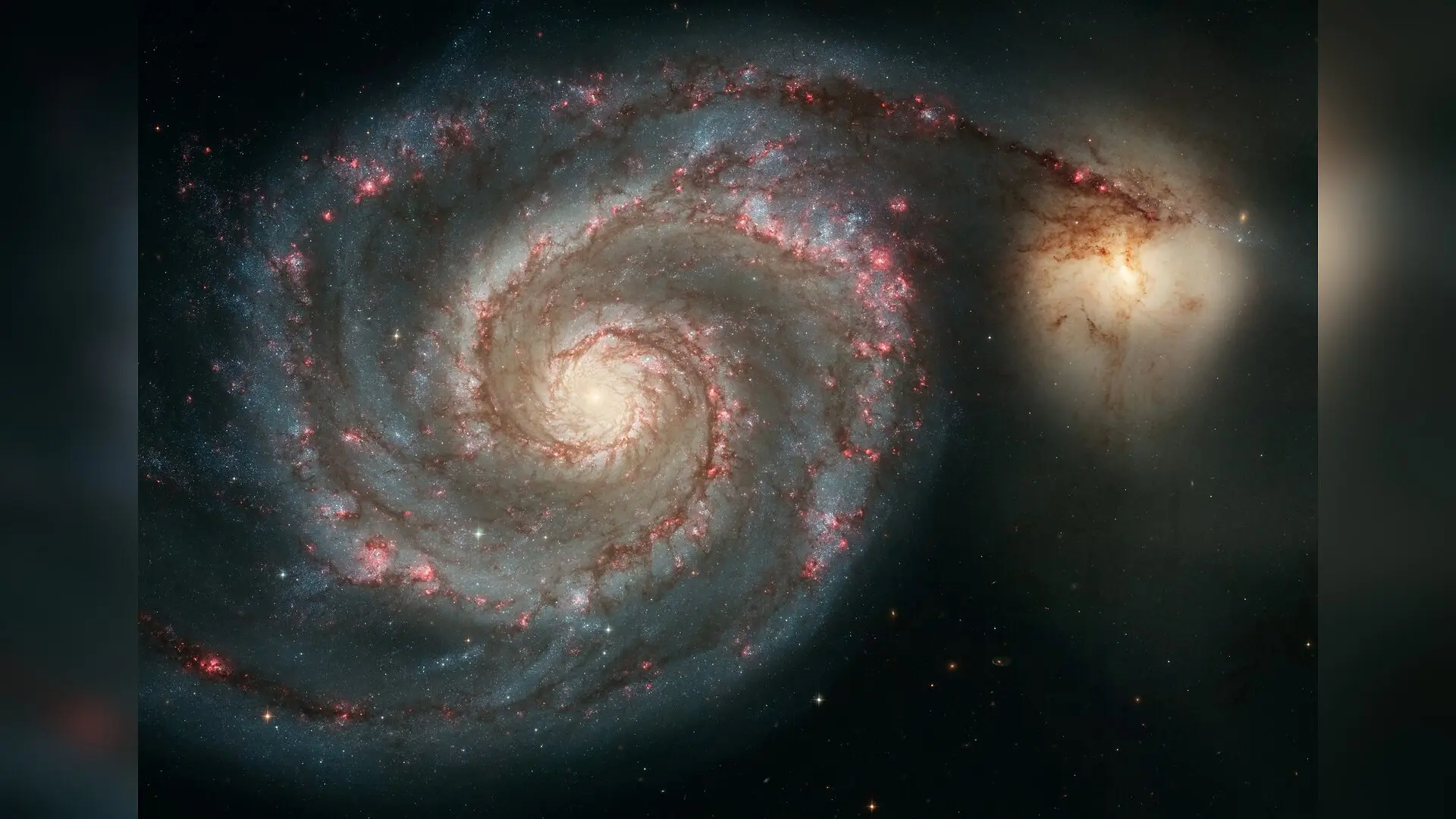
A massive new statistical study of 606 disk galaxies reveals that the lopsided asymmetry seen in many spiral systems is heavily suppressed in fast-rotating, massive disks. The research challenges long-held assumptions about how galactic asymmetry forms and evolves across the universe.
Astronomers have known for decades that disk galaxies often display asymmetric features, where their luminous centers or outer edges appear offset. In a new investigation published in the arXiv preprint server, researchers analyzed a deduplicated compilation of 606 unique disk objects to understand what regulates this asymmetry, known scientifically as the $m = 1$ Fourier mode or lopsidedness.
Why Do Galaxy Asymmetries Follow Log-Normal Statistics?
Led by Abbos Omonov and colleagues from the National University of Uzbekistan and other institutions, the team examined Fourier amplitudes across a sample roughly three times larger than previous homogeneous datasets. They tested three mathematical distributions to see how lopsidedness and bar-like structures ($m = 2$ mode) are spread across the galaxy population. The analysis shows that both amplitudes follow log-normal distributions rather than Rayleigh or exponential forms.
This statistical preference points directly to a multiplicative amplification process, similar to how an initial small disturbance grows exponentially through internal disk instabilities. Furthermore, the two structural modes exhibit a clear mathematical coupling described by $A_2 = 0.29 A_1 + 0.11$. This indicates that bars and spiral arms receive a base background level independent of lopsidedness, alongside an additional component that scales directly with the asymmetry.
How Galaxy Rotation and Mass Quench Lopsidedness
When looking at physical traits, the authors found that lopsidedness rises steadily from early-type lenticular galaxies up to late-type Magellanic spirals. However, it moves in the opposite direction when compared against gas rotation velocity and total stellar mass. Fast-rotating disks with velocities above 150 kilometers per second show a median lopsidedness amplitude of about 0.06, whereas slow rotators near 60 kilometers per second display much higher asymmetry values near 0.19.
In a cross-matched subsample of 246 galaxies with independent stellar mass estimates, the researchers observed a fourfold drop in lopsidedness as stellar mass increased across 1.5 orders of magnitude. Multivariate regression tests revealed that the depth of the dynamical potential, represented by rotation velocity, acts as the dominant predictor rather than stellar mass alone. Differential rotation in massive systems likely shears out the lopsided pattern much faster than in lighter, shallower potential wells.
Cosmological Simulations Confirm the Trend
To place these findings in a wider cosmological framework, the team compared their observational data against 915 simulated disk galaxies from the IllustrisTNG50-1 project, processed via a specialized decomposition pipeline. The simulation successfully reproduced the observed anti-correlation between stellar mass and lopsidedness, yielding a Spearman coefficient matching the real universe closely.
Although the simulated galaxies displayed absolute asymmetry amplitudes roughly 1.4 times lower than the observational sample, this offset aligns with known selection effects in heterogeneous catalogs. Ultimately, the work points away from purely external tidal interactions as the primary driver of galactic lopsidedness, highlighting internal dynamics and potential well depth as the key regulators of cosmic asymmetry.
The study was posted to the arXiv preprint server on November 10, 2026.
This article has been fact checked for accuracy, with information verified against reputable sources. Learn more about us and our editorial process.
Last reviewed on .
Article history
- Latest version
Reference(s)
- Omonov, Abbos. “A Statistical Analysis of Lopsidedness in Disk Galaxies.” arXiv.org <http://arxiv.org/abs/2611.14435v1>.
Cite this page:
- Posted by John Williams