Physicists Solve a Longstanding Cosmic Mapping Discrepancy
A new theoretical framework uses renormalization group equations to bridge conflicting galaxy clustering scales and unify cosmic survey data.
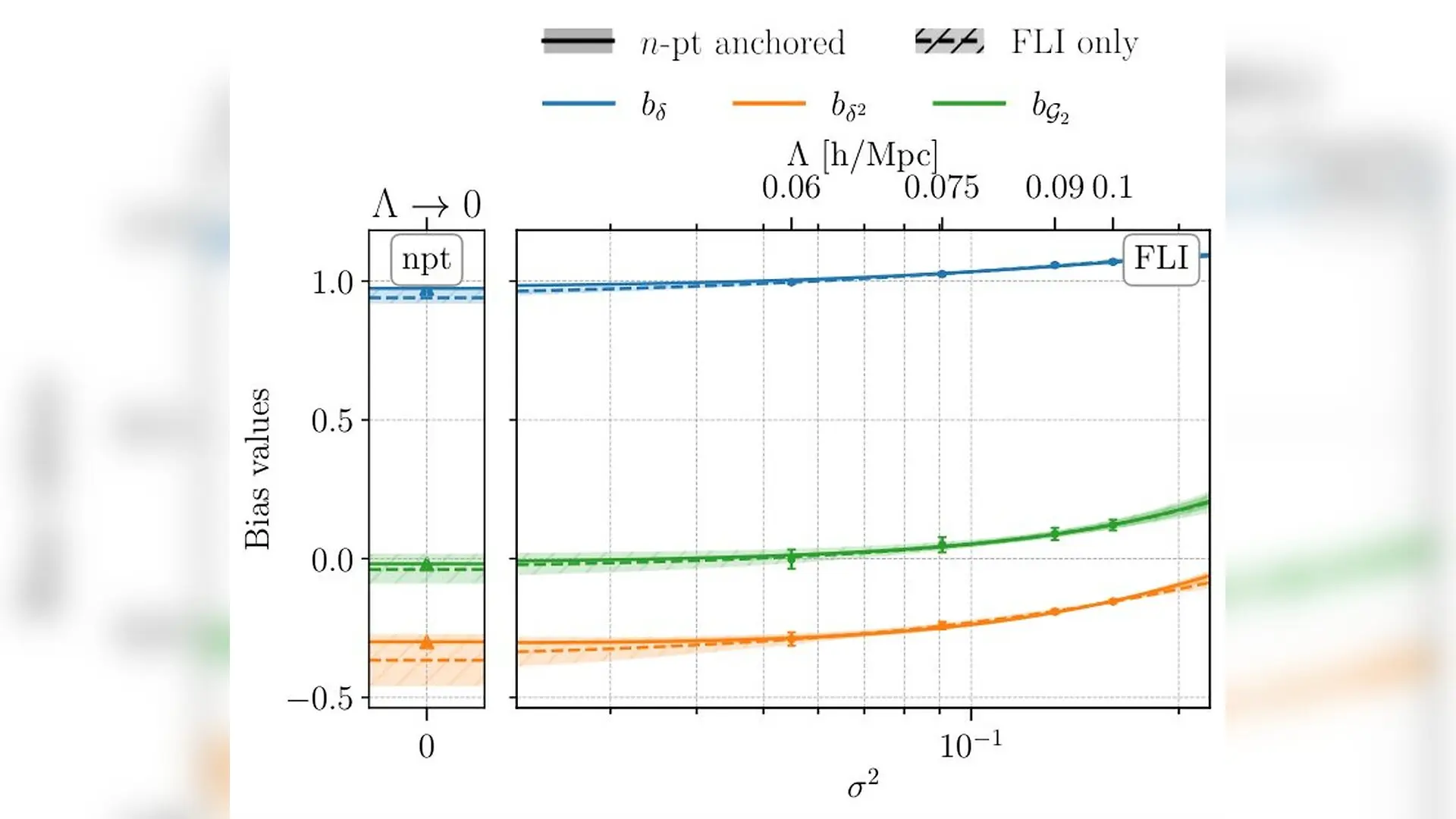
Cosmologists mapping the large-scale structure of the Universe have long wrestled with a frustrating mathematical mismatch when trying to connect how galaxies cluster to the underlying distribution of invisible dark matter. A team of astrophysicists has deployed a physics framework called the renormalization group to solve this discrepancy, bridging the gap between small-scale map analysis and large-scale statistical surveys. The study, published on the arXiv preprint server in November 2026 by researchers Hsiang-Ming Huang, Henrique Rubira, and Fabian Schmidt, demonstrates how galaxy bias parameters evolve across different resolution scales.
Why Mapping Cosmic Structures Requires Complex Calculations
Galaxies do not spread out randomly across space, but instead trace the gravitational scaffolding of dark matter. To extract precise cosmological data about dark energy and the origins of the cosmos, researchers must rely on mathematical rules known as galaxy bias parameters to relate visible galaxies to invisible matter. However, different analysis techniques evaluate these parameters at conflicting scales. Field-level mapping relies on a finite cutoff resolution grid, while traditional statistical methods evaluate properties in the zero-limit low-wavenumber regime.
This difference in scale introduces numerical variations that make it difficult to compare results across different scientific studies. To fix this, the authors utilized the renormalization group, a mathematical toolkit originally built for particle physics and critical phenomena. The renormalization group uses ordinary differential equations to describe how physical parameters shift when zooming in or out between different resolution cutoffs. By tracking this evolution, the team established a natural bridge connecting high-resolution grid measurements directly to large-scale statistical predictions.
Testing Theoretical Predictions Against Mock Universes and Simulation Halos
To verify whether their theoretical equations matched reality, the researchers tested their model using two different data sets. First, they generated a suite of 100 mock galaxy fields using a Lagrangian perturbation theory forward model called LEFTfield, which evolves initial cosmic conditions under gravity. Because the input bias parameters were strictly known for these controlled mocks, the team could precisely measure how the parameters ran across various cutoff scales.
The team then analyzed more realistic dark matter halo catalogs derived from full numerical N-body simulations carried out with the GADGET-2 code. These simulations tracked millions of dark matter particles grouped into distinct mass bins representing both weakly and highly biased cosmic structures. By applying both field-level inference techniques and traditional n-point correlation functions, the researchers mapped out the running of first-order linear bias and second-order quadratic bias terms.
What the Results Reveal About Cosmic Evolution
The analysis revealed that the measured bias parameters systematically rise when lowering the cutoff scale and approach a steady constant at low cutoffs. For the controlled mock fields, the predicted renormalization group running closely tracked the measured data across the entire range of spatial scales. The team found that linear bias parameters followed theoretical curves exceptionally well, while second-order bias terms showed good general agreement alongside slight deviations near higher-cutoff boundaries.
When applied to the dark matter halo catalogs, the framework successfully reproduced expected physical behaviors for both low-mass and high-mass samples. Lower-mass halos exhibited slower running because their main driving coefficients were smaller, whereas heavier, highly biased halos showed faster running and wider uncertainty bands. Despite these wider bands, the predicted curves remained completely consistent with the measured data within expected statistical error margins.
Limitations and Future Improvements in Galaxy Survey Analysis
The authors noted several technical limitations in their current model, particularly regarding how perturbative gravity and higher-order bias terms are truncated. While the study accounted for third-order bias parameters by analytically marginalizing over them in the likelihood function, completely capturing higher-order interactions requires evaluating complex multi-loop contributions. Furthermore, because the halo catalog analysis relied on a single simulation realization, statistical uncertainties were naturally larger than those found in the multi-mock ensemble tests.
Despite these caveats, the research successfully demonstrates that renormalization group flow provides a robust, systematic framework for unifying disparate cosmological measurement techniques. By offering a reliable way to account for missing higher-order contributions and compute accurate systematic error bars, the work gives astronomers a powerful tool to construct consistent bias priors for upcoming galaxy surveys.
The study was posted to the arXiv preprint server on November 10, 2026.
This article has been fact checked for accuracy, with information verified against reputable sources. Learn more about us and our editorial process.
Last reviewed on .
Article history
- Latest version
Reference(s)
- Huang, Hsiang-Ming. “Connecting field-level and n-point function measurements of galaxy bias.” arXiv.org <http://arxiv.org/abs/2611.14456v1>.
Cite this page:
- Posted by John Williams