Ice Forms Spontaneously Around Ions in Cold Plasma Experiments
Laboratory tests and theoretical models reveal how negative ion clustering bypasses the need for solid dust seeds in space.
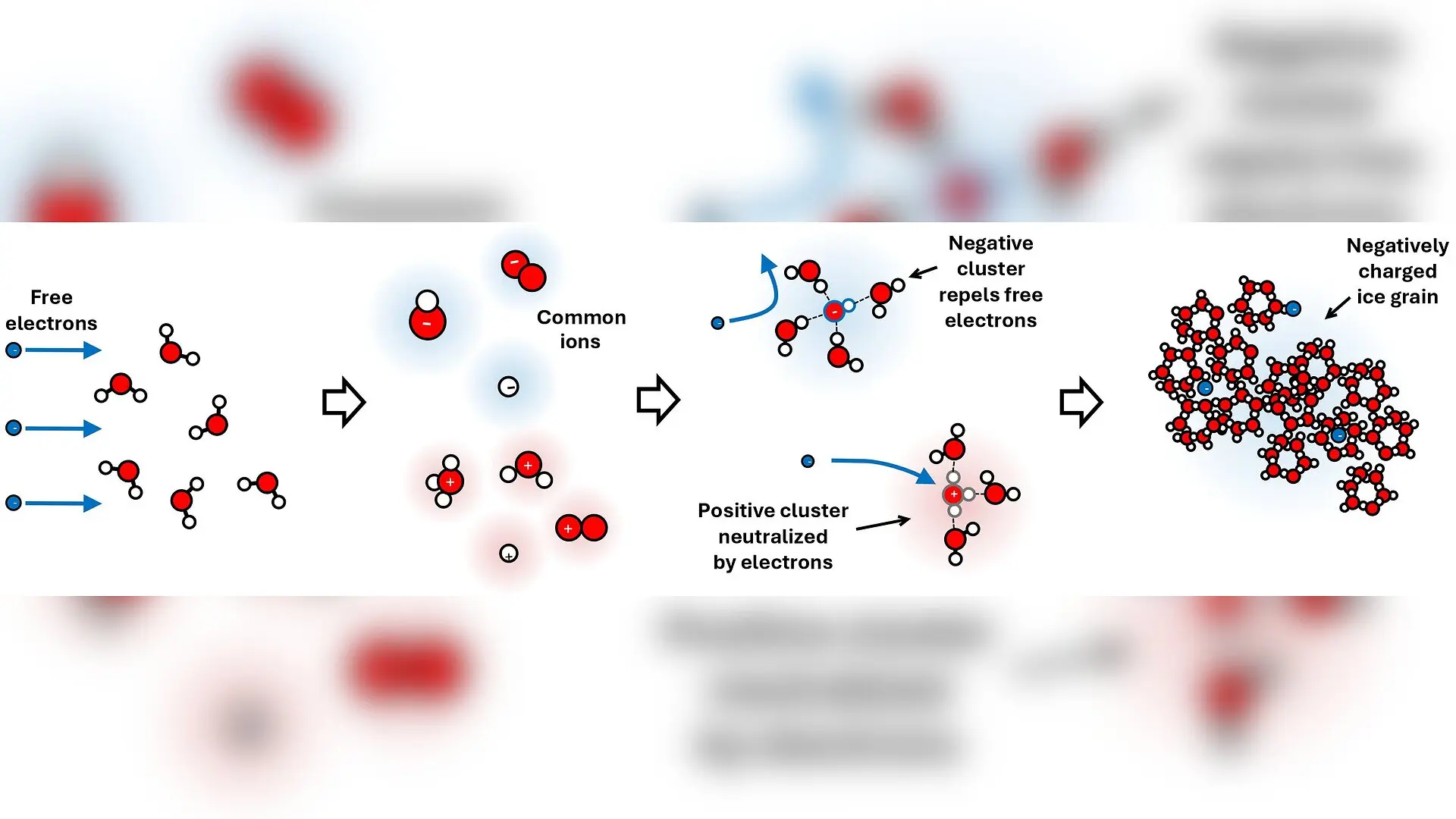
Water ice grains form spontaneously in cold laboratory plasma without needing foreign dust particles, solving a long-standing mystery about how ice builds up in space. Researchers observed that water molecules cluster rapidly around charged ions when temperatures drop below approximately 200 Kelvin (minus 73 degrees Celsius).
The study, available on the arXiv preprint server, demonstrates that tiny ice crystals grow directly from water vapor through an electric process. This mechanism bypasses traditional theories that require foreign impurities to act as seeds for ice formation.
How Negative Ions Drive Rapid Ice Growth
Water ice is one of the most abundant solids in the universe, yet scientists have struggled to explain how pure ice clouds form in places like the Earth’s upper atmosphere or distant protoplanetary disks without foreign particles. Traditional models suggest that water vapor needs a solid surface to condense upon, but observations frequently show ice aerosols forming in pristine, weakly ionized environments.
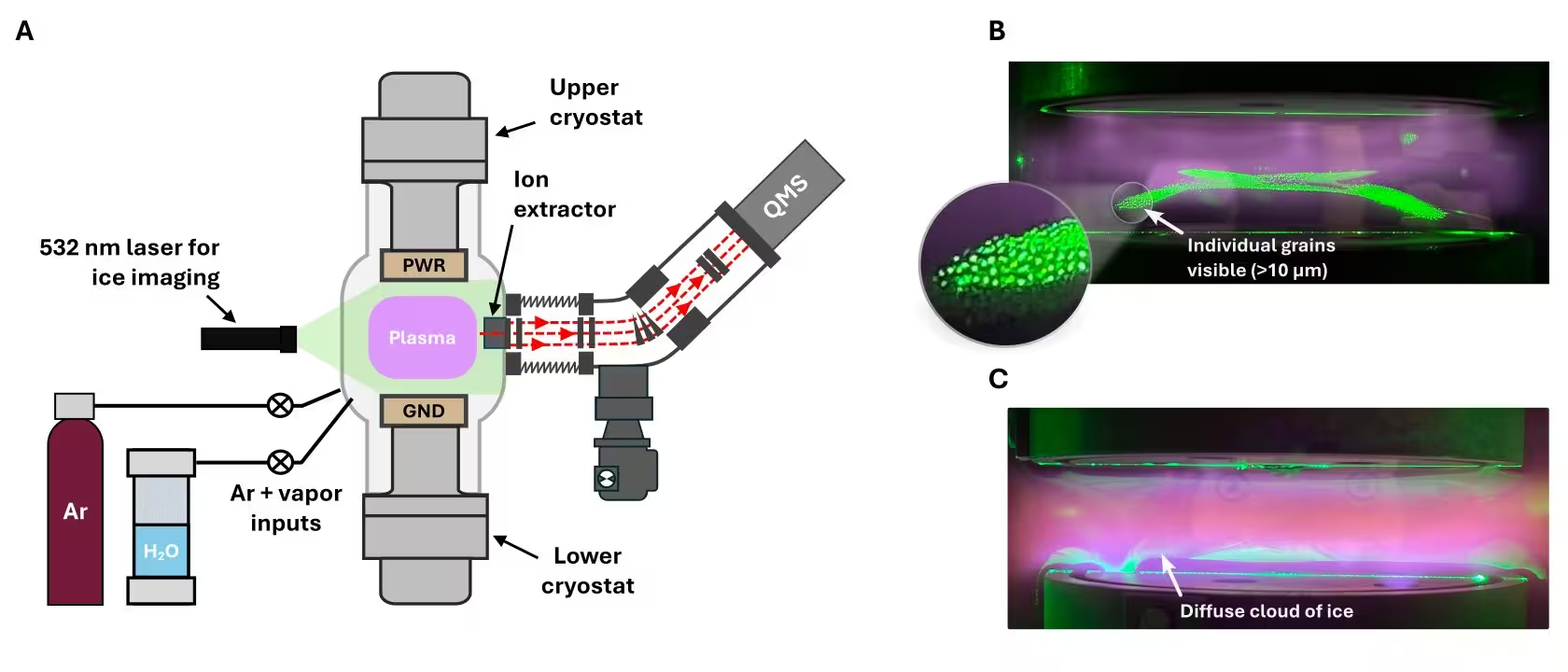
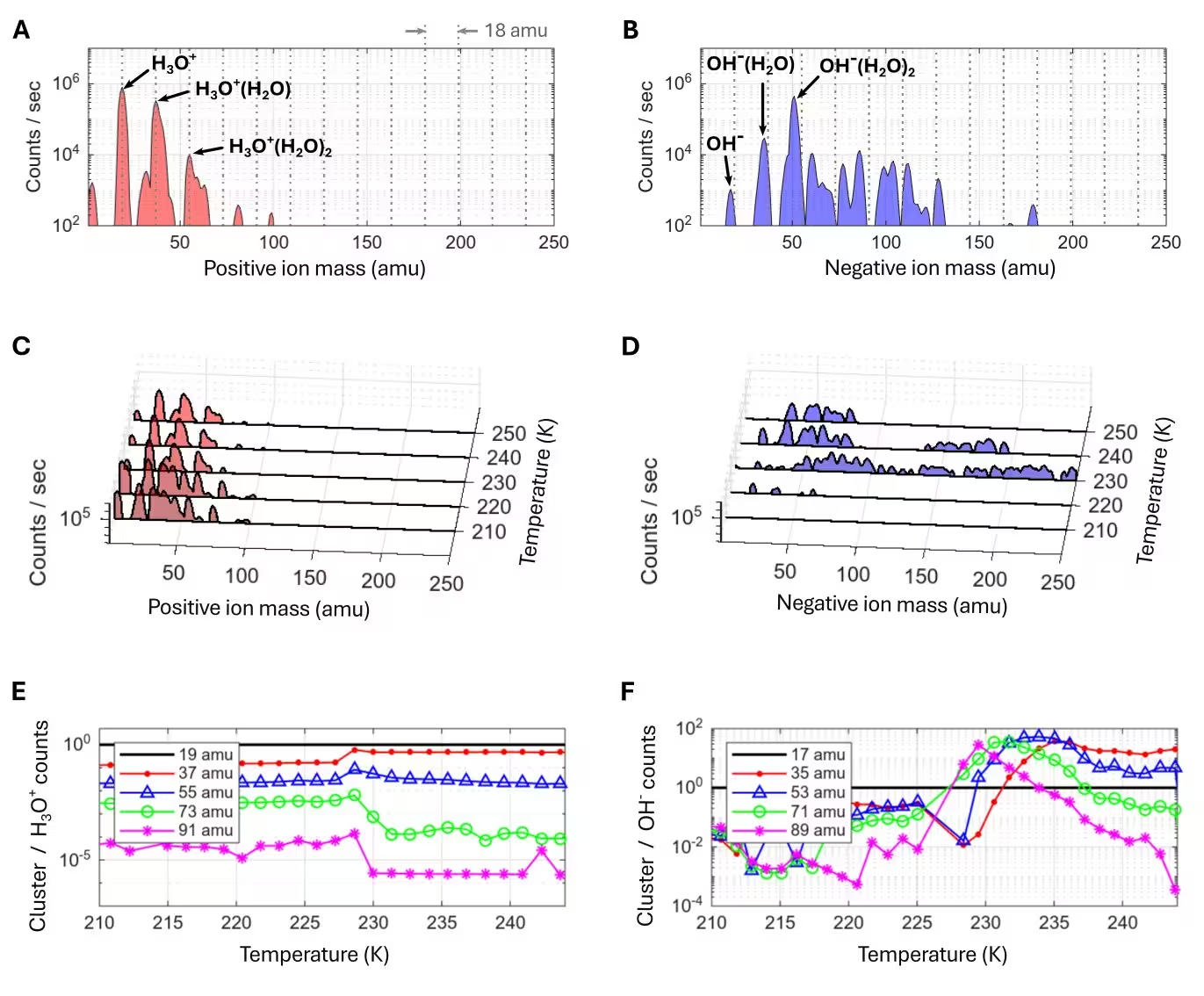
To investigate this, the authors used a low-pressure argon and water vapor gas discharge device chilled between 50 and 300 Kelvin. Using quadrupole mass spectrometry, the team tracked water molecules clustering around ions and monitored the resulting ice grains with laser light scattering. They found that water molecules gathered into clusters around negative ions, such as hydroxide, growing to roughly 200 atomic mass units before disappearing below a critical temperature.
In contrast, positive ion clusters remained small and short-lived because free electrons neutralized them almost instantly. This charge asymmetry creates a powerful kinetic filter that allows negative ion clusters to survive and accumulate water molecules.
What Happens When Temperatures Drop Below Critical Thresholds
As the laboratory temperature decreased toward 225 Kelvin, the team noted that larger negative clusters became remarkably stable. Below this threshold, the clusters underwent rapid, runaway growth into macroscopic ice grains that measured hundreds of microns in size at temperatures under 150 Kelvin.
The researchers calculated that the electric attraction between water’s permanent dipole moment and the negative ion creates an intense local electric field. This electric lensing effect dramatically enhances the capture cross-section of hydroxide ions, pulling in surrounding water vapor at rates far exceeding geometric expectations.
Implications for Planetary Disks and Earth Atmosphere
These findings reshape our understanding of icy environments across the cosmos, from protoplanetary disks surrounding young stars to noctilucent clouds in Earth’s polar mesosphere. In regions like the outer layers of a T-Tauri protoplanetary disk at 20 Astronomical Units, low temperatures and high ultraviolet radiation create conditions where negative ion nucleation can dominate over traditional dust grain deposition.
By showing that ice can nucleate spontaneously around simple ions without a liquid phase or solid impurities, the work provides a unified framework for astrophysical ice formation. Future research will need to test how mixed-gas environments containing atomic hydrogen, nitrogen, or oxygen modify these hydration rates in specific planetary atmospheres.
The study was posted to the arXiv preprint server on November 10, 2026.
This article has been fact checked for accuracy, with information verified against reputable sources. Learn more about us and our editorial process.
Last reviewed on .
Article history
- Latest version
Reference(s)
- Nicolov, André. “Nucleation of water ice under weak ionization via clustering on negative ions.” arXiv.org <http://arxiv.org/abs/2611.14441v1>.
Cite this page:
- Posted by Nida Rehman