New Algorithm Hunts Faint Exoplanets Hiding Behind Blinding Stellar Glare
A data-driven noise modeling technique helps astronomers spot elusive alien worlds in high-contrast telescope images.
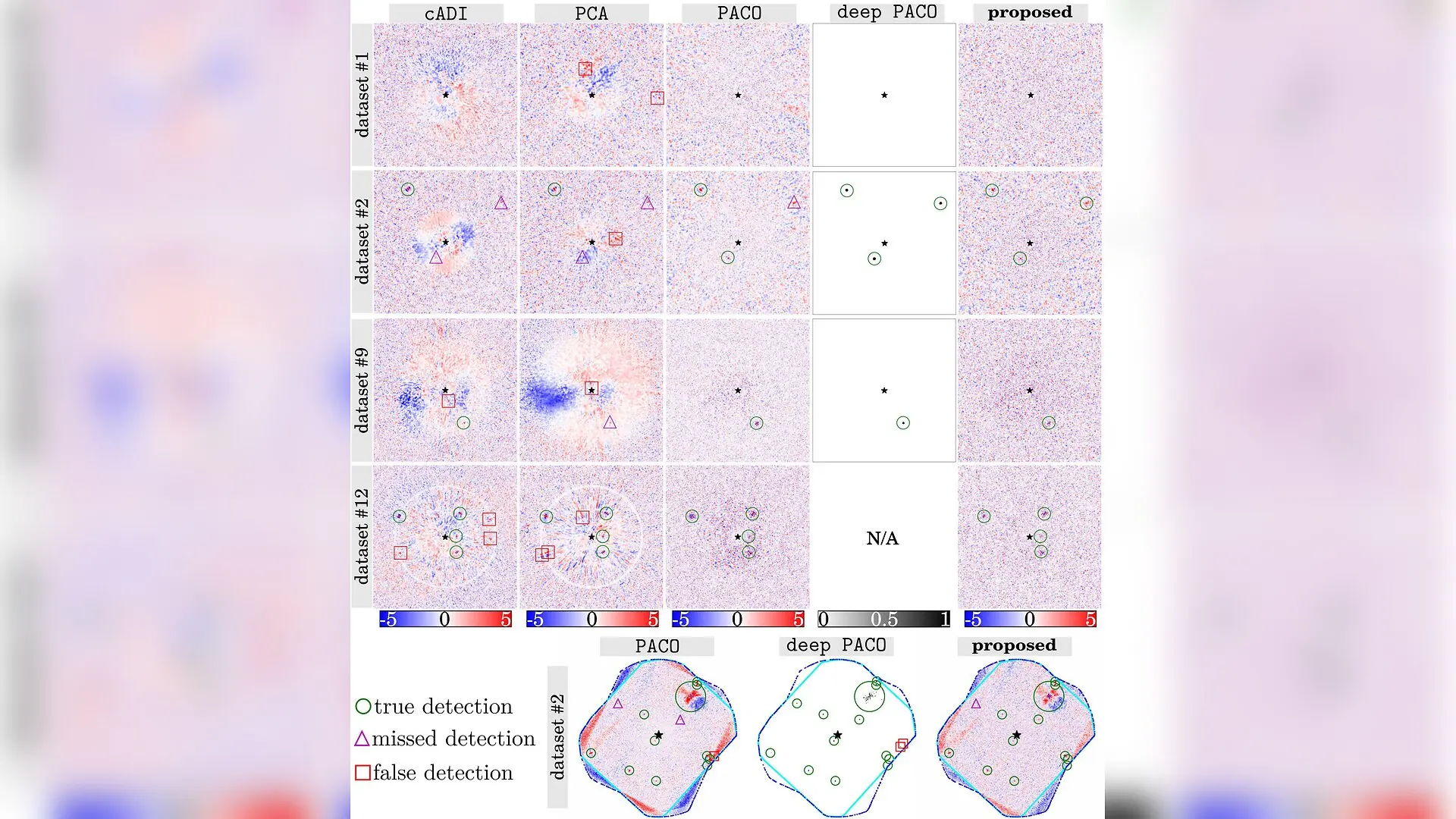
Astronomers peering into deep space face a daunting obstacle when hunting for alien worlds around distant stars, as a blinding glare from stellar leakage and optical imperfections routinely washes out faint planetary signals. Finding these elusive exoplanets requires spotting faint objects in multivariate data corrupted by a strong and spatially correlated nuisance component in the low-sample regime, where traditional statistical tools fail to compute reliable noise estimates.
To solve this hurdle, a team of researchers developed a novel data-driven framework that models the inverse of the data covariance matrix, known as the precision matrix, through sparse approximations. The authors report their findings in a study published on the arXiv preprint server (2026), detailing a technique that builds a low-complexity statistical model by approximating the precision matrix using a pivoted sparse Cholesky factorization whose non-zero coefficients are learned directly from observations via maximum likelihood.
In astronomical imaging, instruments such as the SPHERE instrument at the Very Large Telescope generate data cubes consisting of roughly 50 frames containing about one million pixels each. In these high-contrast imaging scenarios, the ratio of planet flux to stellar brightness ranges from 10 to the power of negative five to 10 to the power of negative six before optical correction, and remains below 10 to the power of negative three in recorded images. This background noise is heavily non-stationary and correlates across multiple spatial scales, combining local speckles with extended structures that shift in complex ways.
Traditional detection pipelines rely on empirical modeling or local covariance patches under strict Gaussian assumptions, which often struggle to capture large-scale correlations across entire images. The new approach overcomes this limitation by using structured sparsity patterns, including random and multi-scale configurations, to accurately reproduce both local speckles and distant structural correlations in the noise. By coupling this precision matrix model with a generalized likelihood ratio test, the detector maintains strict control over false alarms while delivering high sensitivity.
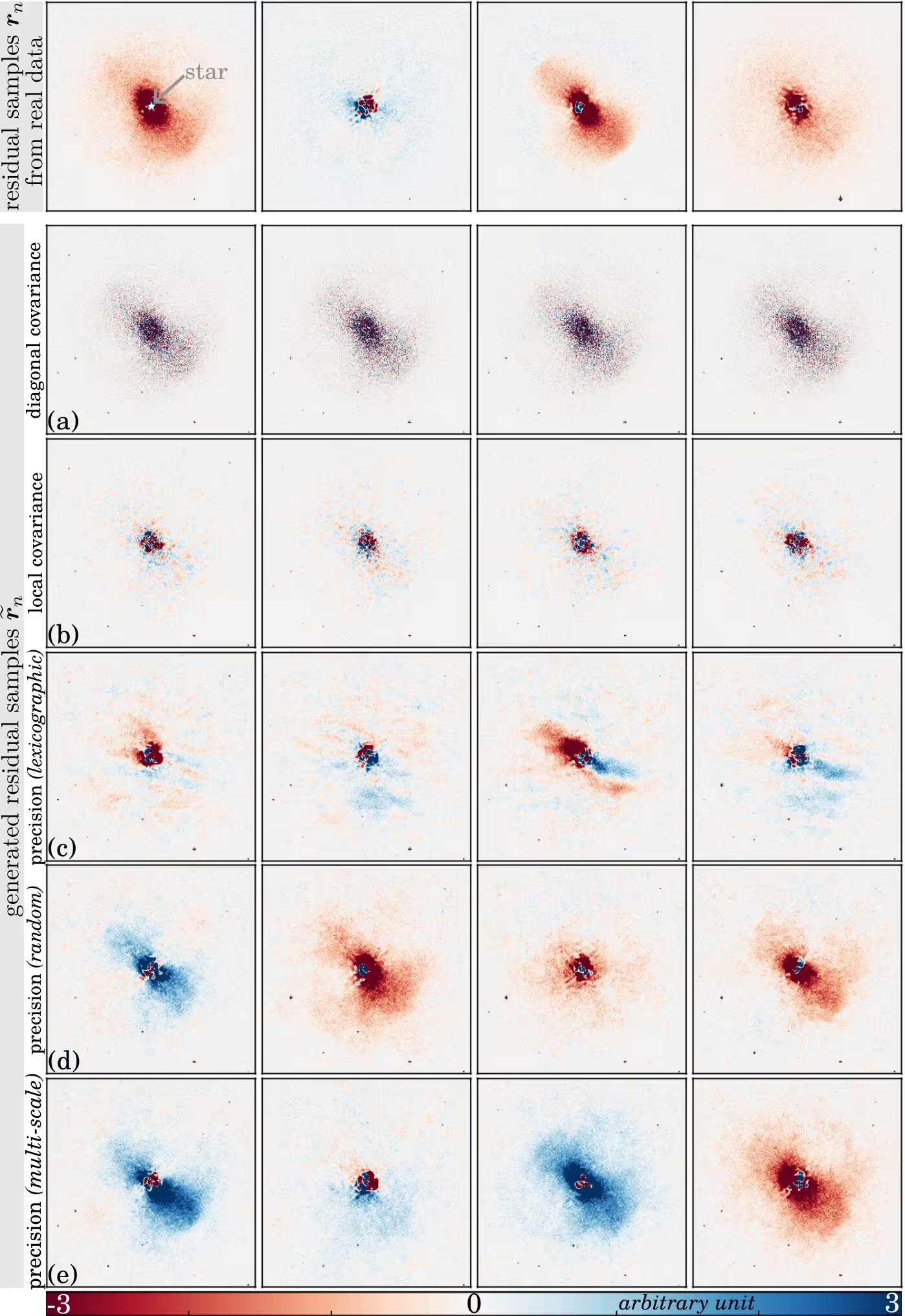
Selecting the optimal model complexity without contaminating the results with real planetary signals required an unsupervised strategy based on leave-one-out cross-validated predictive log-likelihood. By masking pixels that potentially contain bright astronomical sources, the algorithm evaluates how well a specific noise model generalizes to unseen data without manual tuning. Tests across 13 datasets acquired under various instrumental configurations demonstrated that this unsupervised model selection aligns closely with supervised benchmarks.
When evaluated against established baseline techniques across 13 datasets containing both real targets and simulated synthetic sources, the proposed detector achieved competitive performance, particularly in the low false discovery rate regime favored by astronomers. Furthermore, flux estimates for detected sources showed excellent agreement with ground-truth values for signals with a signal-to-noise ratio of three or higher. The authors plan to extend this statistical framework to additional imaging modalities and multi-spectral observation tasks in future work.
The study was posted to the arXiv preprint server on November 10, 2026.
This article has been fact checked for accuracy, with information verified against reputable sources. Learn more about us and our editorial process.
Last reviewed on .
Article history
- Latest version
Reference(s)
- Flasseur, Olivier. “Learning a model of non-stationary nuisances with non-local correlations for object detection.” arXiv.org <http://arxiv.org/abs/2611.14479v1>.
Cite this page:
- Posted by Nida Rehman