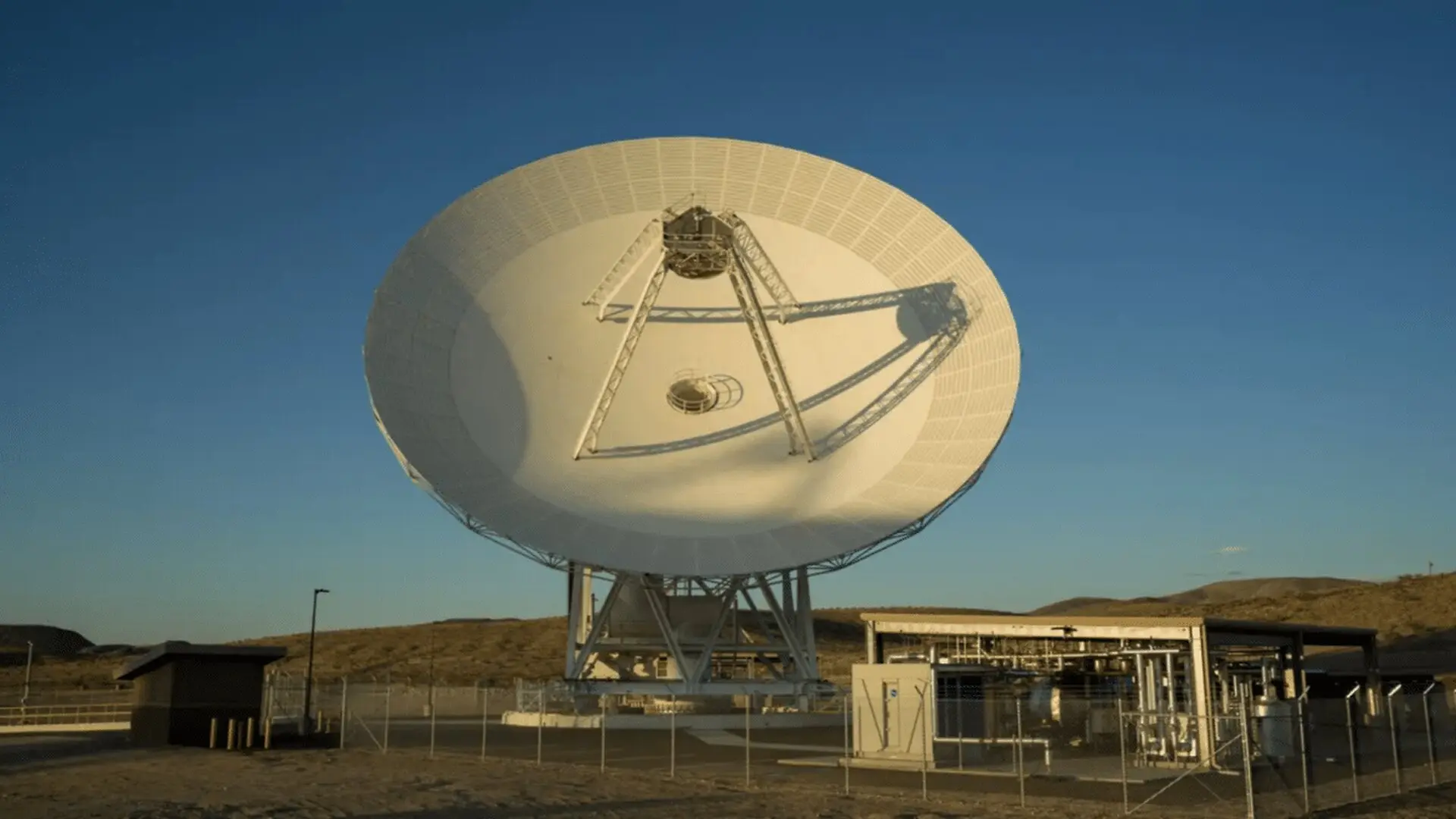
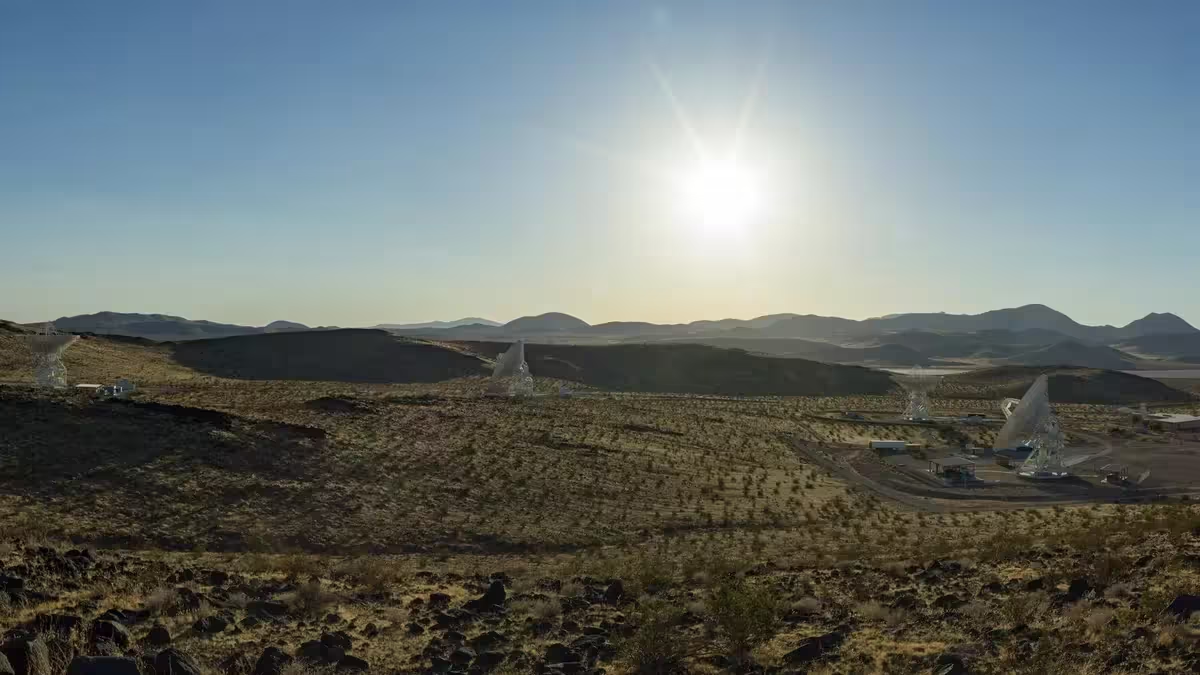
NASA has officially expanded its reach into the cosmos by bringing a new, high-capacity antenna online at the Goldstone Deep Space Communications Complex in California’s Mojave Desert. This latest addition to the Deep Space Network (DSN) is a critical strategic move as the agency grapples with an unprecedented surge in demand from both robotic explorers and the burgeoning human spaceflight program.
The DSN serves as the essential umbilical cord for humanity’s presence in space, acting as the primary conduit for commands and scientific telemetry between Earth and assets traversing the solar system. Managed by NASA’s Jet Propulsion Laboratory (JPL), this global array of massive radio antennas—strategically positioned in California, Spain, and Australia—must maintain near-constant contact with hardware millions, or even billions, of miles away.
Antennas at the Deep Space Network’s Goldstone complex near Barstow, California. The recently completed Deep Space Station 23 is in the foreground to the right. (Image credit: NASA/JPL-Caltech)
The Looming Bottleneck in Interplanetary Comms
As noted by Space.com, the integration of this new antenna is a necessary response to an increasingly crowded celestial landscape. With a growing roster of international and commercial entities launching missions, the window of available time on these giant dishes is shrinking rapidly. Because deep space communication is bound by the rigid constraints of physics, missions require massive hardware to detect the infinitesimally weak signals returning from distant planetary probes and rovers.
The operational pressure is expected to intensify further with the escalation of the Artemis program. As NASA prepares to return astronauts to the lunar surface, the agency faces the challenge of prioritizing human safety over scientific data collection. Brad Arnold, the DSN manager at JPL, characterized the lunar program as the “gorilla in the room” during a recent presentation, cautioning that human missions will inherently take precedence, potentially leaving robotic explorers with reduced access to critical communication windows.
NASA is marking the addition of a powerful new 34-meter antenna to our Deep Space Network. The next-generation antenna will expand the communication and navigation capabilities of missions to the Moon and beyond. pic.twitter.com/jSZvHy8GHS
The addition of the new California antenna serves as more than just a capacity upgrade; it represents a fundamental recognition that ground infrastructure is as vital to discovery as the spacecraft themselves. As the cadence of Mars rover operations, deep-space probes, and lunar sorties accelerates, the network must evolve to handle a multi-faceted mission schedule that never sleeps.
Ultimately, the expansion at Goldstone highlights a significant shift in space exploration, where the sheer volume of active, far-flung technology is beginning to outpace the legacy systems designed to support them. Moving forward, NASA will need to continue balancing the technical requirements of human-rated lunar missions with the sustained, data-heavy demands of its scientific fleet as the global appetite for exploration continues to grow.
Fact Checked
This article has been fact checked for accuracy, with information verified against reputable sources. Learn more about us and our editorial process.
Ahmed, Aisha. “NASA Is Building A Massive New Antenna To Save Its Overwhelmed Deep Space Network.” BioScience. BioScience ISSN 2521-5760, 07 September 2026. <https://www.bioscience.com.pk/en/subject/astronomy/nasa-builds-a-giant-desert-antenna-to-handle-the-explosion-of-space-missions>.
Ahmed, A. (2026, September 07). “NASA Is Building A Massive New Antenna To Save Its Overwhelmed Deep Space Network.” BioScience. ISSN 2521-5760. Retrieved September 07, 2026 from https://www.bioscience.com.pk/en/subject/astronomy/nasa-builds-a-giant-desert-antenna-to-handle-the-explosion-of-space-missions
Ahmed, Aisha. “NASA Is Building A Massive New Antenna To Save Its Overwhelmed Deep Space Network.” BioScience. ISSN 2521-5760. https://www.bioscience.com.pk/en/subject/astronomy/nasa-builds-a-giant-desert-antenna-to-handle-the-explosion-of-space-missions (accessed September 07, 2026).