Mysterious Gamma-Ray Burst Feature Tested Against Starlight Scatters
New calculations explore whether ultraviolet and infrared light echoing off surrounding gas clouds can explain the puzzling mega-electronvolt radiation from GRB 221009A.
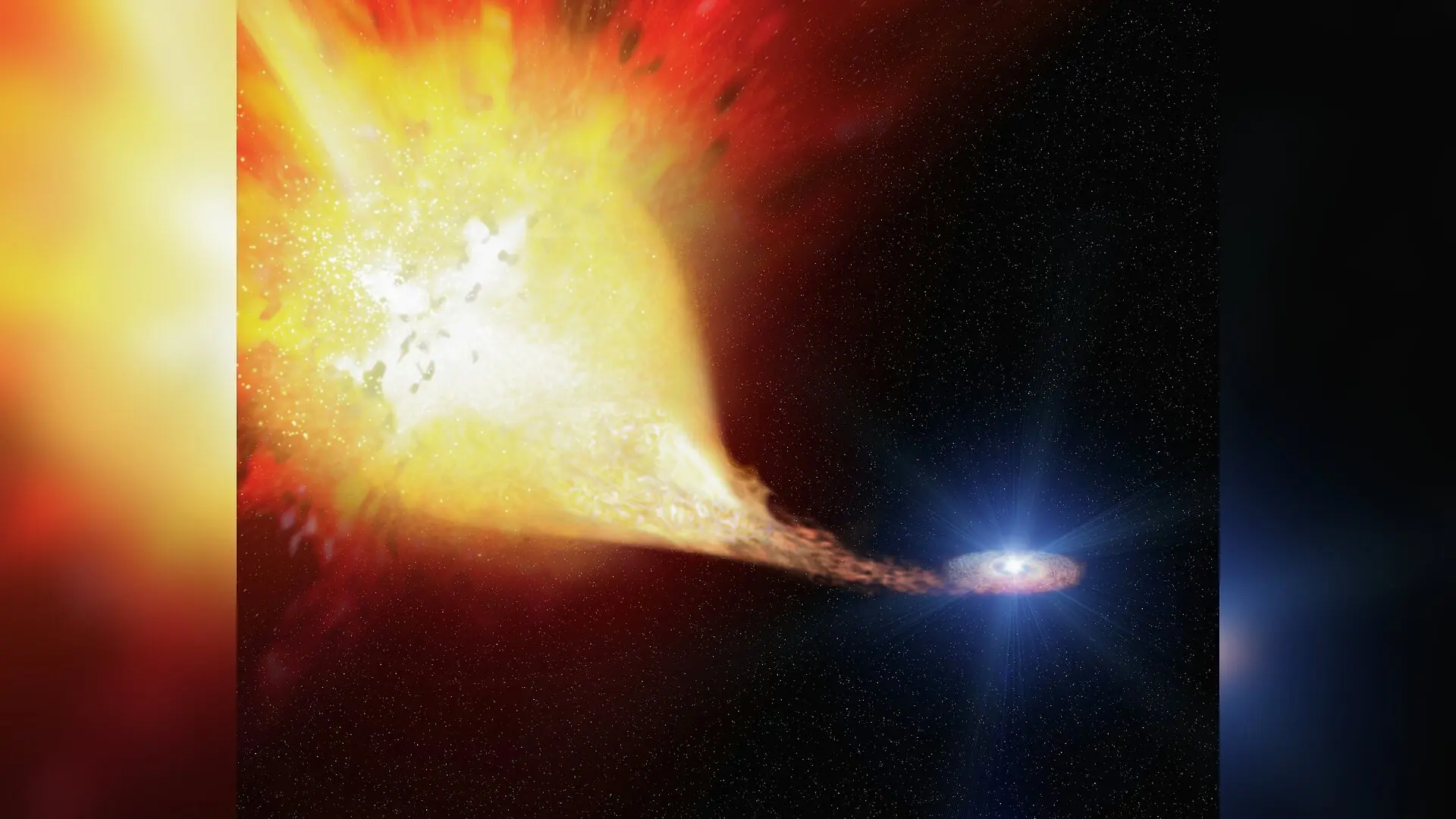
When the brightest cosmic explosion ever recorded, a gamma-ray burst known as GRB 221009A, lit up the distant universe in October 2022, it left astronomers puzzling over an unexpected pulse of mega-electronvolt radiation. A new theoretical analysis investigates whether this mysterious high-energy spectral feature could be produced when fast-moving electrons collide with ambient atomic and molecular line photons, a mechanism called inverse-Compton scattering. The study, available on the arXiv preprint server, evaluates various candidate seed photons including hydrogen lines, ionized metals, and molecular hydrogen.
What Sparked the Investigation Into Cosmic Light Seeds?
GRB 221009A erupted at a redshift of $z = 0.151$, releasing an astonishing amount of energy that triggered space-based detectors like the Fermi Gamma-ray Burst Monitor. Shortly after the main event, researchers identified a distinct emission feature with an energy starting around 12 MeV and fading to 6 MeV over roughly 80 seconds. While some scientists previously interpreted this signal as Doppler-boosted electron-positron annihilation radiation, the new work tests whether everyday starlight and gas transitions in the surrounding medium could act as scattering targets.
The primary motivation for testing molecular hydrogen comes from late-time observations by the James Webb Space Telescope, which detected strong molecular emission lines at the projected explosion site. These line ratios heavily favor ultraviolet fluorescence over shock heating. To determine if these environments could generate the observed gamma-ray feature, the author examined how relativistic electrons might upscatter infrared and ultraviolet photons.
How Well Do Molecular and Atomic Seeds Match the Data?
The author tested whether assuming lateral illumination by the molecular hydrogen transition at $2.122\,\mu\text{m}$ could reproduce the measured centroids and widths of the gamma-ray feature. By calibrating lognormal electron distributions across specific observing intervals, the models successfully matched the spectral moments of the published data. However, when incorporating a broader spectrum of accompanying molecular transitions from published photodissociation-region calculations, the predicted spectra consistently exceeded the adopted central spectral references at certain energies.
The investigation also checked whether the ultraviolet photons driving molecular fluorescence would simultaneously produce an overproduction of high-energy emission in the Fermi Large Area Telescope band. While the kinematic calculations show that molecular and atomic seeds like hydrogen, magnesium, silicon, and iron are viable energy-boosting targets, proving their actual presence during the prompt explosion remains difficult. Observed host galaxy emission lines and late-time X-ray afterglow features point to rich surrounding gas, but they do not automatically guarantee the local photon densities required during the brief gamma-ray burst.
Could a Precursor Flare Explain the Missing Photons?
To address the challenge of supplying enough local seed photons, the study considered a gamma-ray precursor observed roughly three minutes before the main explosion as a potential preparation phase. In this scenario, a burst of ultraviolet radiation could excite molecular hydrogen, leaving a reservoir of elevated energy states that continue to emit infrared photons as the main jet arrives. Analytical estimates indicate that improved geometrical interception significantly reduces the ideal energy-storage deficit compared to naive spherical models.
Despite these improvements, compact configurations still fall short of the required reference-line photon density by factors of roughly 4 to 9, even under ideal excitation and escape assumptions. Furthermore, high radiation densities introduce rapid electron cooling times that can rival the physical crossing time of the emitting region, meaning that continuous energy injection or a detailed transport calculation would be required to maintain the electron populations.
The study was posted to the arXiv preprint server on November 10, 2026.
This article has been fact checked for accuracy, with information verified against reputable sources. Learn more about us and our editorial process.
Last reviewed on .
Article history
- Latest version
Reference(s)
- Fraija, Nissim. “Spectral Constraints on Line-Seed Inverse-Compton Models for the MeV Feature in GRB 221009A.” arXiv.org <http://arxiv.org/abs/2611.14363v1>.
Cite this page:
- Posted by Aisha Ahmed