New AI Model Learns Quasar Flickering to Find Supermassive Black Holes
Nullasar bypasses traditional assumptions about black hole variability to improve the search for binary supermassive black holes in deep space surveys.
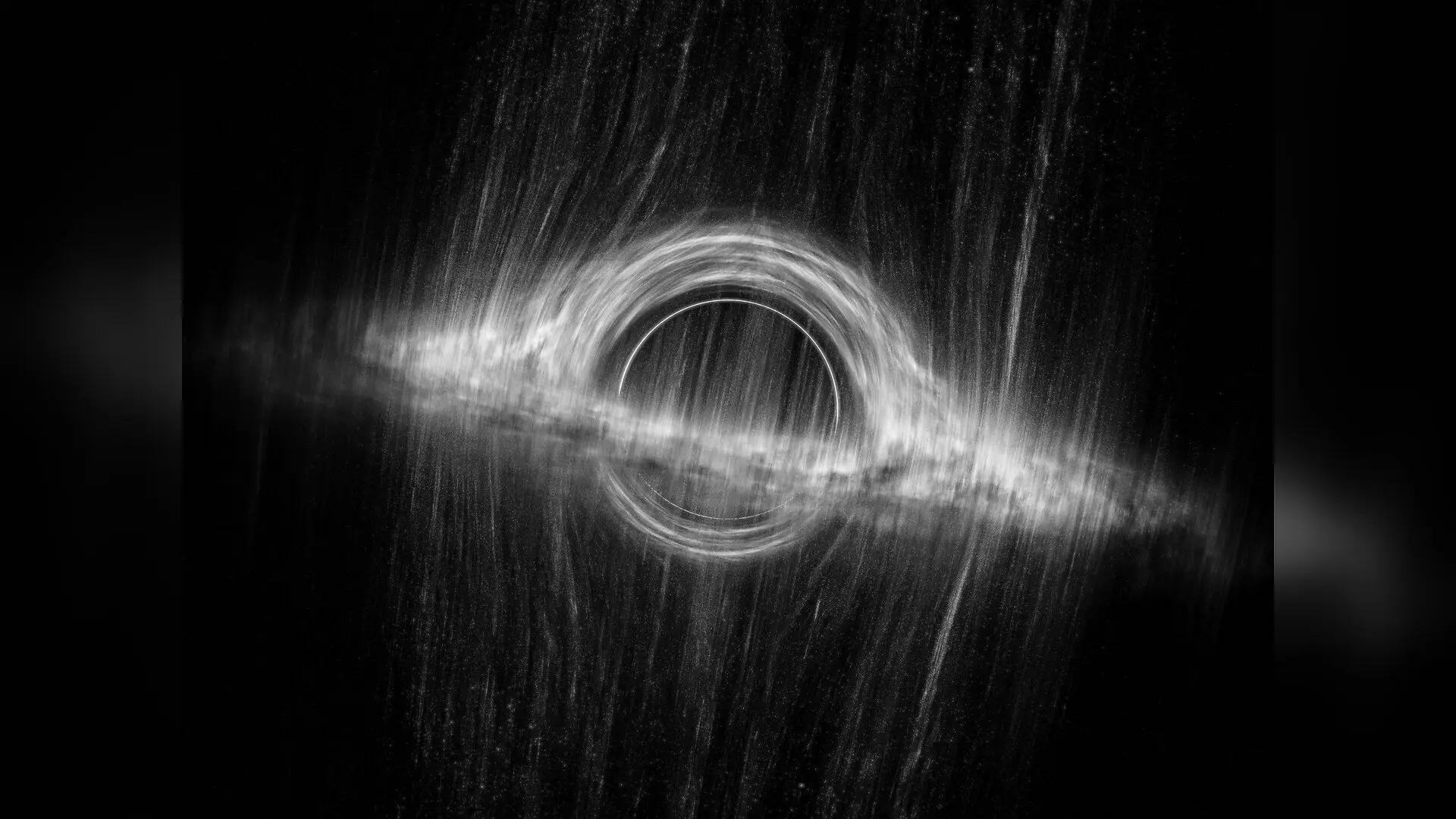
A new artificial intelligence model called Nullasar can decode the flickering light patterns of distant quasars without relying on rigid mathematical assumptions. Quasars are powered by growing supermassive black holes located at the centers of galaxies with inferred masses between $10^6$ and $10^9$ solar masses. Their optical light naturally fluctuates in random, stochastic ways, but traditional astronomical searches often mistake these chaotic shifts for periodic signals, complicating efforts to find pairs of giant black holes spiraling toward a collision.
To fix this, researchers developed Nullasar, a generative neural network that learns variability patterns directly from training data. The findings were published in a study available on the arXiv preprint server. By analyzing time-series data without forcing a predetermined noise model, the AI framework manages to match complex physical behaviors that standard statistical models miss.
Astronomers frequently rely on a simplified statistical template called the damped random walk model, abbreviated as DRW, to describe how quasars flicker over hundreds of days. However, real accretion disks surrounding black holes exhibit more complicated dynamics that do not fit neatly into this single framework. When researchers apply an incorrect statistical baseline to search for periodic signals, the resulting significance estimates become systematically biased, leading to false alarms or missing genuine binary signals.
How the AI Framework Outperforms Traditional Statistics
The new architecture uses continuous normalizing flows and flow-matching techniques to map complex probability distributions. Instead of assuming every light curve follows the exact same mathematical formula, Nullasar learns the statistical properties of an entire population of time series. The model captures delicate ensemble-level features, such as non-Gaussian tails in the distribution of Fourier amplitudes, which cannot be discerned from a single observation alone.
In tests involving synthetic datasets where the true underlying physics was precisely controlled, the authors evaluated how well the model performed as a null hypothesis in periodicity searches. When testing light curves generated by a more flexible second-order autoregressive process, known as AR(2), traditional parametric fitting tended to absorb part of an injected sinusoidal signal into the background noise model. This flaw made traditional baselines overly permissive and hindered their ability to detect periodic features.
Nullasar bypassed this limitation by incorporating population-level knowledge during the generation of synthetic null realizations. By leveraging trends learned across thousands of simulated light curves, the AI framework avoided the trap of absorbing genuine periodic signals into the noise estimate, thereby outperforming traditional single-curve fitting methods.
The Catch Regarding Training Contamination
Despite its successes, the study revealed a critical vulnerability in data-driven null hypotheses. If the training dataset contains even a tiny fraction of contaminated light curves carrying hidden periodic signals, the generative model learns to treat those periodic features as normal stochastic behavior. Consequently, the null hypothesis becomes too permissive, degrading the detection of true signals during later searches.
To solve this issue without retraining the entire neural network, the authors introduced a low-rank projection technique using principal component analysis. By projecting the model’s internal conditioning vectors onto their leading principal directions, the system effectively discards the dimensions where contamination leaves its primary imprint. This adjustment restores detection power, demonstrating that data-driven models can remain reliable tools for future astronomical surveys.
The study was posted to the arXiv preprint server on November 11, 2026.
This article has been fact checked for accuracy, with information verified against reputable sources. Learn more about us and our editorial process.
Last reviewed on .
Article history
- Latest version
Reference(s)
- Sellam, Nadav. “Moving Beyond the DRW Model: Learning Quasar Variability with Generative Models.” arXiv.org <http://arxiv.org/abs/2611.15040v1>.
Cite this page:
- Posted by Aisha Ahmed