Physicists Detect Mysterious High Energy Signal That Could Be Dark Matter
The LUX-ZEPLIN experiment has detected a mysterious signal, offering a potential new clue in the ongoing scientific search for elusive dark matter particles.

Researchers operating the LUX-ZEPLIN (LZ) dark matter detector have reported a curious high-energy event that defies simple explanation, sparking a cautious debate within the particle physics community. While the nature of dark matter—the invisible substance thought to constitute the vast majority of matter in the universe—remains one of the greatest mysteries in cosmology, this latest observation suggests that scientists may need to expand their search parameters beyond traditional models.
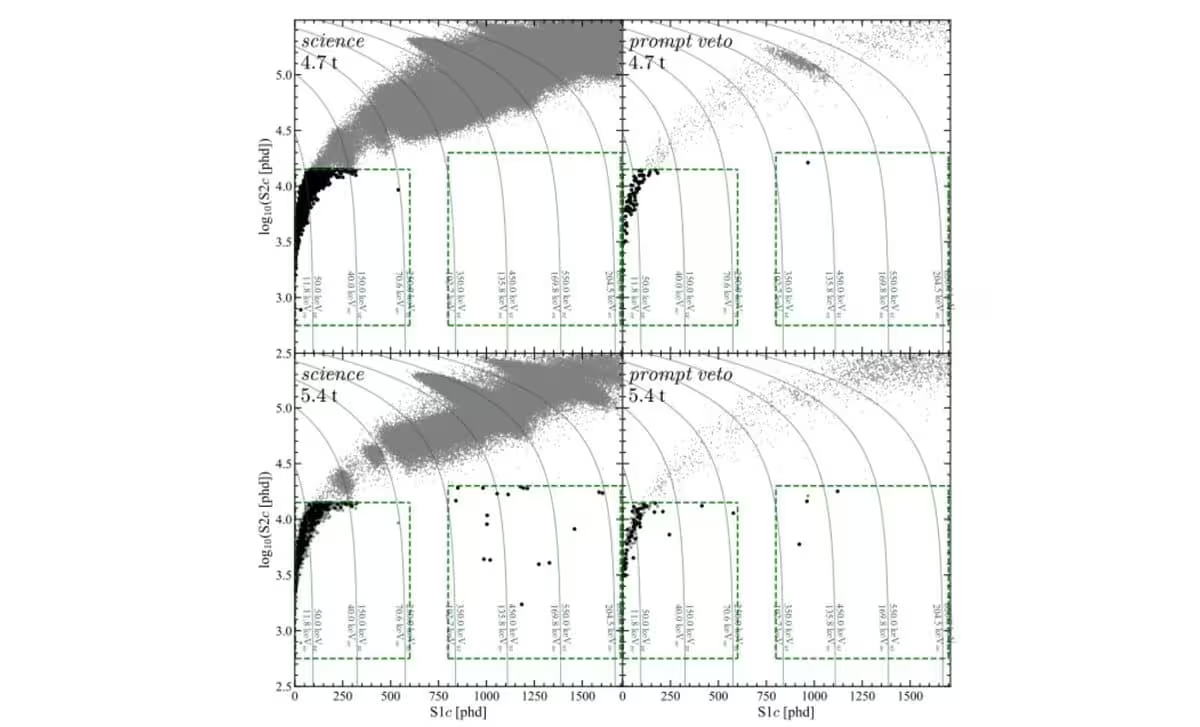
The LZ detector, which utilizes seven tonnes of liquid xenon to identify rare interactions between potential dark matter particles and atomic nuclei, captured the signal on June 16, 2023. During a 220-day observation window, the instrument recorded a nuclear recoil event at an energy level of 248 ± 23 kiloelectronvolts. This finding, detailed in a recent research paper, is particularly notable because it appeared in an experimental region where expected background noise from radioactive materials, neutrons, or neutrinos was exceptionally low.
Expanding the Scope of Dark Matter Detection
For years, the search for dark matter has been dominated by the hunt for Weakly Interacting Massive Particles, or WIMPs. These hypothetical entities were long considered the primary candidates for dark matter because they were expected to produce distinct, relatively low-energy collisions with ordinary matter. However, previous attempts to locate these particles have come up empty, prompting the LZ collaboration to broaden its search window to include higher-energy events reaching up to 270 kiloelectronvolts.
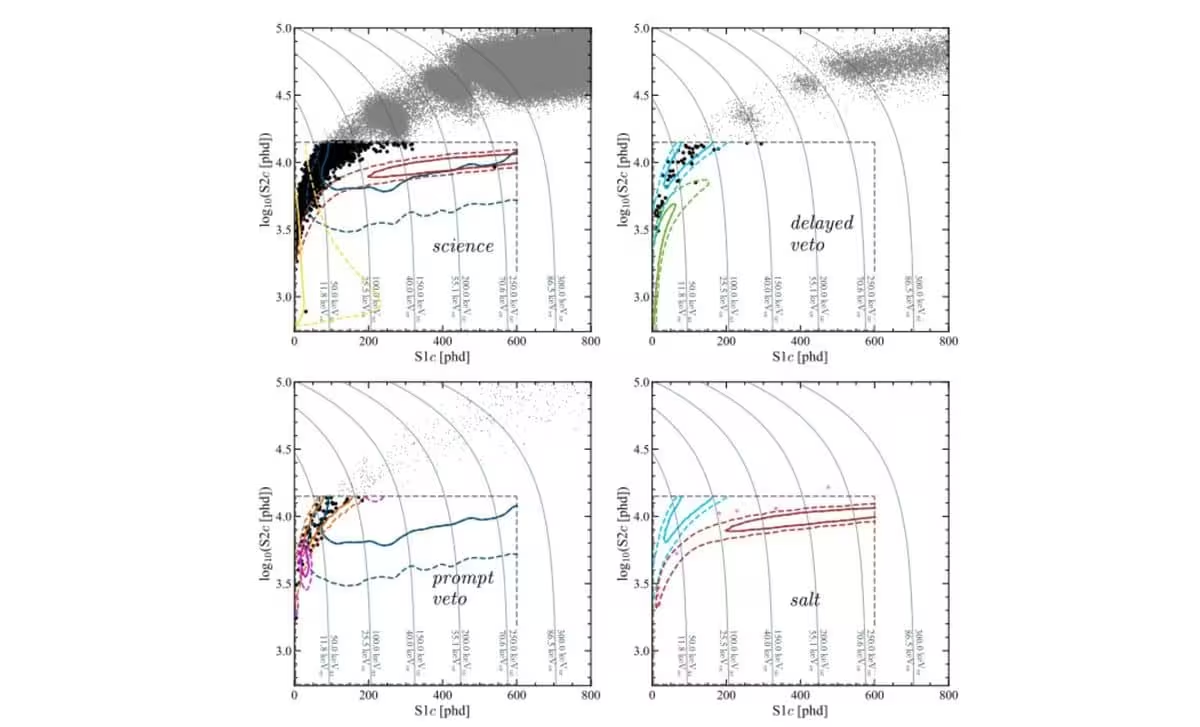
According to Richard Gaitskell, spokesperson for the LZ collaboration, the event presents a significant puzzle. A conventional WIMP interaction would typically be expected to generate a cluster of lower-energy events, yet none were found. This anomaly suggests that if the signal is indeed linked to dark matter, it may involve a far more complex interaction than the current, simplified theoretical models allow.
The Path Toward Verification
Despite the intrigue surrounding the event, the scientific team is far from claiming a breakthrough. The statistical significance of the observation currently sits at 2.6 sigma, far below the 5-sigma threshold required by particle physicists to formally declare a discovery. Consequently, the researchers acknowledge that the signal could simply be a statistical fluke.
The history of dark matter research serves as a reminder of the necessity for extreme caution. The DAMA/LIBRA experiment, for instance, once reported an annual signal modulation that sparked excitement, only for later, more precise experiments such as COSINE-100 and ANAIS-112 to find no evidence supporting that claim after years of monitoring.
For now, the international scientific community is waiting for more data. Other advanced detectors, such as the XENONnT experiment in Italy and the upcoming PandaX upgrades in China, are poised to provide independent verification. Should similar signals emerge in these other facilities, it would validate the reality of the observation and potentially reshape our understanding of how dark matter interacts with the visible universe.
This article has been fact checked for accuracy, with information verified against reputable sources. Learn more about us and our editorial process.
Last reviewed on .
Article history
- Latest version
Reference(s)
- “LZ Preprint 260901 Dark Matter EFT Nuclear Recoil Search At Higher Energies.” <https://lz.lbl.gov/wp-content/uploads/sites/6/2026/08/LZ_Preprint_260901_Dark_Matter_EFT_Nuclear_Recoil_Search_at_Higher_Energies.pdf>.
- “Gaitskell, Richard.” <https://vivo.brown.edu/display/rgaitske>.
Cite this page:
- Posted by Aisha Ahmed