The Universe Is Running Out of Stars But Not the Fuel to Build Them
Galaxies are producing fewer stars despite having ample atomic hydrogen reserves. Astronomers investigate why this fuel isn’t being converted into new stars.
The universe has been growing increasingly quiet over the last 4.5 billion years, with the frantic pace of stellar birth slowing by a factor of more than two. Conventional wisdom once suggested this cooling off was simply due to galaxies exhausting their fuel supply. However, fresh data indicates that the cosmic engine is not stalling because it is running on empty.
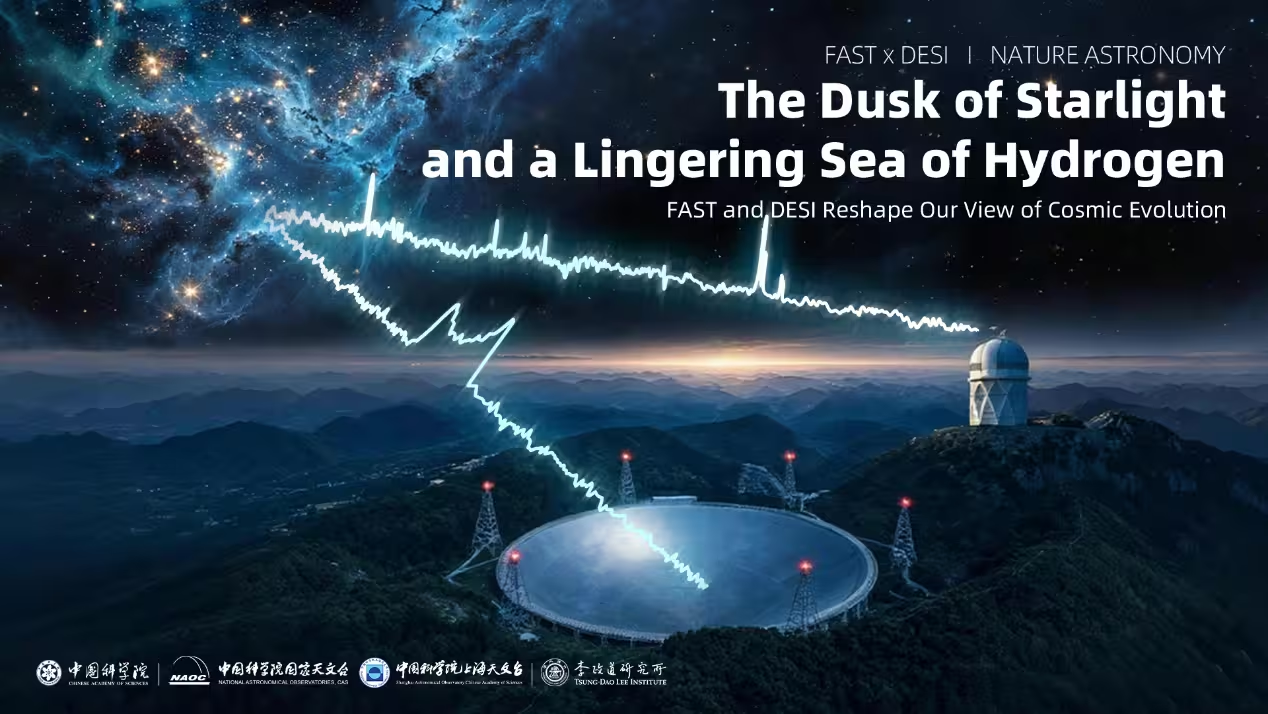
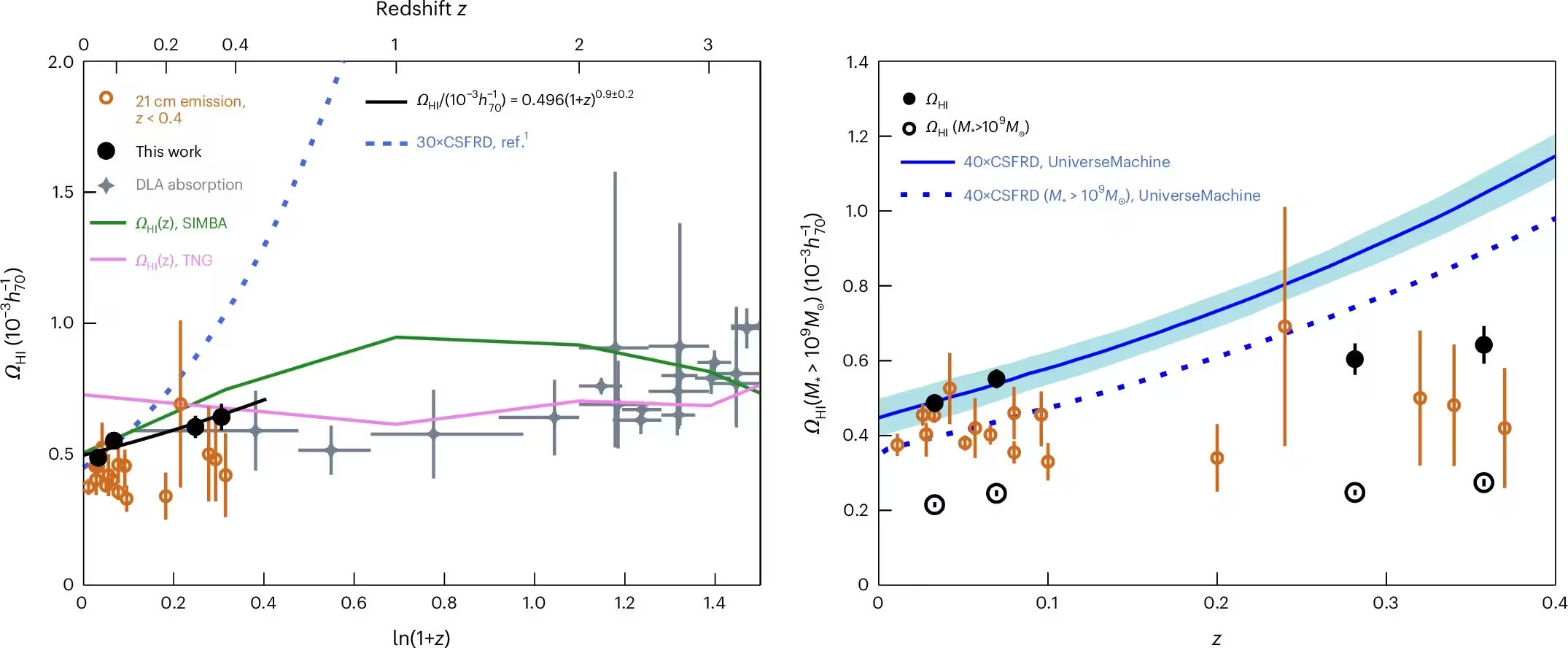
A new analysis, published in Nature Astronomy, reveals that the reservoir of neutral atomic hydrogen—the primary raw material for stars—has remained remarkably consistent, declining only slightly over the same timeframe. By synthesizing observations from China’s Five-hundred-meter Aperture Spherical radio Telescope (FAST) and the Dark Energy Spectroscopic Instrument (DESI), researchers have determined that galaxies have managed to retain their gas supplies even as their ability to forge new stars has plummeted.
Precision Mapping of a Cosmic Reservoir
Tracking neutral atomic hydrogen (H I) across billions of light-years is a notorious challenge in astrophysics. While this gas emits a distinct signal at a 21-centimeter wavelength, the radiation from individual distant galaxies is too faint to be captured easily. Previous surveys were forced to choose between capturing a wide swath of the sky with low sensitivity or conducting deep, narrow-field observations that failed to represent the universe as a whole.
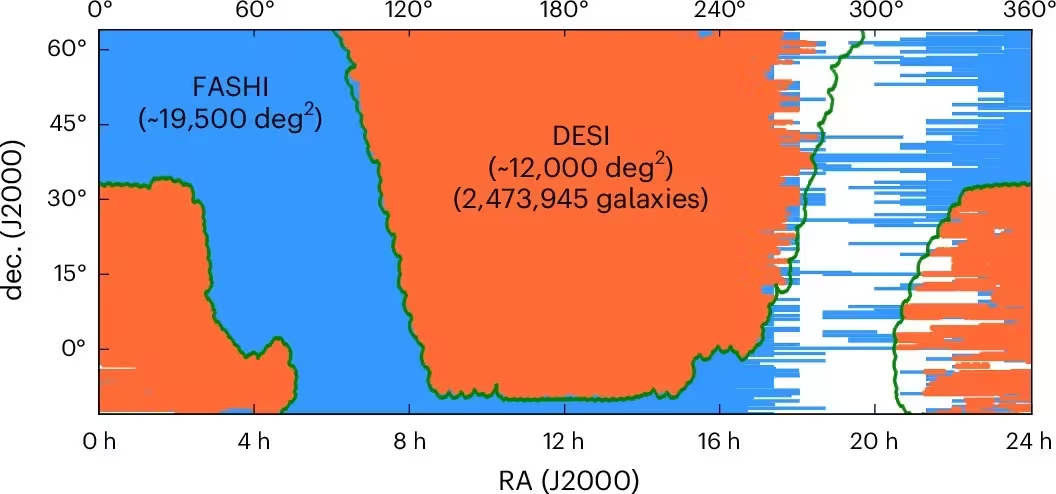
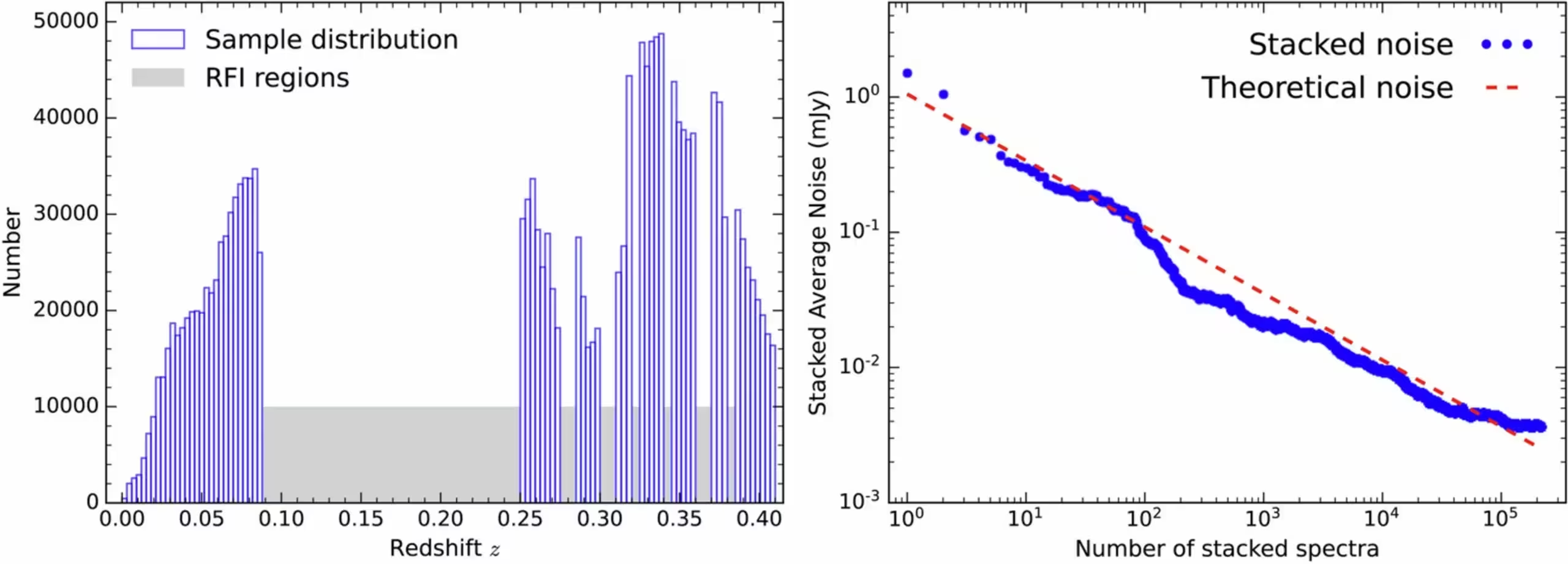
To overcome this, the research team combined the immense sensitivity of the FAST All-Sky H I survey with the highly accurate distance data from the DESI Bright Galaxy Survey. By stacking the spectral data of nearly 2.5 million galaxies, the team was able to cancel out background noise and extract a clear, aggregate signal of hydrogen density spanning the last 4.5 billion years.
The numbers present a stark contrast: while star formation rates dropped by a factor of 2.46, the density of atomic hydrogen declined by only 1.12 to 1.35, depending on the correction methods used. This suggests that the scarcity of atomic gas is not the bottleneck preventing the formation of new stars.
The Bottleneck Between Gas and Stars
If the raw ingredients are still present, why has the “kitchen” stopped cooking? The answer likely lies in the transition from atomic hydrogen to its denser cousin, molecular hydrogen. Stars do not form directly from atomic gas; they require a phase change into molecular clouds, a process governed by complex local dynamics like disk pressure, turbulence, and metallicity.
The research suggests that the slowdown in star formation is likely occurring “downstream.” As the growth of cosmic structures has decelerated, the flow of fresh material into galaxies may have waned, leading to a reduced throughput of gas into the star-forming molecular phase. Effectively, galaxies are still holding onto their atomic hydrogen, but they are struggling to convert it into the dense, cold clouds required to ignite new stellar nurseries.
New Targets for Galactic Simulations
These findings provide a rigorous benchmark for theorists modeling the evolution of the universe. Existing models, such as IllustrisTNG and SIMBA, now face the challenge of explaining how galaxies can maintain steady reservoirs of atomic gas while simultaneously experiencing a sharp decline in molecular hydrogen and stellar output.
This discovery reframes our understanding of galactic life cycles. Rather than being a simple tale of depletion, the history of the universe is one of efficiency and transformation. The gas is still there, lingering in the dark; the universe has simply lost the momentum needed to turn that vast, diffuse supply into the brilliant light of new suns.
Further Reading
- Cosmic CO and [C II] backgrounds and the fuelling of star formation over 12 Gyr (Nature Astronomy, 2026)
- The H I mass function of the Local Universe: Combining measurements from HIPASS, ALFALFA, and FASHI (Astronomy & Astrophysics, 2025)
- Atomic hydrogen reservoirs in quiescent galaxies at z = 0.4 (Astronomy & Astrophysics, 2025)
- H I content at cosmic noon – a millimetre-wavelength perspective (Monthly Notices of the Royal Astronomical Society, 2024)
- The Cosmic Baryon and Metal Cycles (Annual Review of Astronomy and Astrophysics, 2020)
This article has been fact checked for accuracy, with information verified against reputable sources. Learn more about us and our editorial process.
Last reviewed on .
Article history
- Latest version
Reference(s)
- Zhang, Chuan-Peng. “Weak evolution of cosmic atomic hydrogen over the past 4.5 billion years - Nature Astronomy.”, September 1, 2026, pp. 1-13. Nature, doi: 10.1038/s41550-026-02965-9. <https://www.nature.com/articles/s41550-026-02965-9>.
- Zhang, Chuan-Peng. “The FAST all sky HI survey (FASHI): The first release of catalog.” arXiv.org, doi: 10.1007/s11433-023-2219-7. <https://arxiv.org/abs/2312.06097>.
- Chiang, Yi-Kuan. “Cosmic CO and [C II] backgrounds and the fuelling of star formation over 12 Gyr - Nature Astronomy.”, vol. 10, no. 5, pp. 742-752. Nature, doi: 10.1038/s41550-026-02798-6. <https://www.nature.com/articles/s41550-026-02798-6>.
- Ma, Wenlin., et al. “The H I mass function of the Local Universe: Combining measurements from HIPASS, ALFALFA, and FASHI.” Astronomy & Astrophysics, vol. 695, March 25, 2025, pp. A241 EDP Sciences, doi: 10.1051/0004-6361/202452976. <https://doi.org/10.1051/0004-6361/202452976>.
- Bianchetti, A.. “Atomic hydrogen reservoirs in quiescent galaxies at z = 0.4.” arXiv.org, doi: 10.1051/0004-6361/202556367. <https://arxiv.org/abs/2507.16917>.
- Messias, Hugo., et al. “H
i content at cosmic noon – a millimetre-wavelength perspective.” Monthly Notices of the Royal Astronomical Society, vol. 533, no. 4, July 27, 2024, pp. 3937-3956. Oxford University Press (OUP), doi: 10.1093/mnras/stae1807. <https://doi.org/10.1093/mnras/stae1807>. - Péroux, Céline., et al. “The Cosmic Baryon and Metal Cycles.” Annual Review of Astronomy and Astrophysics, vol. 58, no. 1, August 18, 2020, pp. 363-406. Annual Reviews, doi: 10.1146/annurev-astro-021820-120014. <https://doi.org/10.1146/annurev-astro-021820-120014>.
Cite this page:
- Posted by Aisha Ahmed