Webb Telescope Spots Massive Star Explosion From 11.7 Billion Years Ago
The James Webb Space Telescope has captured a distant supernova, offering new insights into how massive stars died in the early universe.
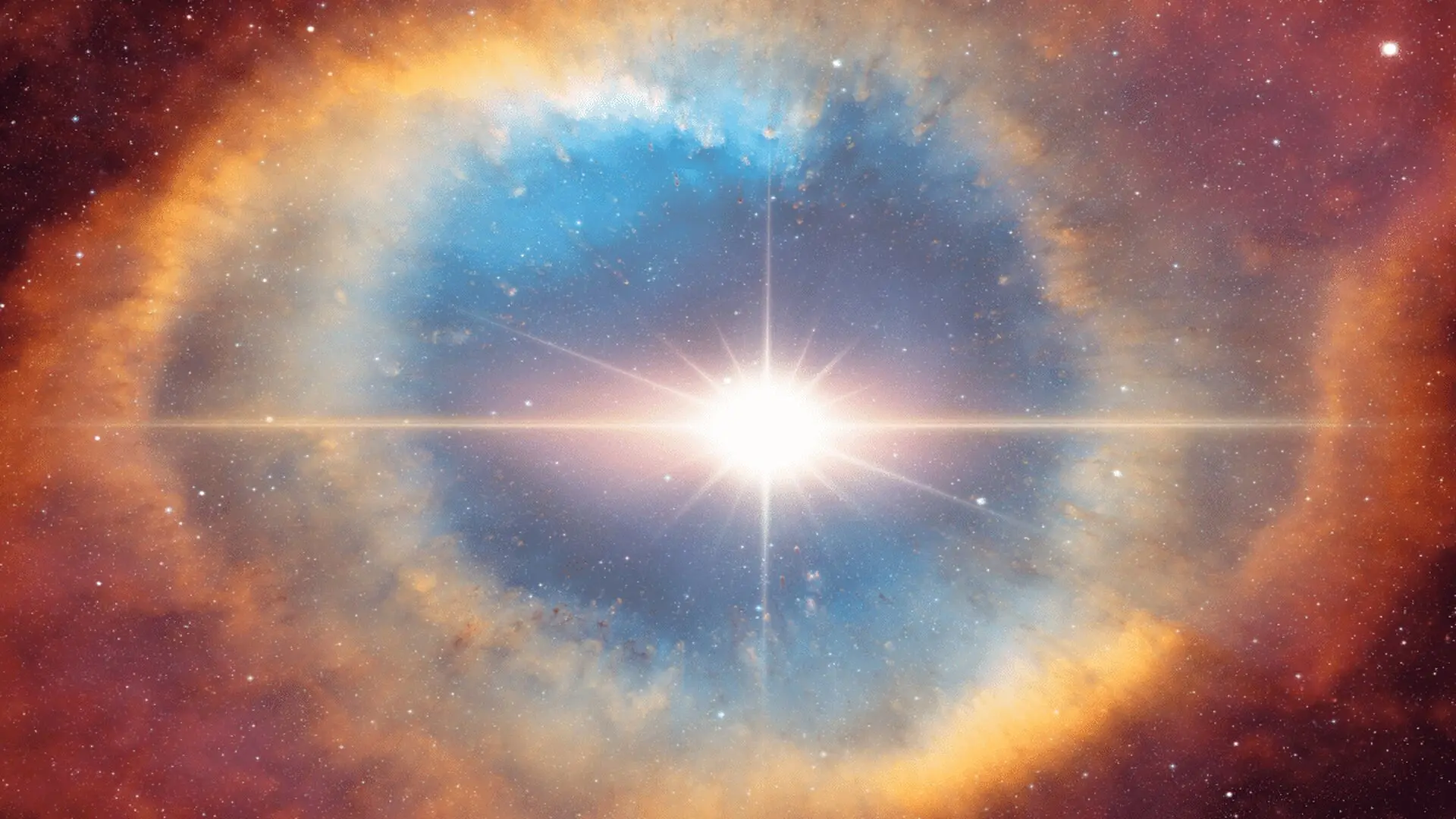
Astronomers have leveraged the unparalleled sensitivity of the James Webb Space Telescope (JWST) to detect one of the most distant supernova candidates ever documented. Identified as SN 2023aeaf, the event occurred approximately 11.7 billion years ago, placing it in an era when the universe was in its relative infancy, just 2 billion years after the Big Bang. The findings, published in The Astrophysical Journal, provide a rare glimpse into the mechanics of stellar death within the metal-poor environments of the early universe.
A Deep-Space Snapshot from the Cosmic Dawn
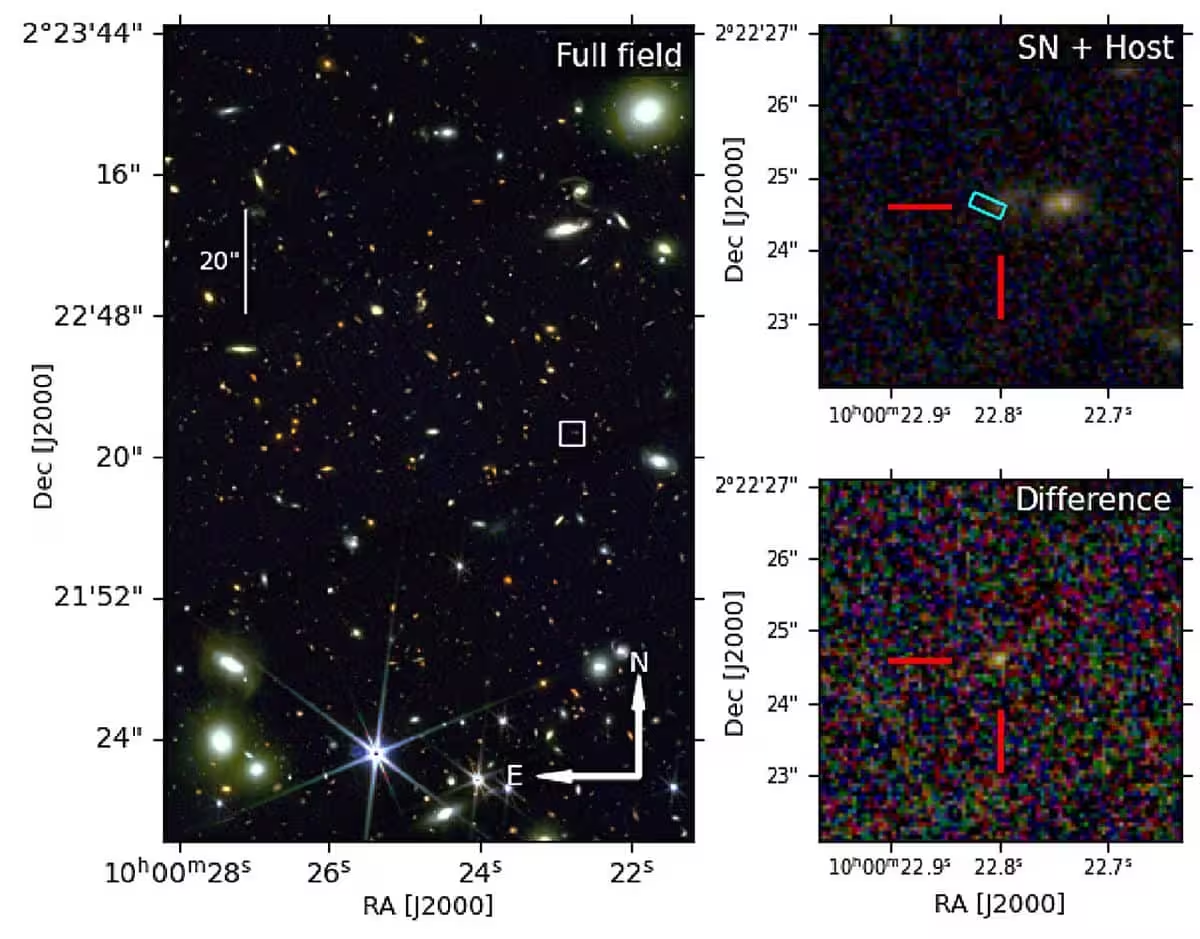
The discovery emerged from data collected during the COSMOS-Web survey, a comprehensive deep-imaging program designed to map the evolution of early galaxies. SN 2023aeaf was captured at a redshift of z = 3.195, a distance that necessitates the advanced infrared capabilities of JWST to resolve. By studying such remote explosions, researchers are able to better understand how massive stars—which act as the engines of galactic evolution—influenced the distribution of heavy elements and the trajectory of star formation during the universe’s formative stages.
Classifying a Primordial Explosion
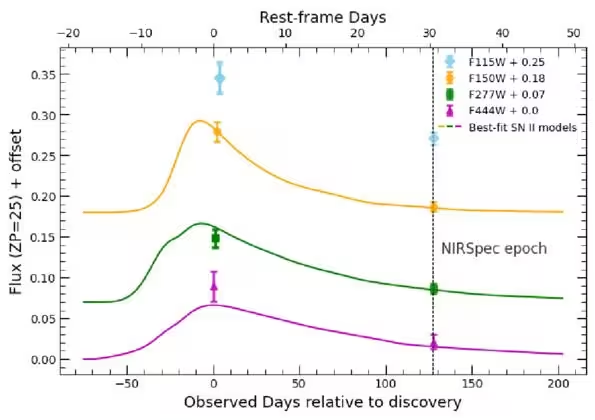
Led by Valeria Aparicio of the Institute for Astronomy at the University of Hawai‘i, the research team analyzed the light curve and color evolution of the transient to determine its classification. Comparisons with simulated supernova models suggest a 97.2% probability that SN 2023aeaf was a Type II supernova. This category typically signals the core collapse of a massive star that has managed to retain its hydrogen-rich outer layers until its final moments.
The host environment of the supernova is a small, rapidly forming dwarf galaxy. Given its status as a chemically young system, it serves as an ideal laboratory for investigating whether stellar death in the early, metal-poor universe differed significantly from the processes observed in our more mature cosmic neighborhood. As the team noted in their study, the host’s low-mass and metal-poor characteristics align perfectly with theoretical predictions for massive-star explosions occurring at a redshift of approximately 3.
Modeling the Final Moments
To reconstruct the final stages of the progenitor star, the researchers utilized the STELLA simulation software. The modeling revealed that the explosion was characterized by an unusually high initial temperature and a distinct blue light signature. The team posits that these features were likely the result of the supernova shock wave crashing into a dense shell of gas that the star had ejected shortly before its collapse.
Following this initial interaction, the light curve transitioned into a stable, cooler phase—often referred to as a plateau—which is a hallmark of Type II supernovae. Based on these simulations, the progenitor star is estimated to have been roughly 12 times the mass of our Sun, with about half a solar mass of material shed into the surrounding space just prior to the terminal explosion. While this single data point offers a vital bridge to understanding the ancient universe, astronomers note that expanding the sample size through future JWST observations will be essential to refining our models of stellar life cycles in the early cosmos.
This article has been fact checked for accuracy, with information verified against reputable sources. Learn more about us and our editorial process.
Last reviewed on .
Article history
- Latest version
Reference(s)
- Aparicio, Valeria., et al. “Analysis of a Type II Supernova Candidate at z = 3.19 from JWST’s COSMOS-Web Survey.” The Astrophysical Journal, vol. 1007, no. 2, August 13, 2026, pp. 133 American Astronomical Society, doi: 10.3847/1538-4357/ae884f. <https://iopscience.iop.org/article/10.3847/1538-4357/ae884f>.
Cite this page:
- Posted by Aisha Ahmed