Perseverance Just Captured A Rare Solar Eclipse That Reveals The Secrets Of The Martian Interior
NASA’s Perseverance rover has captured a rare solar eclipse as Phobos transits the Sun, turning the Martian event into vital new scientific data.
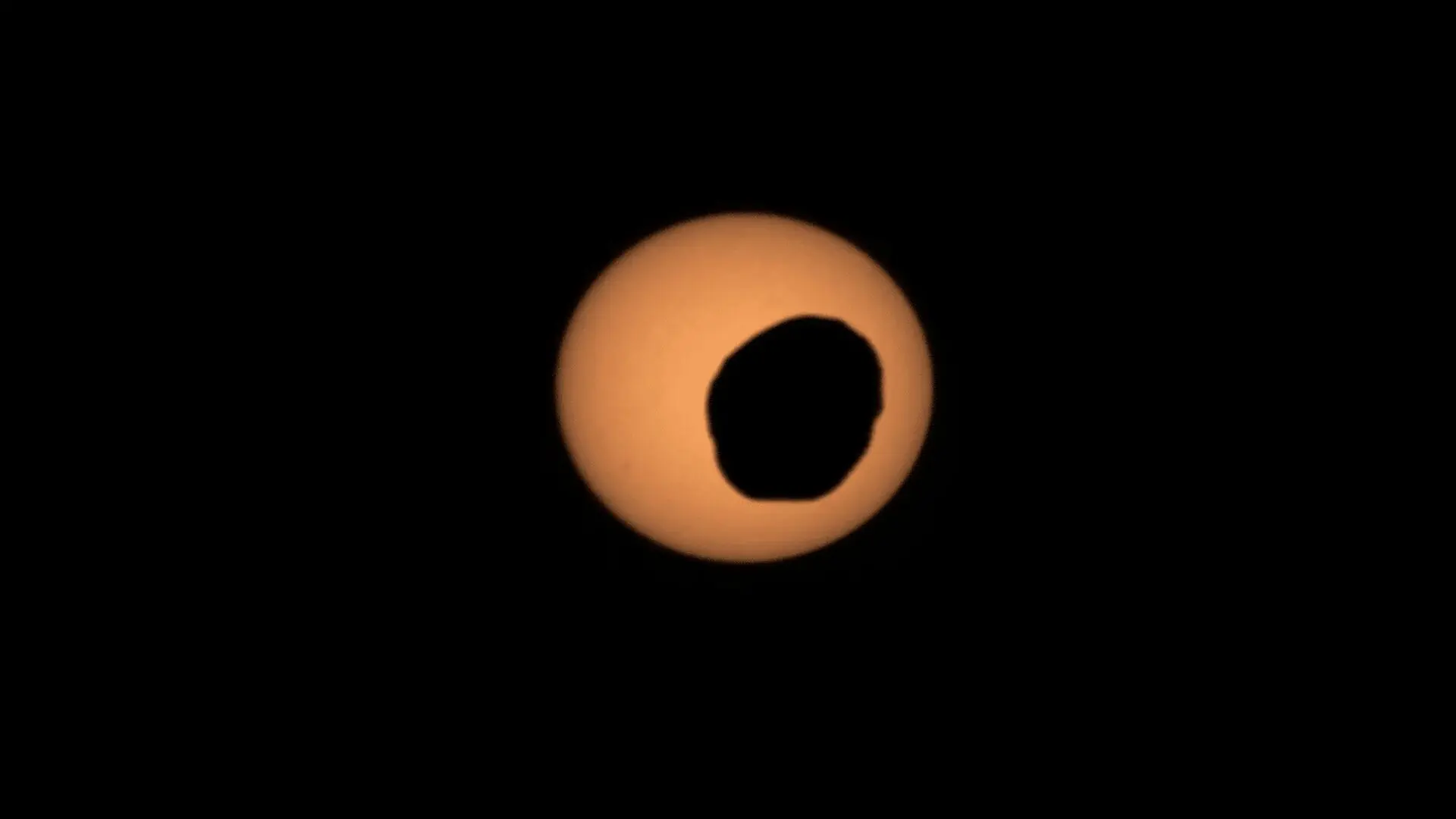
NASA’s Perseverance rover has successfully documented a rare solar transit, capturing the Martian moon Phobos as it crossed the face of the Sun. This observation, recorded on August 12, 2026, during the rover’s 1948th sol within Jezero Crater, provides more than just a striking celestial portrait; it serves as a critical data point for planetary scientists refining their understanding of the Red Planet’s interior and the orbital dynamics of its moons.
A Strategic View of Martian Eclipses
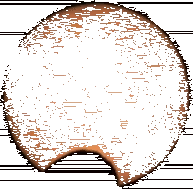
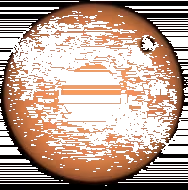
While the transit appears as a fleeting, misshapen annular eclipse, its scientific utility is significant. Unlike solar eclipses on Earth, the transit of Phobos is incomplete due to the moon’s irregular shape and relatively small size of roughly 22 kilometers. Because Phobos orbits at a low altitude—less than 6,000 kilometers above the surface—it traverses the solar disk in under a minute, completing an entire orbit in approximately 7 hours and 39 minutes.
The practice of monitoring these transits dates back to the Viking 1 mission in 1977, though modern rover technology, including the Mastcam-Z camera on Perseverance, has drastically increased the resolution and utility of the data. As noted by Universe Today, these events are now treated as essential astronomical experiments.
Engineering for Solar Precision
Capturing the Sun from the surface of Mars requires specialized equipment and stringent protocols. Perseverance utilizes its Mastcam-Z instrument, equipped with high-density solar filters, to prevent sensor damage. Mark Lemmon, a planetary scientist at the Space Science Institute, explained that these filters function similarly to eclipse glasses, allowing the rover to safely image the Sun while the moon passes in front of it. Beyond solar transits, the rover has been used to monitor sunsets, track the smaller moon Deimos, and even capture passing comets, showcasing the versatility of its remote sensing mast.
Mapping the Martian Interior
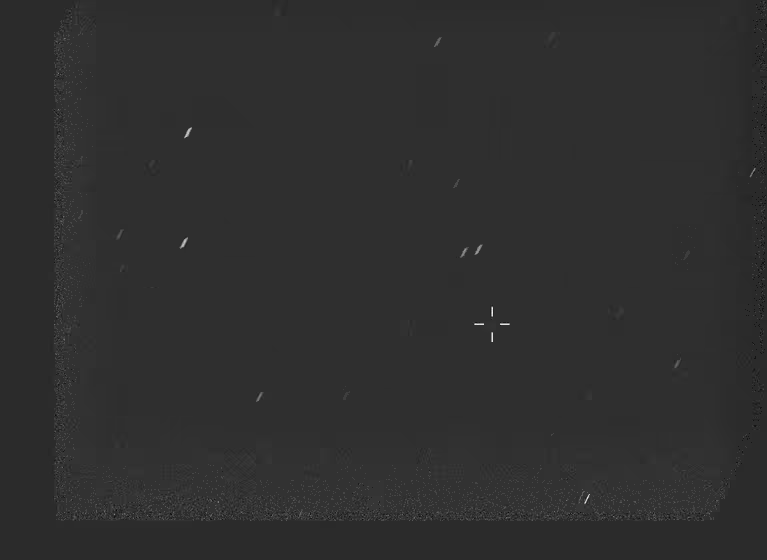
The primary scientific value of these transits lies in the extreme accuracy of the positioning data. By tracking Phobos with sub-100-meter precision during these events, researchers can significantly reduce uncertainty in the moon’s orbital path. According to Lemmon, these observations surpass the capabilities of Earth-based telescopes due to the rover’s proximity to the target.
“The major purpose is to use the orbital evolution as a probe of the Martian (and Phobos’) interior,” Lemmon explained. “Tides raised by Phobos on Mars cause the orbit to change; the changes probe the flexibility of the Martian mantle. This is why we keep doing it; we want a long time baseline of these high-quality measurements.”
This ongoing research, spanning decades from the Spirit and Opportunity era to current missions, allows scientists to better understand the tidal forces at play and the long-term structural evolution of the Mars-Phobos system.
Supporting Future Missions to the Moons
The accumulation of orbital data is increasingly vital for upcoming robotic exploration, most notably the JAXA/NASA Mars Moons Explorer (MMX) mission. Scheduled to launch in 2026, MMX aims to visit Phobos to gather surface samples for return to Earth by 2031. Accurate orbital models provided by Perseverance will be fundamental for navigating the spacecraft during its approach and sampling operations.
To further enhance these models, the research team is currently conducting a nighttime imaging campaign. By observing Phobos against background stars using varied exposure times, scientists can capture the parameters necessary to complete a full, six-dimensional description of the moon’s orbit. These coordinated efforts between surface rovers and future orbital missions represent the next phase of Martian exploration.
This article has been fact checked for accuracy, with information verified against reputable sources. Learn more about us and our editorial process.
Last reviewed on .
Article history
- Latest version
Reference(s)
- Dickinson, David. “Martian Astronomy: Percy Sees a ‘Phobos Eclipse’ From Mars.”, August 31, 2026 Universe Today <https://www.universetoday.com/articles/martian-astronomy-percy-sees-a-phobos-eclipse-from-mars>.
Cite this page:
- Posted by Aisha Ahmed