Milky Way Star Formation History Rewritten By Gaia White Dwarf Census
A new chemo-dynamical model reconciles a massive 81 percent discrepancy in galactic star counts by linking living stars to dead white dwarfs.
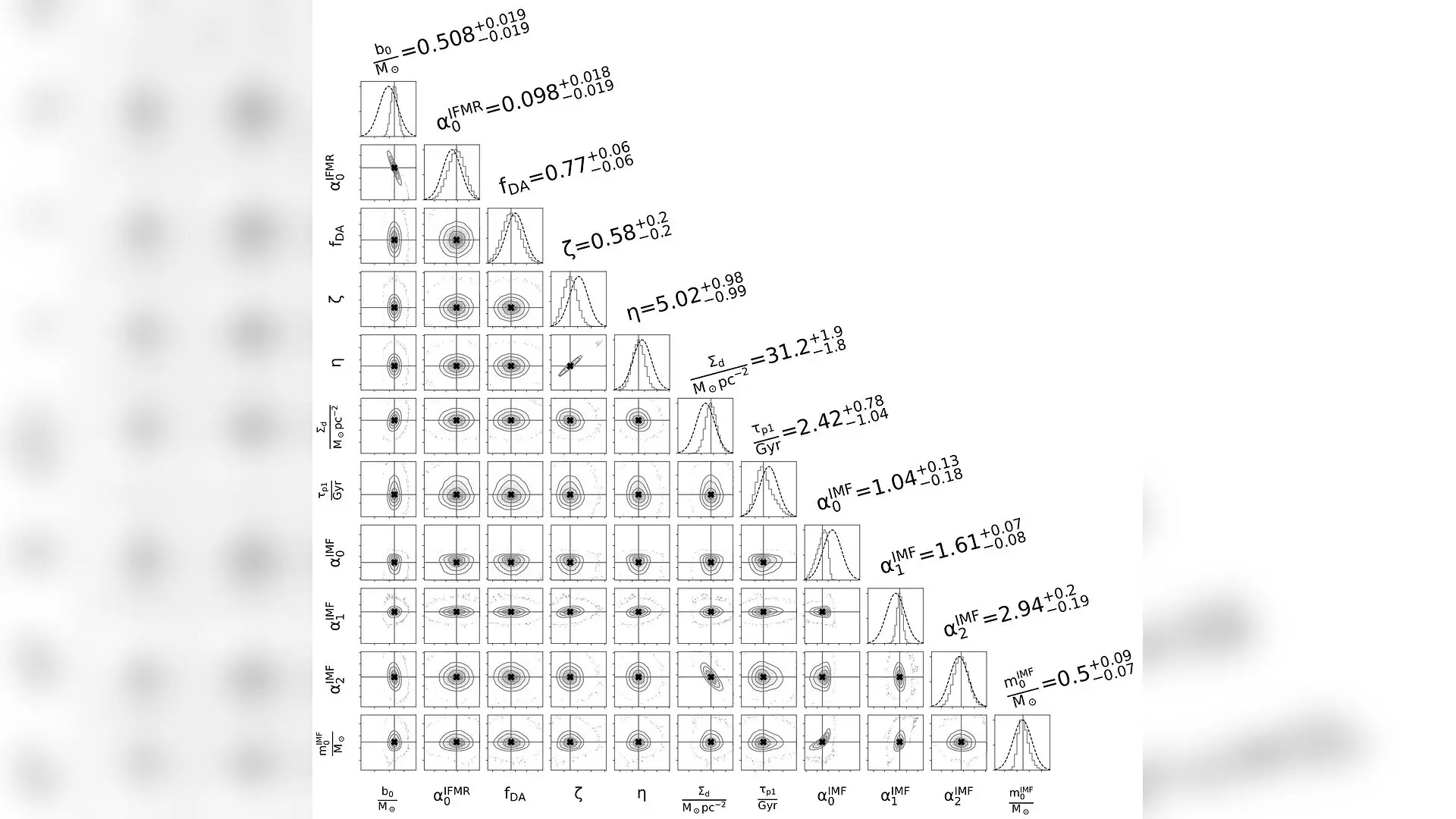
Astronomers have uncovered a major flaw in how we model the stellar graveyard of our galaxy, revealing that the Milky Way formed stars at a much faster rate in its ancient past than previously calculated. By analyzing roughly 1.1 million dead stellar remnants known as white dwarfs alongside nearly eight million living stars using data from the European Space Agency’s Gaia observatory, researchers resolved a stubborn discrepancy that had puzzled astrophysicists for years.
White dwarfs are the dense, cooling cores left behind after ordinary stars exhaust their nuclear fuel. Because nearly all stars with initial masses below roughly eight to eleven solar masses eventually become white dwarfs, these stellar remnants act as an archaeological fossil record of the Milky Way. Their cooling rates and masses encode the history of when stars were born and how they evolved. However, previous attempts to model these dead stars often isolated them from the rest of the galaxy’s living population, leading to massive overpredictions in star counts.
The new research, available on the arXiv preprint server, introduces a semi-analytic chemo-dynamical population synthesis framework named CALOMERA. Developed by researchers K. Sysoliatina and Akash Vani, the framework links the birth, evolution, and vertical distribution of both living stars and white dwarfs within a single self-consistent model of the Milky Way gravitational potential. When the team tested their updated model against the Gaia Data Release 3 catalog, the predicted white dwarf population count dropped from an 81 percent overprediction down to an error of just 0.5 percent.
What Does the New Star Formation Timeline Look Like?
The newly calibrated model paints a detailed picture of how star formation has unfolded across the history of the galaxy. The results indicate that the Milky Way experienced an intense phase of star production early in its history during the thick-disc phase, followed by an exponential decline toward the present day. This declining trend is punctuated by two recent bursts of accelerated star creation, one centered approximately 2.4 billion years ago and another more recent wave around 500 million years ago.
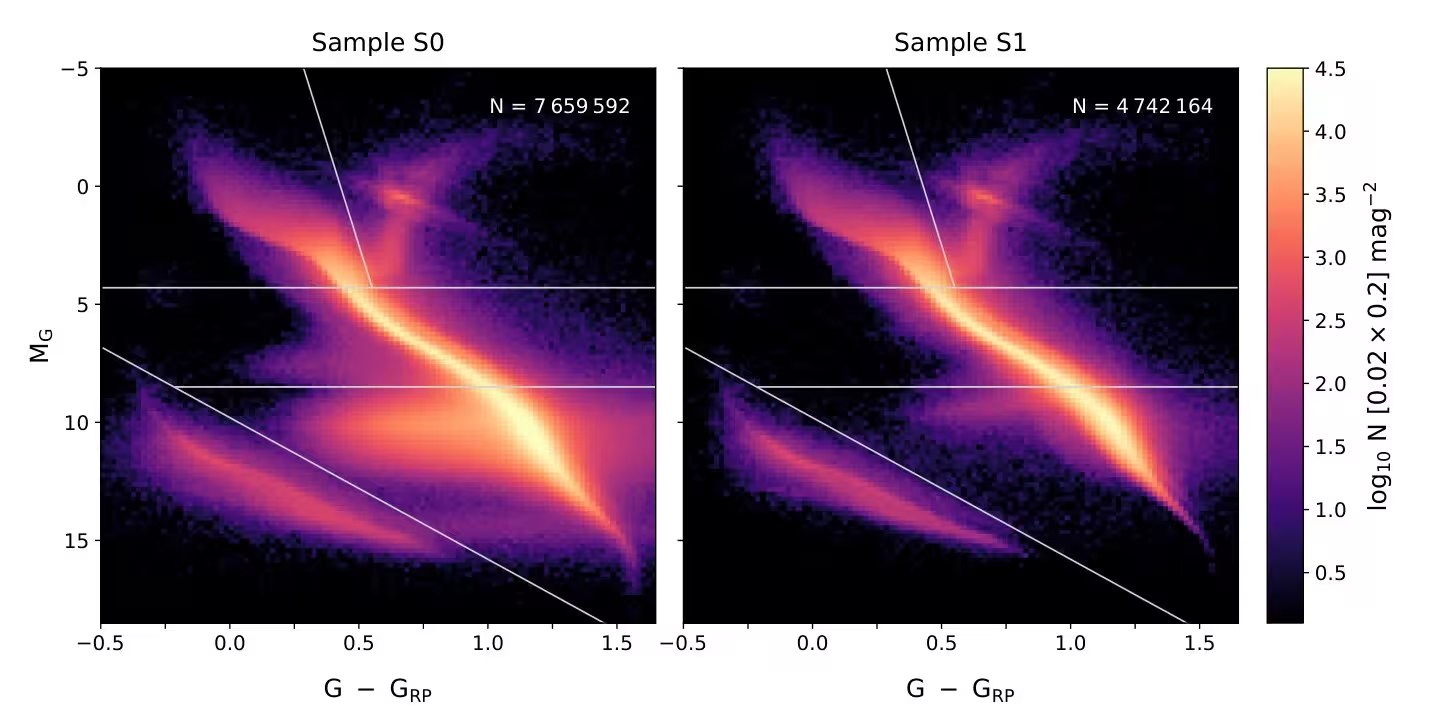
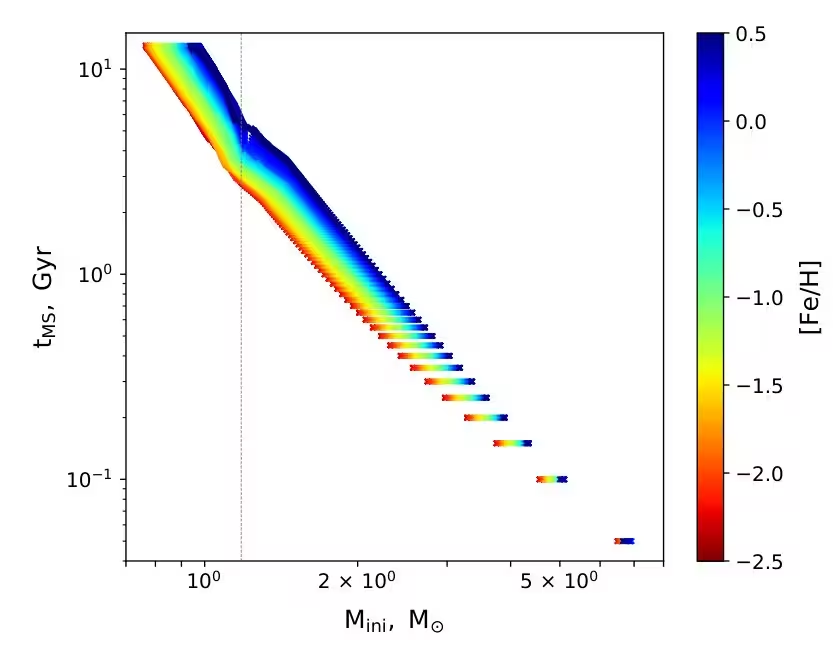
This declining history aligns more closely with recent reconstructions based on living main-sequence stars and red giants than with some previous white-fuel analyses that suggested a near-constant or rising star formation rate over billions of years. By forcing the mathematical model to account for both living stars and dead white dwarfs simultaneously under a single initial mass function and chemical evolution rule, the authors avoided the analytical traps that previously skewed white-dwarf-only studies.
How Do Progenitor Masses Shape the Galaxy?
A crucial component of the new framework involves the initial-final mass relation, which connects the birth mass of an ordinary star to the final mass of the white dwarf it leaves behind. The analysis suggests that low-mass progenitors experience less intense mass loss during their planetary nebula phase than some traditional models assumed, resulting in white dwarfs that are slightly heavier than expected at the low-mass end.
Furthermore, the researchers extended their framework beyond white dwarfs into the substellar regime, predicting the distribution of brown dwarfs across the Milky Way. Brown dwarfs are failed stars that lack the mass to sustain hydrogen fusion. Without any additional tuning of the model, the team’s predictions for local brown dwarfs within 25 parsecs matched existing censuses within 20 percent. The framework also estimated that nearly 100,000 brown dwarfs reside within a 100-parsec sphere around the Sun.
What Are the Implications for Deep Space Surveys?
These forward models provide critical benchmarks for planning future astronomical surveys. As next-generation instruments push deeper into space, understanding the foreground population of faint galactic objects becomes essential. For instance, the researchers calculated that Galactic brown dwarfs can mimic compact red sources in deep observations by telescopes like the James Webb Space Telescope, occasionally being mistaken for distant high-redshift galaxies.
The authors note that while the current model successfully bridges the gap between degenerate and non-degenerate stellar populations, certain limitations remain. The framework currently excludes binary star evolution and radial migration, where stars drift across different regions of the galactic disk over billions of years. Future enhancements incorporating three-dimensional kinematics and more sophisticated binary models will help astronomers refine our understanding of the Milky Way’s evolutionary past.
The study was posted to the arXiv preprint server on November 12, 2026.
This article has been fact checked for accuracy, with information verified against reputable sources. Learn more about us and our editorial process.
Last reviewed on .
Article history
- Latest version
Reference(s)
- Sysoliatina, K.. “The full Gaia colour-magnitude diagram with white dwarfs reveals a declining Milky Way star formation history.” arXiv.org <http://arxiv.org/abs/2611.17337v1>.
Cite this page:
- Posted by Aisha Ahmed