DNA Replication Timing Can Shatter Classical Cellular Limits
Mathematical modeling shows that coupling protein accumulation to gene duplication can sharpen cellular timing beyond traditional constraints.
Cells might use the precise timing of DNA replication to control biological events with unexpected accuracy, according to a mathematical study. Researchers have long known that cellular processes rely on regulatory proteins accumulating until they hit a specific threshold, a milestone traditionally limited by a fundamental counting constraint.
How DNA Duplication Beats Classical Noise Limits
Inside living cells, biochemical reactions like transcription and translation happen at random times, introducing cell-to-cell variability in molecule numbers. When cells time an event by accumulating a protein until it reaches a target threshold, the precision of that timing is typically governed by a classical formula known as the counting limit. For a stable protein produced at a constant rate, the squared coefficient of variation of the first-passage time equals the inverse of the threshold number of molecules.
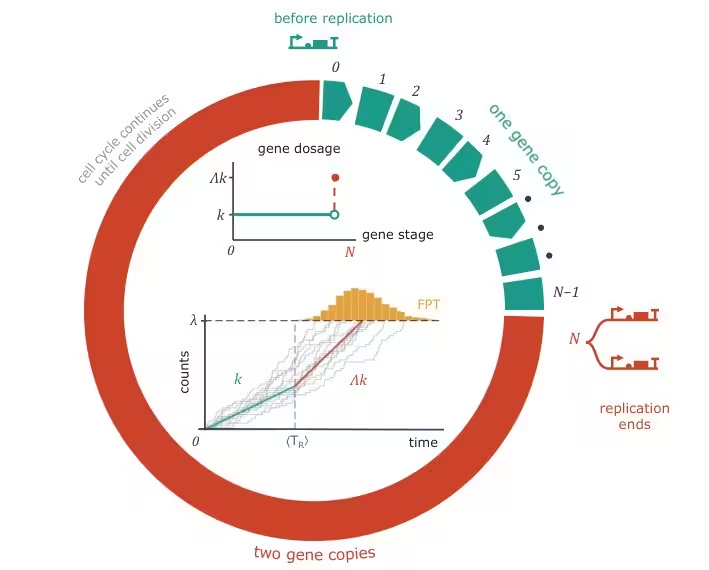
However, protein production rates are rarely constant across the entire cell cycle. When a gene replicates, its copy number doubles, which increases the effective protein production rate. Juan David Marmolejo-Lozano, Nikola Popović, and Ramon Grima published in the arXiv preprint server a stochastic model coupling DNA replication timing directly with protein accumulation.
Unlocking Optimal Replication Windows
The authors solved the chemical master equation for this coupled system and found that when a gene replicates at an optimal moment, timing precision can actually exceed the traditional counting limit. Instead of just acting as a passive template, DNA replication functions as a second, count-independent clock running alongside protein accumulation.
When replication timing is sufficiently regular and occurs at just the right point in the cell cycle, it compresses the duration of slower cellular trajectories. This dual-clock mechanism narrows down the distribution of times it takes to reach the target molecular threshold, effectively reducing noise below what molecular counting alone allows.
The Fine Line Between Precision and Amplification
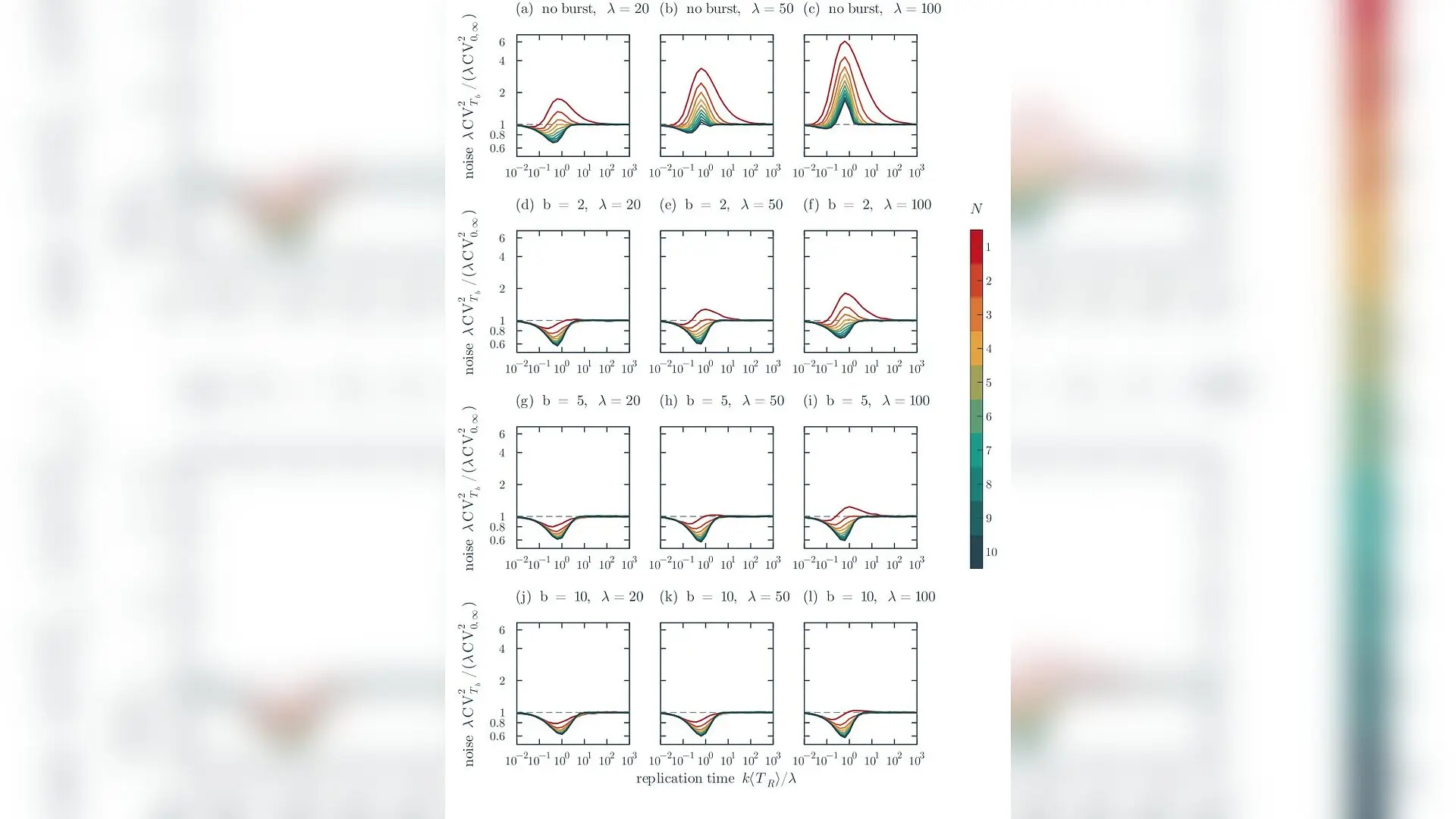
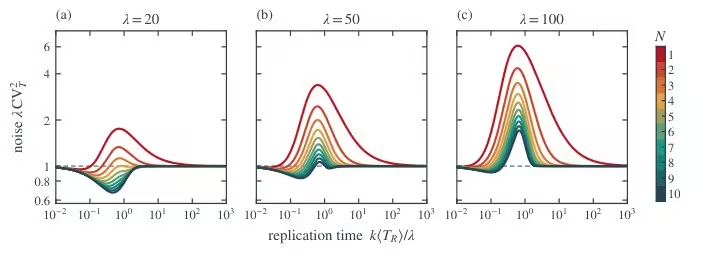
The mathematical analysis reveals that the outcome depends heavily on the reproducibility of replication timing and the gene dosage factor. If replication timing is imprecise or occurs too early with a very large dosage increase, the coupling mechanism can backfire and amplify timing noise well above the counting limit.
Under deterministic replication conditions, where replication timing has no variability, noise is strictly reduced rather than amplified. These theoretical insights suggest that chromosomal positioning and replication timing programs in eukaryotes and bacteria could serve as an evolutionary tuning knob to tightly coordinate or diversify cellular events across a population.
The study was posted to the arXiv preprint server on November 11, 2026.
This article has been fact checked for accuracy, with information verified against reputable sources. Learn more about us and our editorial process.
Last reviewed on .
Article history
- Latest version
Reference(s)
- Marmolejo-Lozano, Juan. “The impact of DNA replication on the timing of cellular events.” arXiv.org <http://arxiv.org/abs/2611.15356v1>.
Cite this page:
- Posted by Hassan Raza