Untrained Neural Networks May Not Match the Brain After All
A comprehensive re-analysis reveals that random computer models only mimic human visual cortex activity due to hidden mathematical choices.
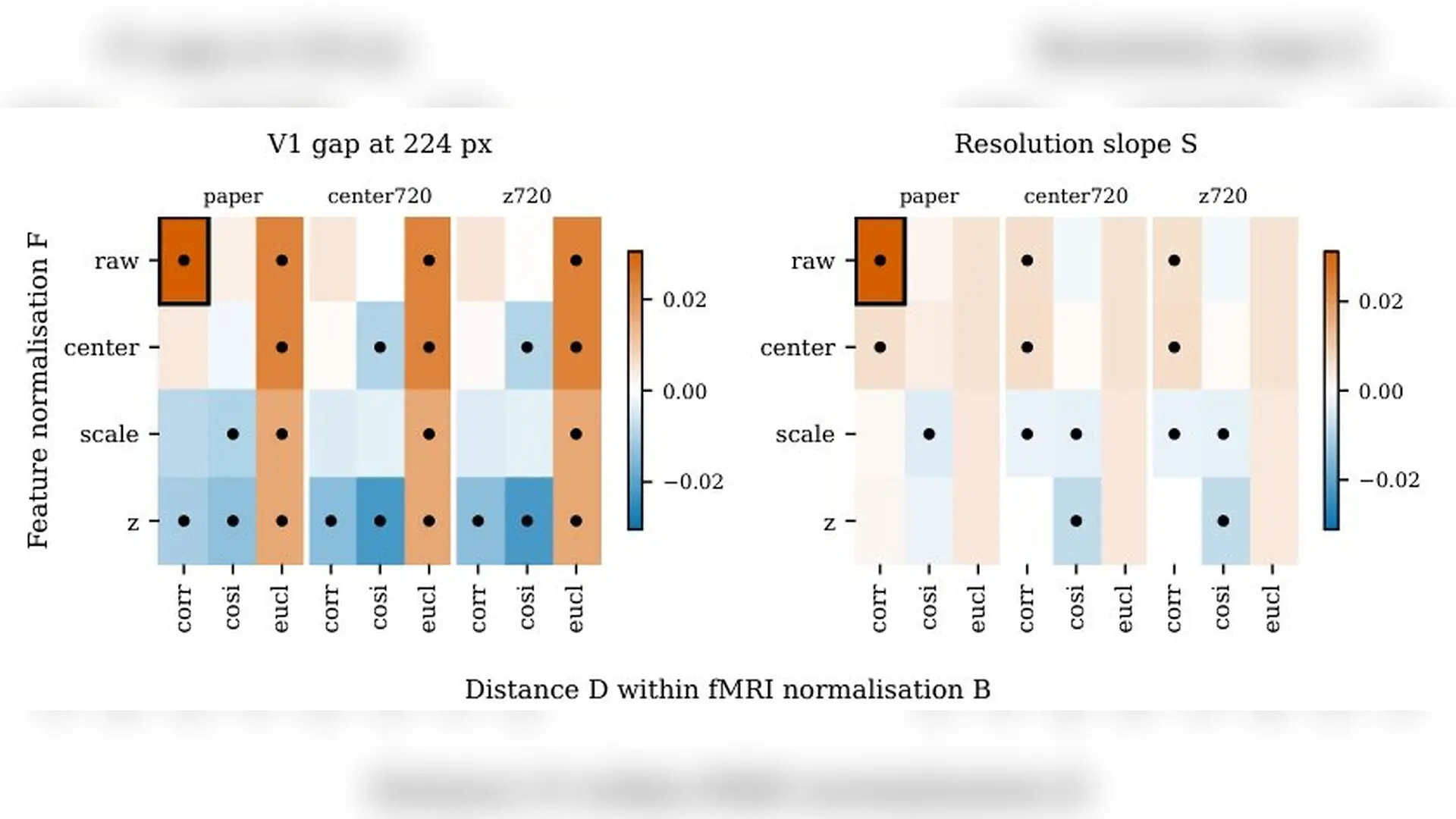
Untrained artificial neural networks with random weights can mimic the human visual cortex just as well as fully trained models, but a new study reveals that this surprising similarity depends almost entirely on hidden analysis choices rather than true brain-like processing. When researchers re-evaluated the data using different mathematical approaches, the apparent advantage of untrained networks vanished.
The findings, published in arXiv, revisit a contentious debate in neuroscience over whether the complex wiring of the brain’s visual processing regions requires rigorous learning or if basic visual architecture alone dictates how we perceive the world. Previous studies had reported that untrained convolutional networks, which are multi-layered computer vision algorithms, could rival or even surpass backpropagation-trained models when mapping activity in the primary visual cortex.
How Analysis Choices Alter Brain Comparisons
To test the robustness of these earlier claims, independent researcher Nils Leutenegger examined fMRI brain scan data from 3 human subjects viewing 720 distinct images from the THINGS-data set. The analysis focused on the primary visual cortex, known as V1, and a higher-level visual region called the lateral occipital complex, or LOC. Using representational similarity analysis, a statistical technique that compares how artificial models and human brains categorize different images, the author tested multiple combinations of data normalization and distance metrics across 36 distinct variations.
The results demonstrate that the previously observed superiority of untrained networks was an artifact of specific measurement conventions. When the researchers standardized model units by centring them over the stimulus set, the performance advantage of untrained networks disappeared. Furthermore, when applying a fitted ridge regression readout directly to the feature maps instead of using standard similarity comparisons, trained networks consistently outperformed their untrained counterparts across every tested grid resolution.
The Hidden Influence of Mean Profiles
To understand why different methods yielded opposite conclusions, the study decomposed the neural response patterns into separate components. The analysis revealed that traditional correlation-distance metrics were heavily influenced by a shared profile of unit means, which acts as a gain-like quantity rather than true structural alignment. When this mean-profile component was mathematically removed, leaving only the orthogonal remainder of the activation patterns, the untrained network advantage at V1 evaporated completely.
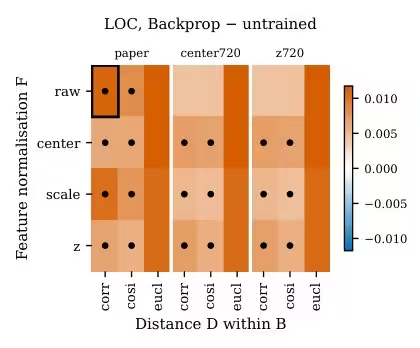
Additional tests involving simple stimulus baselines showed that a basic luminance-and-contrast bank predicted V1 voxel responses better than any tested network model, whether trained or untrained. These baseline models underscore the challenge of isolating true neural learning mechanisms from basic low-level visual properties captured by brain imaging scans.
Limitations and Future Benchmarking
While the study provides a comprehensive re-evaluation, the author notes several important limitations. The dataset comprised only three human subjects, and the analysis did not measure population-level variations across diverse observers. Additionally, absolute correlation scores for the predictive models remained low, and several pre-stated exploratory predictions were not met, meaning that some component interactions remain unresolved.
Ultimately, the work suggests that brain-alignment scores are measurements defined by specific evaluation procedures rather than intrinsic properties of the models themselves. The author recommends that future computational neuroscience research explicitly report sensitivity to centring methods, separate norm and angular components, and incorporate simple stimulus baselines to ensure reliable comparisons between artificial intelligence and biological vision.
The study was posted to the arXiv preprint server on November 11, 2026.
This article has been fact checked for accuracy, with information verified against reputable sources. Learn more about us and our editorial process.
Last reviewed on .
Article history
- Latest version
Reference(s)
- Leutenegger, Nils. “Analysis choices decide whether untrained networks beat trained ones at V1: a multiverse analysis of model-brain RSA.” arXiv.org <http://arxiv.org/abs/2611.15533v1>.
Cite this page:
- Posted by Hassan Raza