Nearby Rocky Exoplanet Unmasked by Space Telescope Reveals Limits of Planetary Atmospheres
Thermal emission data from nearby terrestrial worlds test the boundaries of planetary survival around red dwarf stars.
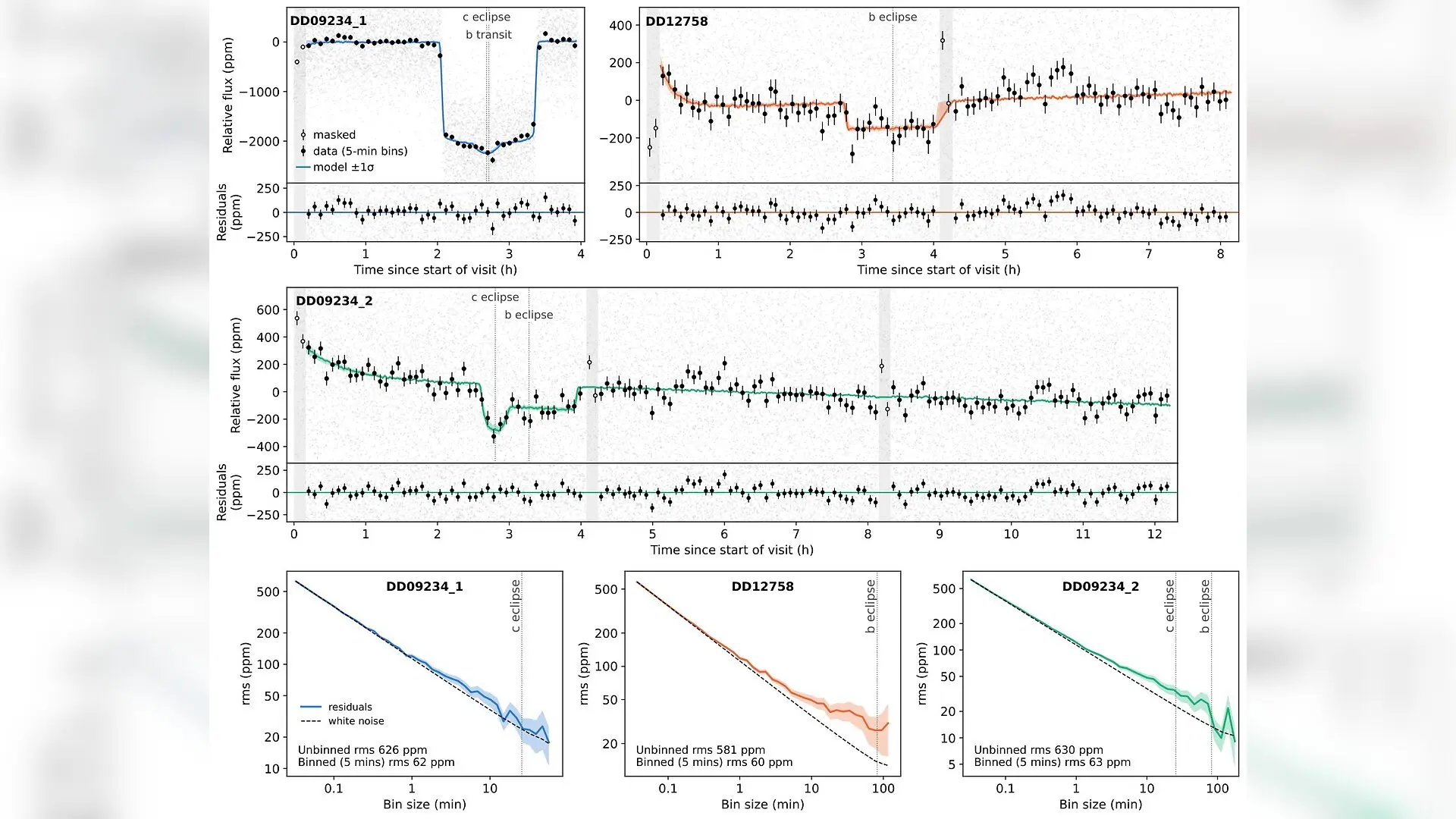
A rocky exoplanet orbiting just 6.9 light-years away has been unmasked by the James Webb Space Telescope, revealing that it lacks a substantial atmosphere and lives up to the theoretical boundaries of planetary survival.
The target, known as LTT 1445 A b, sits closer to the predicted Cosmic Shoreline than any other rocky world examined in secondary eclipse to date. Researchers analyzed high-precision thermal emission data to determine whether the terrestrial sibling can hold onto an insulating blanket of gas against the intense radiation of its host star.
An international team of scientists evaluated observations gathered by the space telescope’s Mid-Infrared Instrument, known as MIRI, operating at a wavelength of 15 microns. The findings were available on the arXiv preprint server, detailing measurements across multiple eclipses alongside archival transit and radial velocity data.
What Did the Thermal Emission Measurements Reveal?
When the planet passed behind its host star, the telescope measured the thermal glow radiating directly from its dayside hemisphere. The resulting eclipse depth of 157 parts per million corresponds to a brightness temperature of roughly 528 Kelvin.
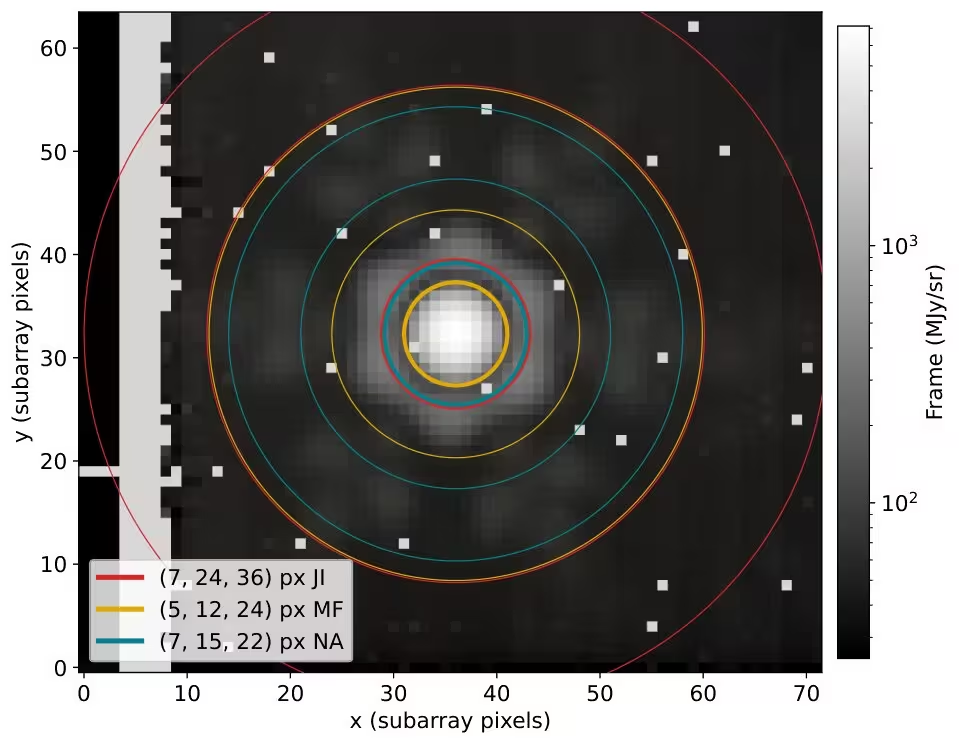
This temperature matches the limit expected for a dark, bare rock devoid of thick atmospheric insulation. The absence of a heat-redistributing blanket means the dayside bakes while the nightside remains locked in shadow, characteristic of tidally locked worlds orbiting close to their parent stars.
Subsequent climate-constrained computer models tested various atmospheric compositions against the observational data. The analysis restricted carbon dioxide partial pressures to less than 0.6 millibars and total surface pressure to under 0.1 bar.
How Does This Shape Our Understanding of the Cosmic Shoreline?
The Cosmic Shoreline is a theoretical dividing line used by astronomers to categorize rocky planets that retain atmospheres from those stripped away by stellar winds and high-energy ultraviolet radiation. LTT 1445 A b orbits an M-type red dwarf star, experiencing a harsh irradiation environment that typically strips away primordial envelopes.
Because this world resides very close to the theoretical boundary on the dry, airless side, its confirmed lack of a substantial atmosphere provides crucial calibration. The results suggest that the true separating line cannot lie much further toward the airless domain than previously calculated by planetary evolution models.
What Complicates the Neighboring Planet’s Data?
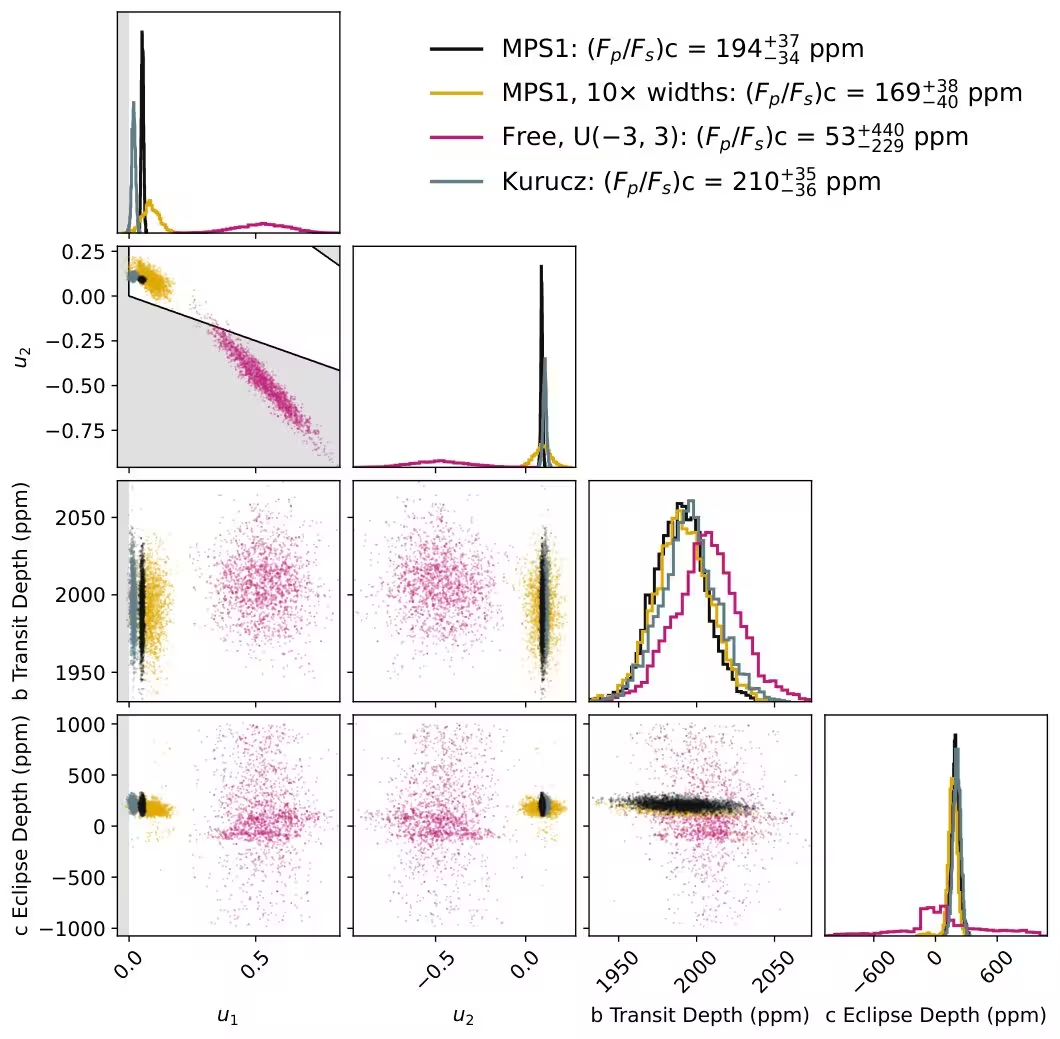
The system features a second transiting rocky sibling designated as LTT 1445 A c, which shares a compact orbital arrangement with planet b. However, interpreting the MIRI observations for the inner companion proved significantly more challenging due to a grazing eclipse geometry.
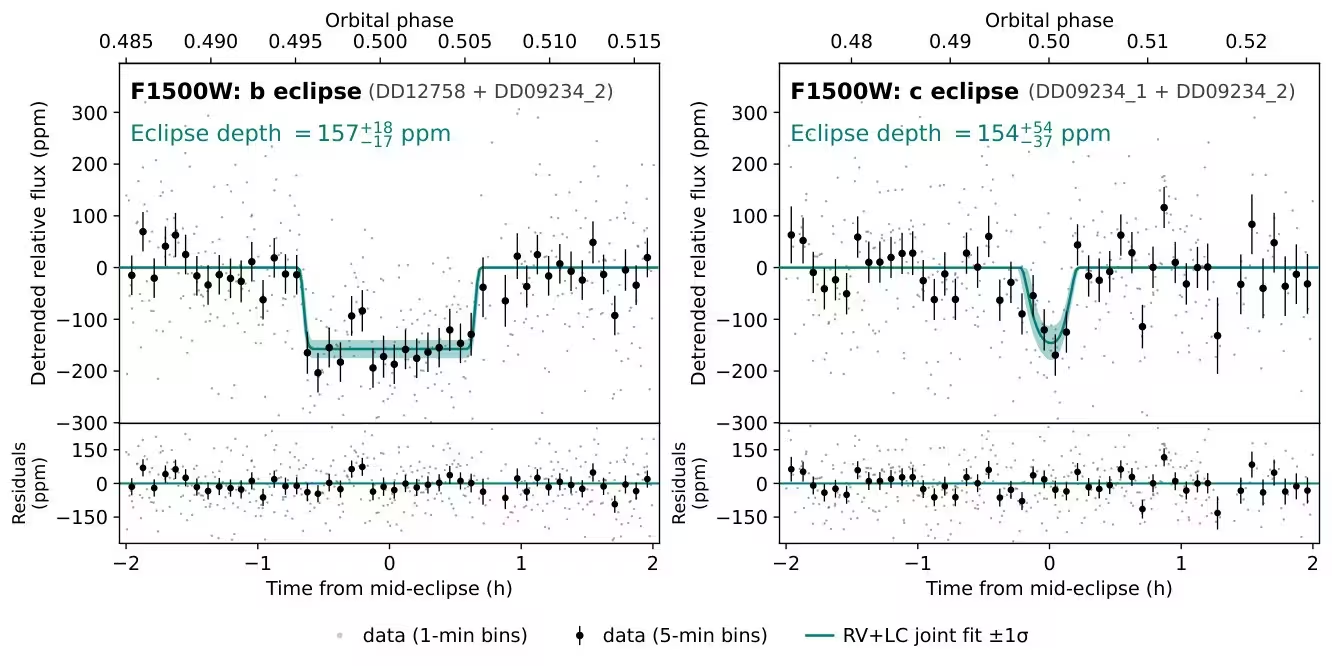
The overlapping orbital events and grazing alignment created large uncertainties in the eclipse depth for planet c. While the data successfully rule out thick, carbon-dioxide-dominated Venus-like atmospheres, they leave open the possibility of thinner, transparent gases or various bare rock surfaces.
The researchers note that future observing strategies will need to account for instrumental settling behaviors observed during filter changes and exposure breaks. Understanding these minor detector ramps ensures that future thermal emission measurements of nearby terrestrial worlds achieve the precision required to test planetary survival theories further across the galaxy.
The study was posted to the arXiv preprint server on November 12, 2026.
This article has been fact checked for accuracy, with information verified against reputable sources. Learn more about us and our editorial process.
Last reviewed on .
Article history
- Latest version
Reference(s)
- Ih, Jegug. “JWST Rocky Worlds DDT Observations of LTT 1445 A b and c in Secondary Eclipse Using MIRI/F1500W.” arXiv.org <http://arxiv.org/abs/2611.17300v1>.
Cite this page:
- Posted by John Williams