Chandra Reveals Cosmic Particle Accelerator Hidden Inside Ancient Stellar Explosion
NASA’s Chandra observatory has uncovered new details about how a pulsar-powered nebula within the CTA 1 supernova remnant accelerates particles to extremes.
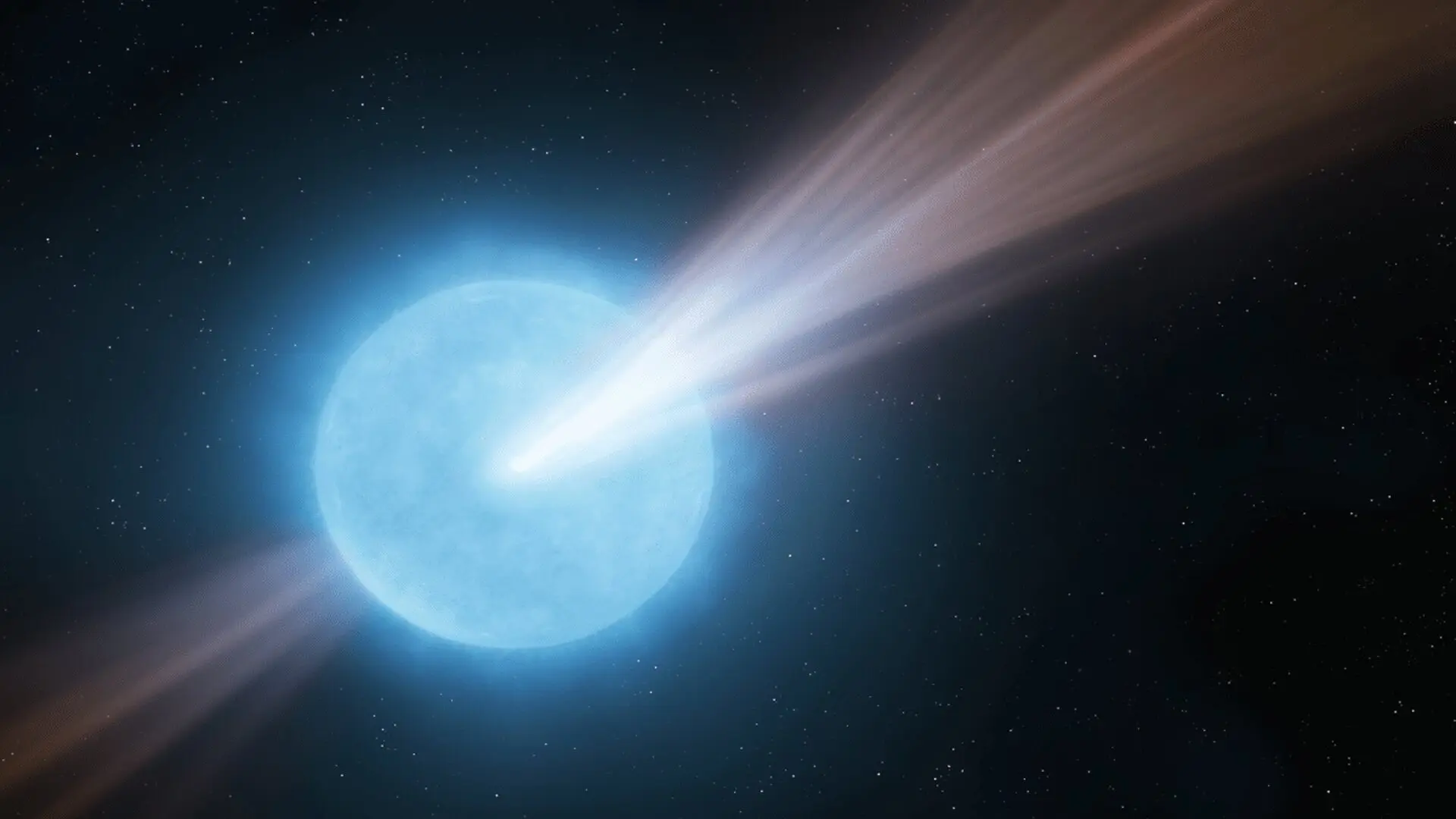
Astronomers have unveiled fresh insights into the high-energy environment surrounding the CTA 1 supernova remnant, revealing a compact pulsar wind nebula driven by a young, radio-quiet neutron star. New observations from NASA’s Chandra X-ray Observatory, detailed in a study recently published on arXiv, highlight the complex interplay between the pulsar PSR J0007+7303 and the remnants of its parent star, challenging existing models of how these energetic systems evolve.
Mapping the Architecture of a Cosmic Particle Accelerator
Located approximately 4,600 light-years from Earth, the CTA 1 remnant contains both an expansive shell and a central pulsar wind nebula (PWN). At the heart of this structure lies PSR J0007+7303, a rapidly spinning neutron star with a rotation period of 315.8 milliseconds and a powerful magnetic field measuring roughly 10 trillion Gauss. With an estimated age of about 14,000 years, the pulsar remains silent in radio wavelengths, making its high-energy X-ray and gamma-ray emissions the primary windows into its behavior.
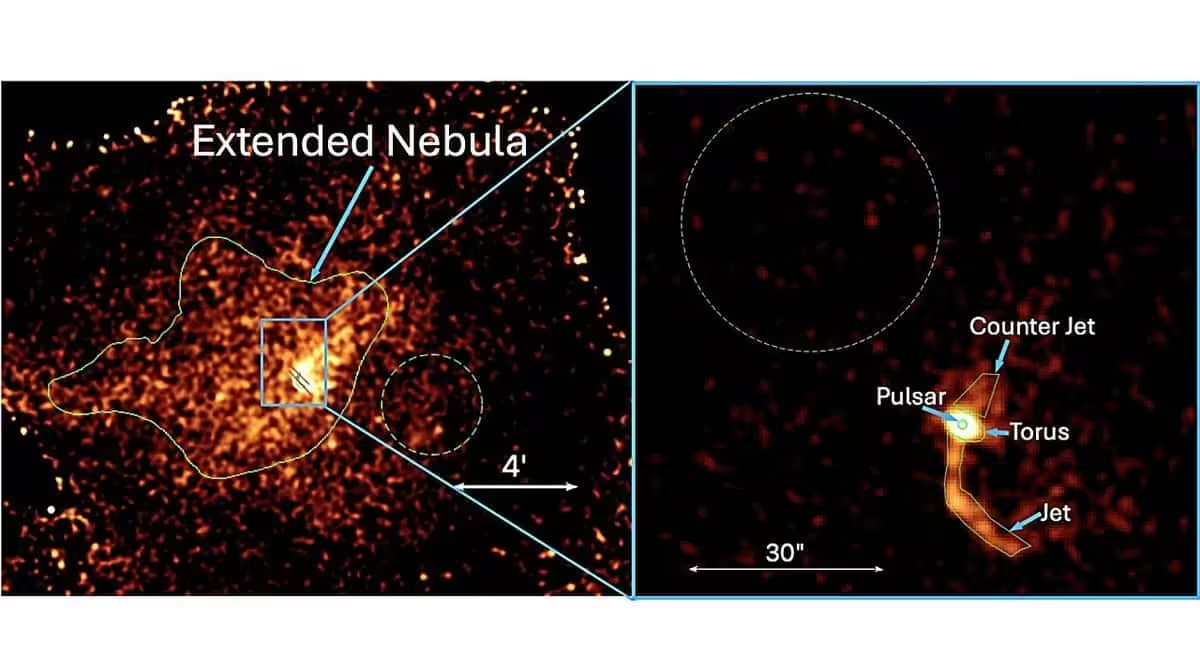
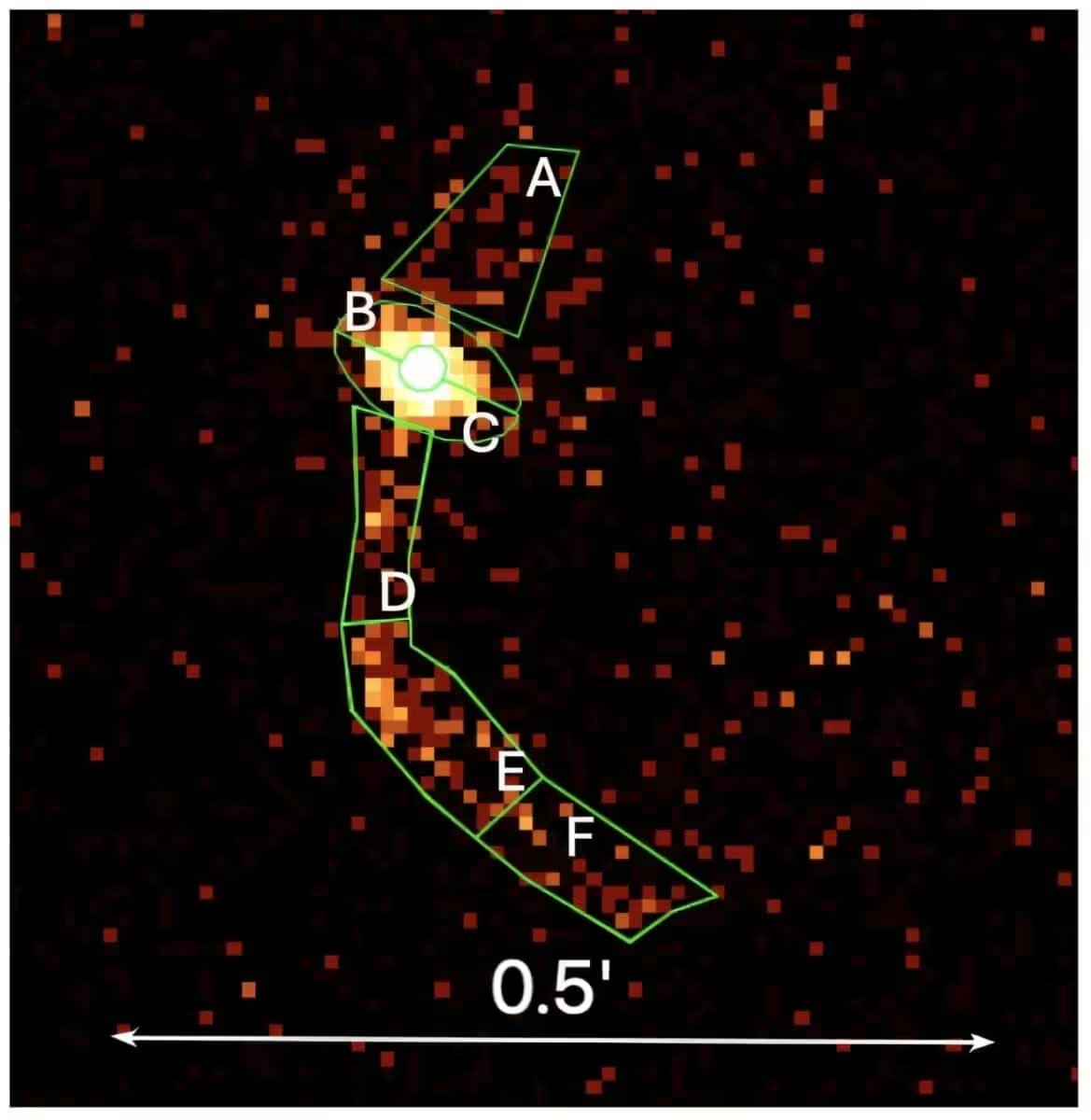
A research team led by scientists from George Washington University synthesized new and archival data from Chandra with insights from NASA’s Fermi Gamma-ray Space Telescope. This multi-wavelength approach allowed the researchers to construct a comprehensive model of the nebula’s structure, revealing distinct features including a prominent southern jet that curves toward the southwest, a fainter northern counter-jet, and a torus-like structure oriented nearly perpendicular to the jets.
Challenging Assumptions on Velocity and Age
The morphology of these jets suggests significant interaction with the surrounding interstellar medium, likely influenced by the supernova remnant’s reverse shock. These findings have also prompted a reevaluation of the pulsar’s movement. Contrary to earlier, higher velocity estimates based on the pulsar’s offset from the center of the remnant, the new analysis indicates a transverse velocity of less than 200 kilometers per second. This lower speed implies that either the CTA 1 remnant is older than previously believed or that the initial stellar explosion resulted in a highly asymmetric expansion.
PeV-Scale Acceleration in a Low-Magnetization Zone
Despite its relatively low X-ray radiative efficiency and a weak magnetic field measured between 1.4 and 3.2 microgauss, the nebula remains a potent particle accelerator. The study identified electron cutoff energies reaching 0.2 to 0.3 PeV, marking the system as a significant laboratory for studying particle acceleration near the PeV scale. This combination of low magnetization and high-energy output positions CTA 1 as a critical case study for understanding how young pulsars distribute energy into their local environments.
Future Prospects for High-Energy Astrophysics
As astronomers continue to refine the evolutionary timeline of PSR J0007+7303, CTA 1 stands out as a prime example of the dynamic processes following a supernova. By acting as a natural testing ground for the interaction between magnetic fields and relativistic particles, the nebula offers a deeper look at the mechanisms that govern the lifecycle of neutron stars. Ongoing and future missions will likely continue to use this system to probe the limits of particle acceleration in the high-energy universe.
This article has been fact checked for accuracy, with information verified against reputable sources. Learn more about us and our editorial process.
Last reviewed on .
Article history
- Latest version
Reference(s)
- Gagnon, Seth. “Chandra X-ray Observations of the Pulsar Wind Nebula within CTA 1.” arXiv.org <https://arxiv.org/abs/2605.21278>.
Cite this page:
- Posted by Aisha Ahmed