Fast Radio Bursts Reveal How the Milky Way Traps Heavy Elements
Radio flashes from distant galaxies help astronomers weigh invisible metal reservoirs in the circumgalactic medium.
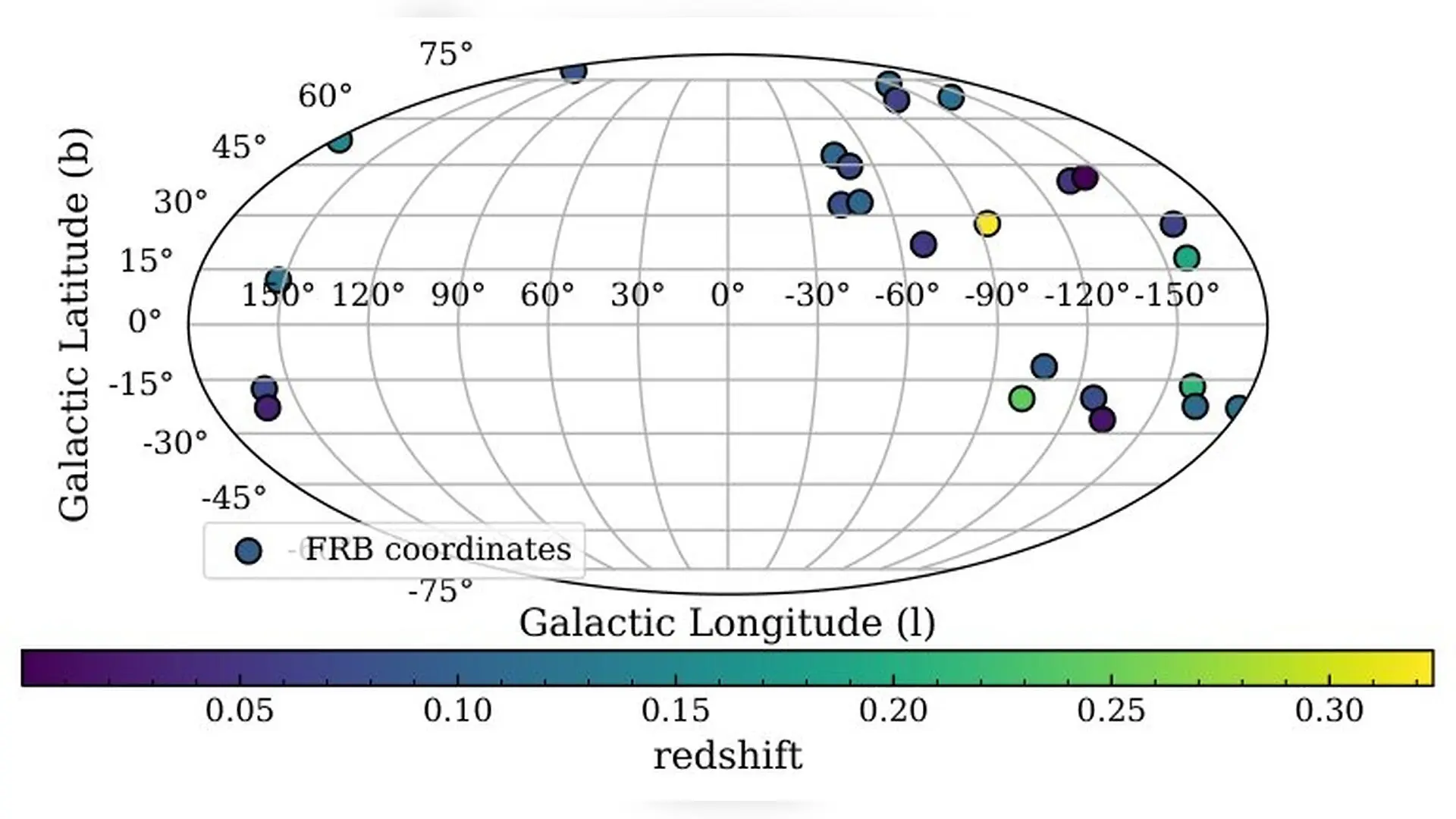
A team of astrophysicists has used signals from 25 fast radio bursts to peer into the invisible gaseous halo surrounding our home galaxy. The new technique reveals that the Milky Way effectively traps and recycles heavy elements rather than letting them escape into deep space.
How Fast Radio Bursts Map the Invisible Galactic Halo
The circumgalactic medium is a massive, diffuse envelope of gas that extends far beyond the bright spiral disk of the Milky Way. Acting as the ultimate interface for galactic recycling, this region is continuously refueled by cosmic gas flowing inward and metal-rich winds blowing outward from supernova explosions and active galactic nuclei. Mapping this halo has historically presented a major challenge because X-ray observations can detect high-temperature gas via oxygen absorption lines, but they cannot measure total hydrogen column densities along the exact same sightlines.
To bypass this roadblock, the researchers analyzed the dispersion measure of localized fast radio bursts, which are millisecond-duration flashes of radio waves originating from distant galaxies. Because these bursts travel minimal cosmic distances to reach Earth, their total dispersion measure is dominated by the Milky Way and the host galaxy halos rather than the intervening intergalactic medium. By comparing metallicity-dependent oxygen absorption estimates with metallicity-independent radio burst measurements, the authors report in a study published on the arXiv preprint server a direct way to calculate the chemical composition of the hot gas phase.
What the Derived Metallicity Ratios Reveal About Galactic Retention
The team tested three different models for the diffuse baryon fraction in the intergalactic medium, representing the proportion of cosmic matter residing outside galaxies. When assuming a zero intergalactic contribution, the median metallicity of the hot galactic halo stands at 0.12 times the solar value. Raising the diffuse baryon fraction to 0.6 and 0.8 yields median halo metallicities of 0.26 and 0.39 times the solar value, respectively.
However, the highest baryon fraction model leads to physically implausible super-solar metal abundances across several sightlines. The authors explain that standard stellar feedback mechanisms cannot naturally enrich the diffuse, low-density outer halo to several times solar abundance on global scales. Instead, these extreme values suggest that short radio burst sightlines intersect fewer intervening halos, causing cosmological models to over-correct the foreground subtraction.
Why Galactic Outflows Stay Trapped in the Milky Way
Even under conservative lower-bound estimates where the intergalactic contribution is set to zero, the inferred halo metallicity significantly exceeds the sparse enrichment expected from pristine infalling primordial gas. Pristine cosmic accretion typically exhibits a metallicity below 0.1 times the solar value. The elevated baseline measured across the sample provides empirical evidence that galactic feedback material is efficiently trapped within the dark matter halo.
Furthermore, the analysis uncovers substantial sightline-to-sightline variations in metal abundance across different regions of the sky. This spatial fluctuation indicates that the extended Milky Way halo is highly anisotropic and multi-phase rather than smooth and uniform. Complex interactions between feedback-driven galactic outflows and cosmic accretion shape this uneven distribution, confirming that the halo serves as a long-term reservoir for recycled baryonic material.
The study was posted to the arXiv preprint server on October 29, 2026.
This article has been fact checked for accuracy, with information verified against reputable sources. Learn more about us and our editorial process.
Last reviewed on .
Article history
- Latest version
Reference(s)
- Roy, Manami. “From Dispersion to Metallicity: Probing the Milky Way Circumgalactic Medium with Fast Radio Bursts.” arXiv.org <http://arxiv.org/abs/2610.40609v1>.
Cite this page:
- Posted by Aisha Ahmed