Hidden Black Hole Bubbles Might Completely Erase Their Own X-Ray Shadows
A tiny fraction of energetic particles can camouflage giant cosmic cavities in the early universe by shining brightly in X-rays.
Invisible bubbles carved by supermassive black holes in distant galaxy clusters might hide in plain sight because energetic particles inside them shine in X-rays. Researchers calculating how radiation interacts with the ancient cosmos have found that high-energy electron populations can completely fill the soft X-ray shadows normally used to spot these cosmic cavities.
Astronomers study supermassive black hole feedback by looking for dark, empty depressions in the hot gas of galaxy clusters, which mark where jets of plasma pushed the surrounding material aside. Measuring the volume and pressure of these cavities helps calculate the mechanical power injected by the black hole over cosmic time. However, pushing these searches to higher redshifts reveals a major complication involving the cosmic microwave background, the remnant heat left over from the Big Bang.
As researchers note in a study available on the arXiv preprint server, the ambient radiation field of the early universe is intense enough to both cool relativistic electrons and provide seed photons that trigger inverse-Compton X-ray emission. Because of this dual role, radiating particles inside a bubble can lose pressure while simultaneously generating enough internal X-rays to mask the thermal deficit of the cavity. Consequently, a bubble might remain mechanically powerful and energetically important even as its X-ray shadow fades away.
To understand this effect, the authors developed an analytical model that tracks electron cooling, bubble volume, enthalpy evolution, and X-ray visibility using a single accumulated cooling variable. They tested their framework against the high-redshift cluster SPT-CL J2215-3537, which sits at a redshift of 1.16, meaning its light took about 8.5 billion years to reach Earth. At this distance, the ambient radiation density is much higher than in nearby clusters, dramatically increasing the cooling rate of relativistic leptons.
How Tiny Particle Fractions Erase Giant Cosmic Cavities
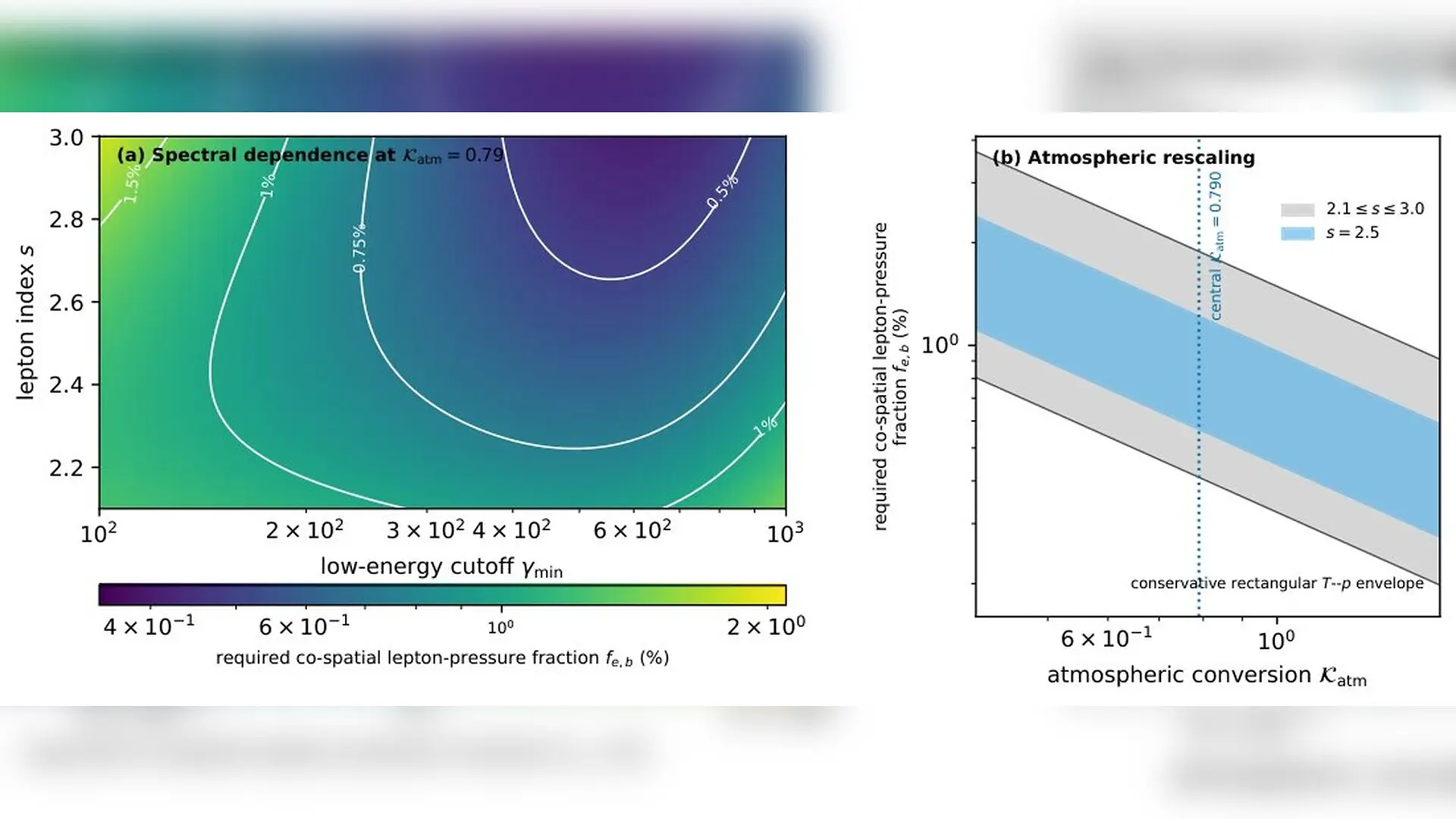
The calculations show that only a small fraction of the total bubble pressure needs to be carried by radiating electrons to completely wipe out the soft X-ray deficit. For uncooled electron populations with standard power-law energy distributions, the atmosphere of the testbed cluster requires just 0.6 to 1.2 percent of its pressure in radiating leptons to fill the soft-band gap entirely. Across the full range of tested spectral properties and atmospheric conditions, the required fraction spans from 0.2 to 3.7 percent.
This means a tiny population of energetic particles can effectively camouflage a massive cavity. Even if this radiating component experiences complete loss, the overall enthalpy, or total energy content of the bubble, drops by less than 3 percent compared to an identical adiabatic bubble at the same pressure. The team also discovered that the required fraction scales inversely with the fourth power of one plus the redshift, meaning black hole cavities in the early universe are much more susceptible to this X-ray filling effect.
Why X-Ray Shadows Can Fading and Reappear Over Time
The study went beyond instantaneous calculations to model how X-ray surface brightness evolves as a bubble ages after its jet turns off. Because the response of the X-ray band is broad, electrons with very high initial energies can cool down into the energy range that dominates the observed band before eventually fading below it. This creates a surprising non-monotonic evolution where the internal X-ray emission actually brightens during the early stages of cooling, even as the overall energy of the particles decreases.
Depending on the initial parameters and pressure history, this spectral shift can cause a cavity’s X-ray deficit to cross the detection threshold twice. In such scenarios, a cavity might start out visible, become completely hidden as internal X-rays fill the gap, and then become visible again later as the electrons cool further. The fractional enthalpy deficit during these recovery crossings remains below 0.4 percent, proving that a bubble’s X-ray visibility can change drastically while its mechanical energy remains nearly constant.
Uncertainties and What Lies Ahead for Cosmic Feedback Studies
The primary physical uncertainty identified by the authors lies in the poorly constrained low-energy spectrum of the electrons. When testing a control spectrum with a much lower energy cutoff, the required lepton pressure jumps to nearly 19 percent because most of that population’s energy lies below the soft X-ray response band.
The researchers emphasize that translating these theoretical thresholds into observational corrections will require detailed modeling of instrument responses, viewing angles, point spread functions, and background noise. Future surveys searching for distant black hole feedback must account for the fact that stronger inverse-Compton emission should be associated with weaker X-ray cavities. Failing to find this relationship could challenge current models of relativistic plasma, while confirming it will refine our understanding of how supermassive black holes regulate galaxy growth across cosmic history.
The study was posted to the arXiv preprint server on October 29, 2026.
This article has been fact checked for accuracy, with information verified against reputable sources. Learn more about us and our editorial process.
Last reviewed on .
Article history
- Latest version
Reference(s)
- Santra, Ramananda. “The Conditional CMB Visibility of High-Redshift X-Ray Cavities in Galaxy clusters.” arXiv.org <http://arxiv.org/abs/2610.40610v1>.
Cite this page:
- Posted by John Williams