Physicists Observe Continuous Confinement Transition in Quantum Magnet
A rare laboratory observation reveals how bosonic magnons transform into fermionic spinons, mimicking high-energy particle physics in a solid-state material.
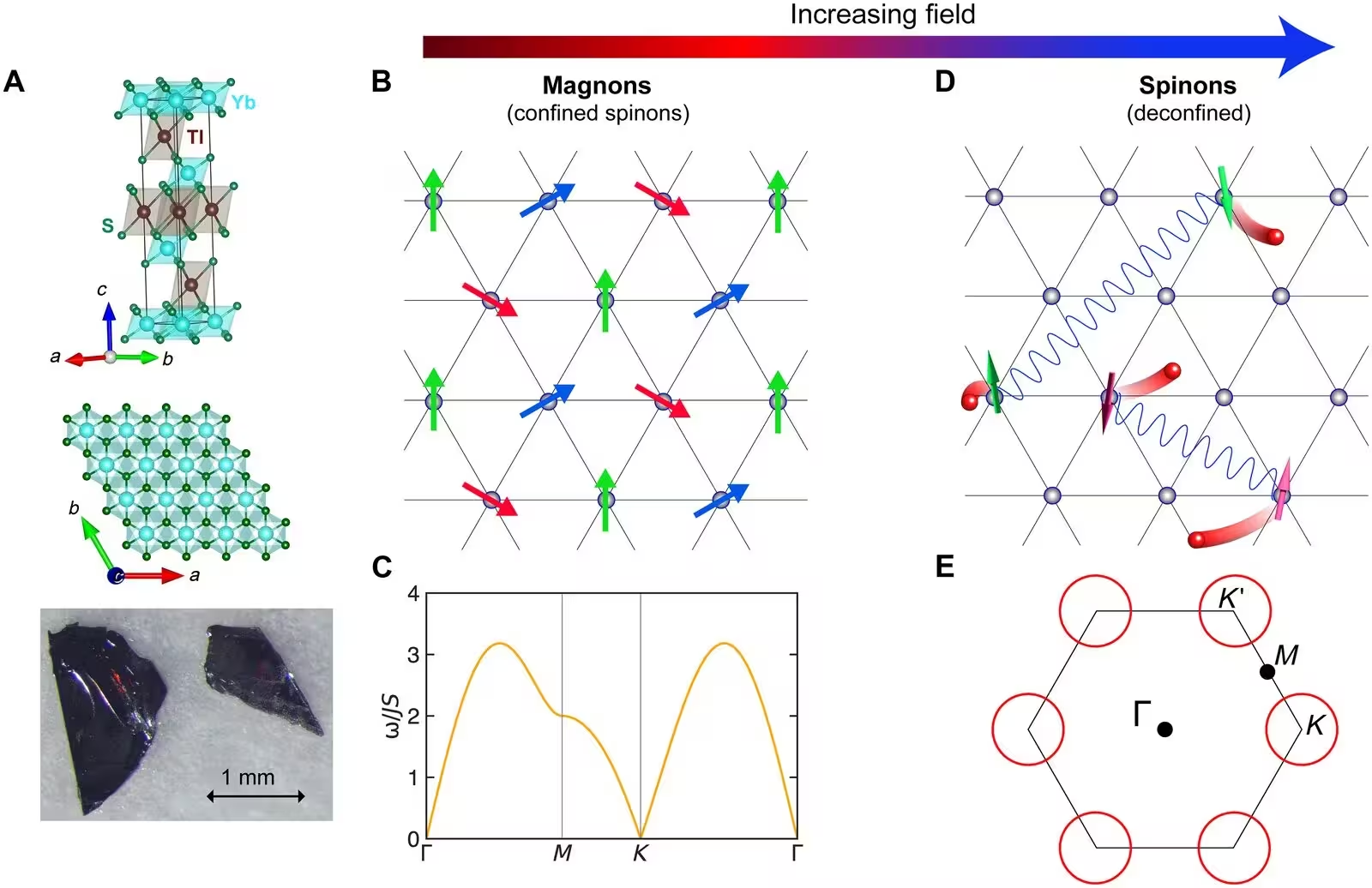
A continuous transition between quantum phases hosting distinct foundational excitations, specifically bosonic magnons versus fermionic spinons, has long remained a central goal in modern quantum magnetism. This phenomenon shares deep conceptual parallels with the confinement-deconfinement transition in quantum chromodynamics, where confined quarks and gluons break free into a quark-gluon plasma under extreme conditions. A team of international researchers has now reported experimental evidence for such a continuous transition occurring inside the triangular-lattice antiferromagnet thallium ytterbium disulfide (TlYbS2), marking a major step forward for condensed matter physics.
The detailed findings, published in Science Advances, illuminate how geometric frustration and strong quantum entanglement can prevent conventional magnetic ordering. In standard magnets, ordered magnetic moments support bosonic wave-like excitations known as magnons, which possess a spin of one. Theoretical frameworks dictate that these bosonic magnons can be viewed theoretically as bound states of pairs of underlying fermionic spinons. Unbinding these components corresponds directly to a confinement-deconfinement transition, yet observing this process continuously in a real material has historically proven exceptionally difficult.
Unraveling the Triangular Lattice Antiferromagnet
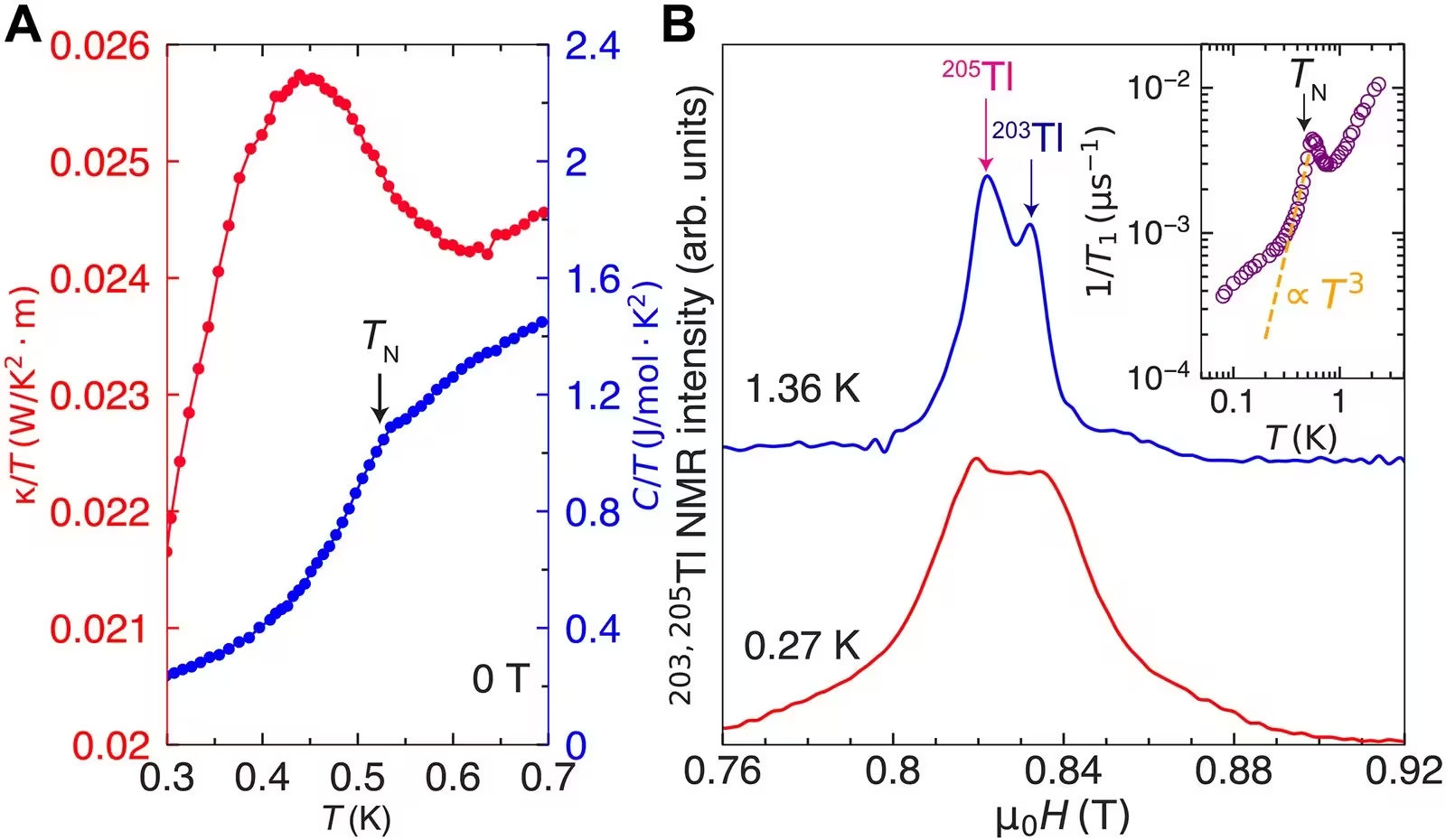
At zero magnetic field, TlYbS2 develops a stable antiferromagnetic order below a critical temperature of approximately 0.53 kelvin, featuring a characteristic 120-degree noncollinear magnetic arrangement across its undistorted triangular lattice of effective spin-1/2 ytterbium ions. However, because the system experiences intense geometric frustration, much of the magnetic entropy is already released well above this ordering temperature. When the scientists applied a magnetic field aligned along the crystallographic c-axis, this zero-field magnetic order was progressively suppressed.
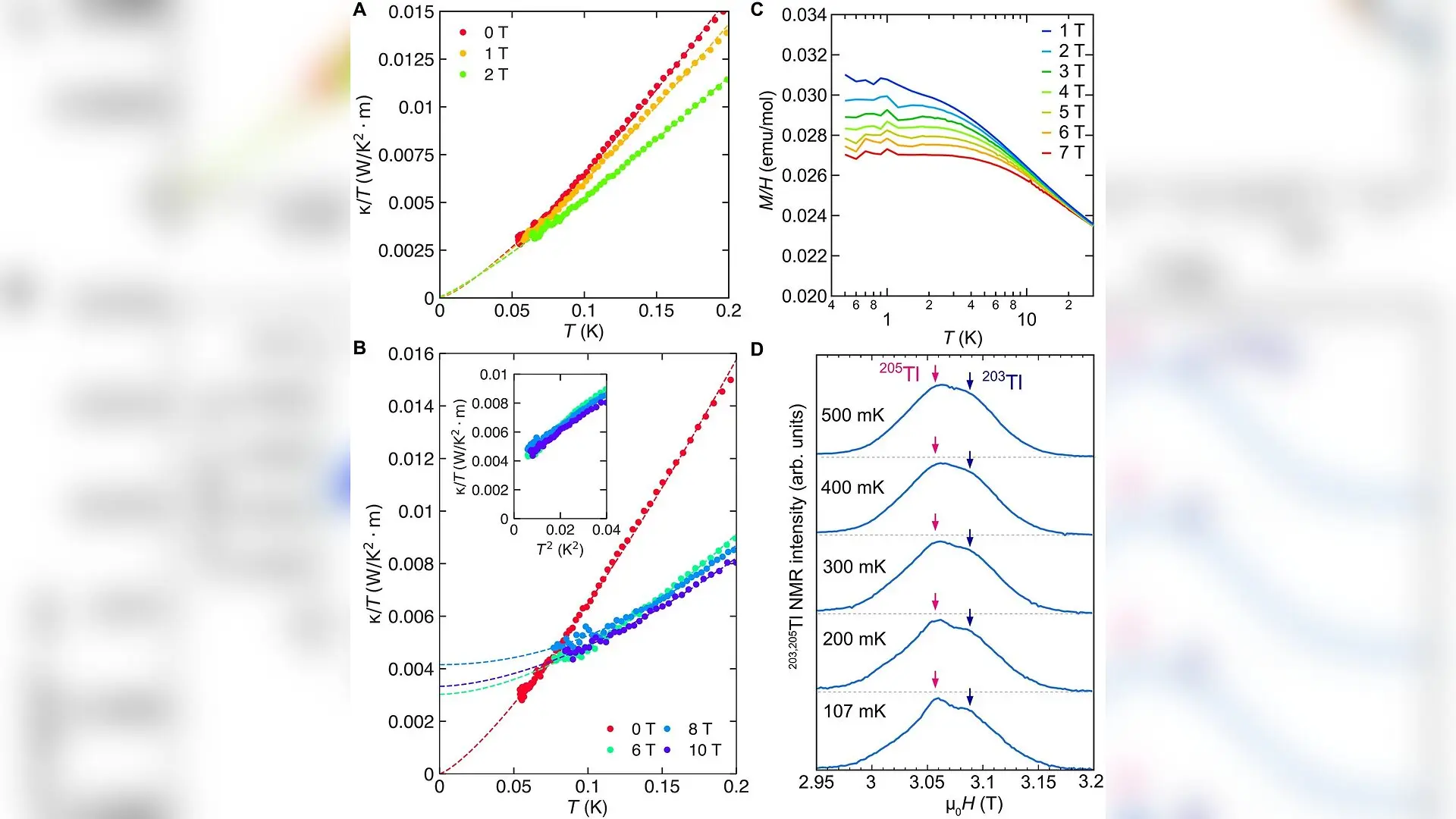
Through comprehensive measurements encompassing thermal conductivity, specific heat, magnetic susceptibility, and nuclear magnetic resonance (NMR), the investigators tracked the system as it crossed a critical magnetic field threshold of roughly 3 tesla. Below this critical point, thermal conductivity measurements yielded a vanishing residual linear term at zero temperature, entirely consistent with a conventional ordered state where bosonic excitations freeze out. Above the critical field, however, a finite residual linear term emerged cleanly, indicating the appearance of mobile, gapless itinerant excitations capable of carrying heat.
Probing the Spinon Fermi Surface
The emergence of these itinerant excitations signaled a dramatic shift from a spinon-insulating state to a deconfined quantum spin liquid phase hosting a spinon Fermi surface. To ensure these observations were intrinsic and independent of potential sample imperfections, the team verified their thermal transport signatures across multiple independently grown single crystals from different batches.
Furthermore, nuclear magnetic resonance measurements performed down to 107 millikelvin revealed no line broadening or splitting in the high-field phase, confirming the complete absence of static long-range magnetic order. The persistence of a temperature-independent, Pauli-like magnetic susceptibility and a constant NMR Knight shift throughout the high-field regime provided robust proof of a finite density of low-energy states, naturally explained by fermionic spinons behaving akin to electrons in a metal despite the lack of true conduction electrons.
Implications for Quantum Criticality
The transition observed in TlYbS2 diverges significantly from conventional magnetic quantum criticality governed by the standard Ginzburg-Landau paradigm. While thermodynamic quantities tied directly to the density of states showed smooth behavior across the boundary, transport properties sensitive to scattering rates exhibited pronounced enhancements. The researchers attribute this behavior to critical fluctuations of an emergent U(1) gauge field acting upon the deconfined spinons.
Because replicating confinement-deconfinement transitions in particle physics typically requires temperatures on the order of 10 to the 12th power kelvin, this solid-state realization opens up an accessible laboratory testbed. Future investigations will focus on mapping out the precise critical exponents and exploring whether higher magnetic fields eventually drive a reconfinement back into conventional quasiparticles.
The research was published in Science advances on October 23, 2026.
This article has been fact checked for accuracy, with information verified against reputable sources. Learn more about us and our editorial process.
Last reviewed on .
Article history
- Latest version
Reference(s)
- Hosoi, Suguru., et al. “A continuous confinement-deconfinement transition in a triangular quantum magnet.” Science Advances, vol. 12, no. 43, October 23, 2026 American Association for the Advancement of Science (AAAS), doi: 10.1126/sciadv.aej9484. <https://doi.org/10.1126/sciadv.aej9484>.
Cite this page:
- Posted by John Williams