Rigid Crystal Structures Unlock Amplified Spontaneous Emission in 2D Tin Perovskites
A structural comparison between mono- and ditopic alkylammonium tin perovskites demonstrates that enhanced lattice rigidity suppresses detrimental vibrations and achieves optical gain.
Two-dimensional metal halide perovskites have emerged as versatile semiconductors for advanced optoelectronic technologies, largely due to their solution processability and tunable luminescence. By modifying their constituent elements and organic components, scientists can tailor their optical and electronic behavior with high precision. While three-dimensional lead halide perovskites made early strides in demonstrating amplified spontaneous emission and optical lasing, translating this success to layered two-dimensional architectures has proven difficult. Issues concerning material stability against moisture, oxidation, and ionic diffusion, coupled with poor reproducibility in optical gain performance, have historically hindered development.
Recent investigations published in the Journal of the American Chemical Society reveal that tin-based two-dimensional perovskites offer superior properties for coherent light emission compared to their lead counterparts. Until now, achieving efficient amplified spontaneous emission in these materials typically required organic cations possessing aromatic rings with pi-stacked electron systems. These aromatic interactions were thought to provide the necessary structural rigidity to facilitate radiative recombination. However, a new study demonstrates that aliphatic, nonaromatic spacers can achieve similar or superior optical gain if the molecular geometry imposes sufficient structural stiffness through alternative bonding configurations.
Comparing Ruddlesden-Popper and Dion-Jacobson Architectures
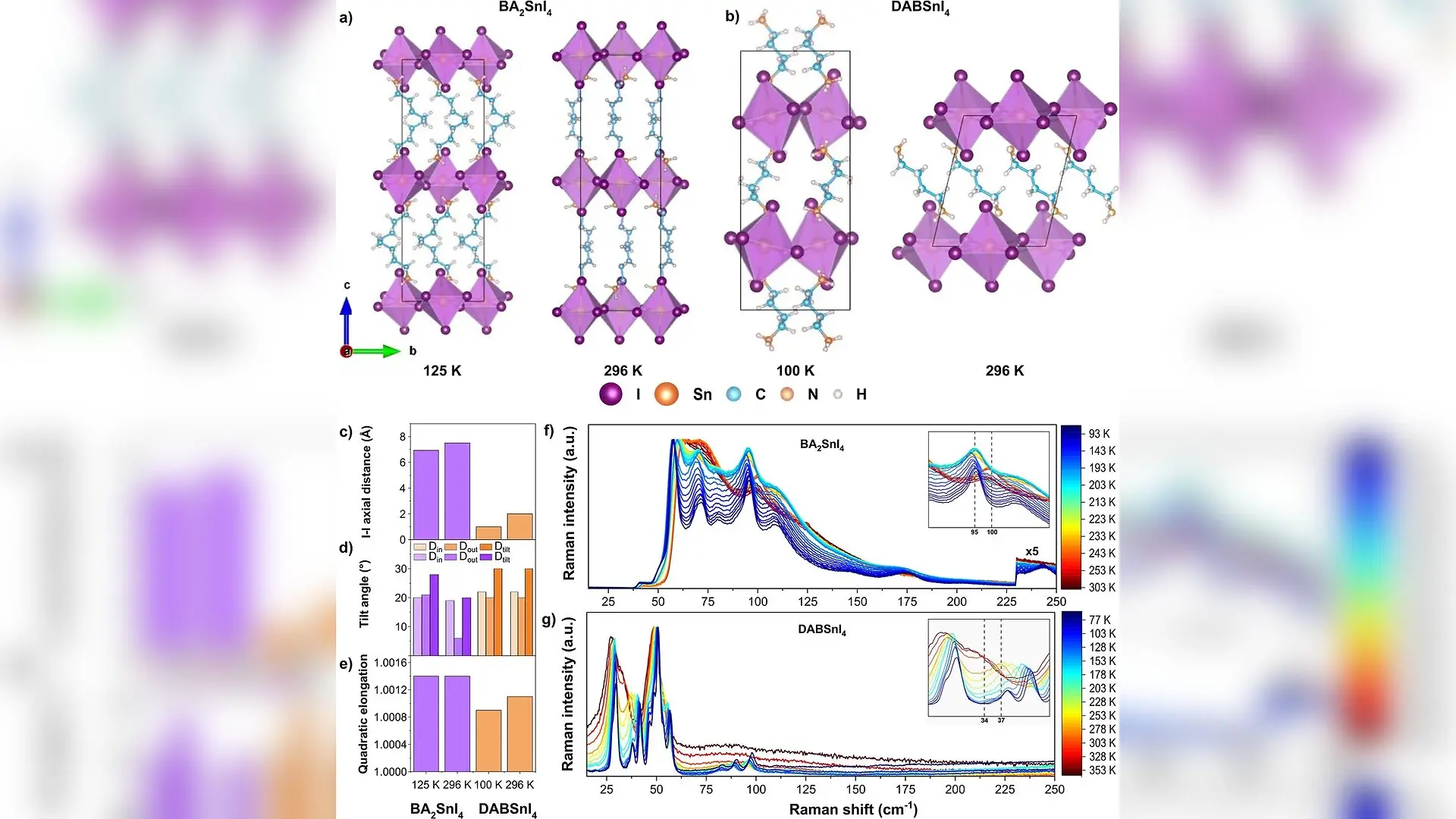
To understand how organic spacer chemistry controls macroscopic optical properties, the researchers investigated two distinct structural prototypes, namely the Ruddlesden-Popper butylammonium tin iodide and the Dion-Jacobson 1,4-diammoniobutane tin iodide. In the Ruddlesden-Popper phase, monovalent butylammonium cations form bilayers that separate inorganic sheets with a characteristic van der Waals gap. Conversely, the ditopic diammonium cations in the Dion-Jacobson architecture directly link adjacent inorganic layers without any intervening gap, forcing an eclipsed configuration and a significantly shorter interplanar distance of roughly 3.9 angstroms.
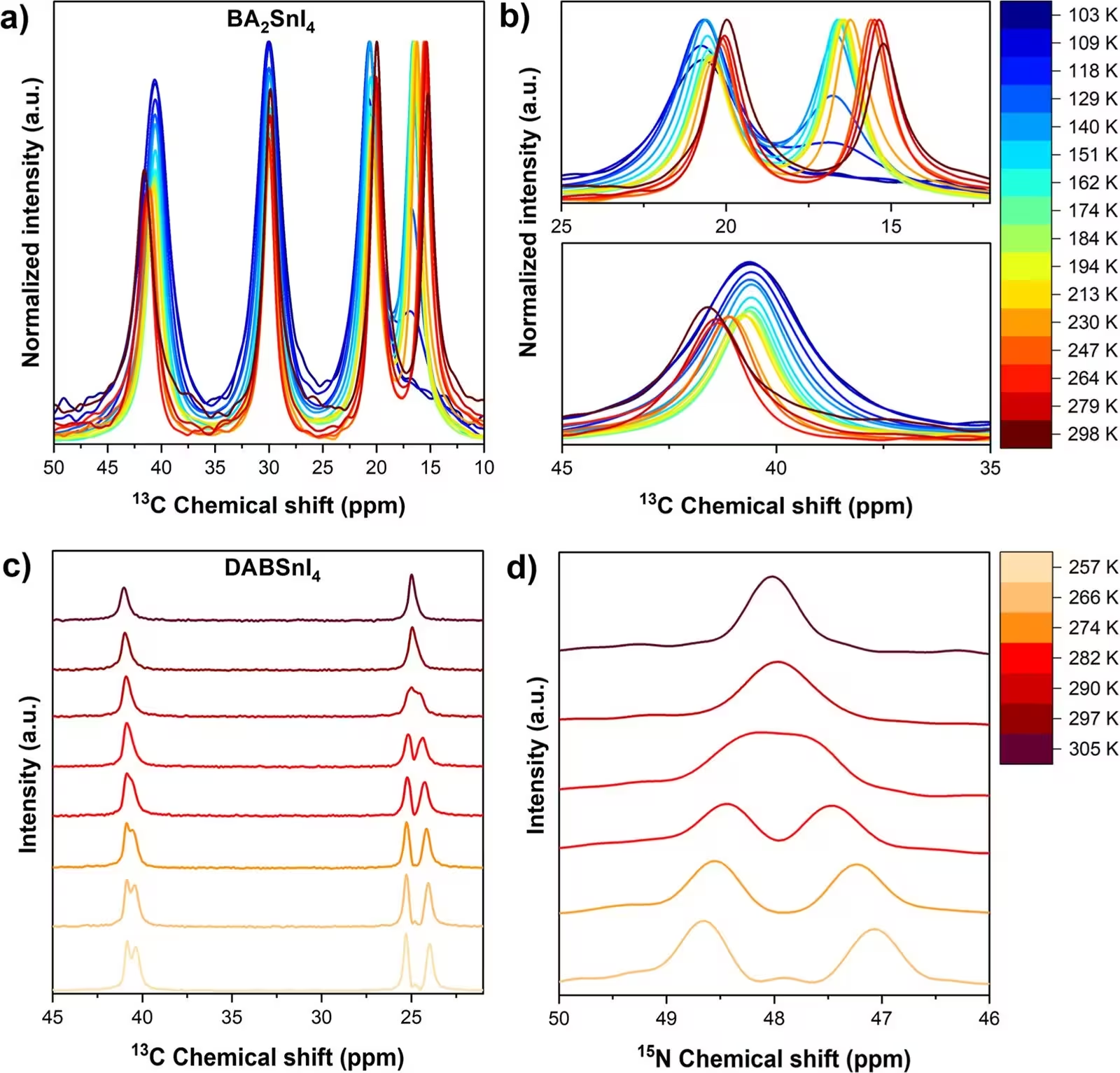
Through single-crystal X-ray diffraction and variable-temperature solid-state nuclear magnetic resonance spectroscopy, the team identified a previously unreported low-temperature monoclinic phase for the Dion-Jacobson material alongside a symmetry-breaking phase transition near room temperature. Quantitative analysis of the structural parameters demonstrated that the bivalent cations tightly constrain the inorganic sublattice, maintaining a stable octahedral distortion across temperature shifts. In contrast, the Ruddlesden-Popper analogue undergoes pronounced structural evolution and exhibits substantially greater conformational disorder due to the loose terminal mobility of its monovalent alkyl chains.
Suppressed Lattice Vibrations and Exciton Dynamics
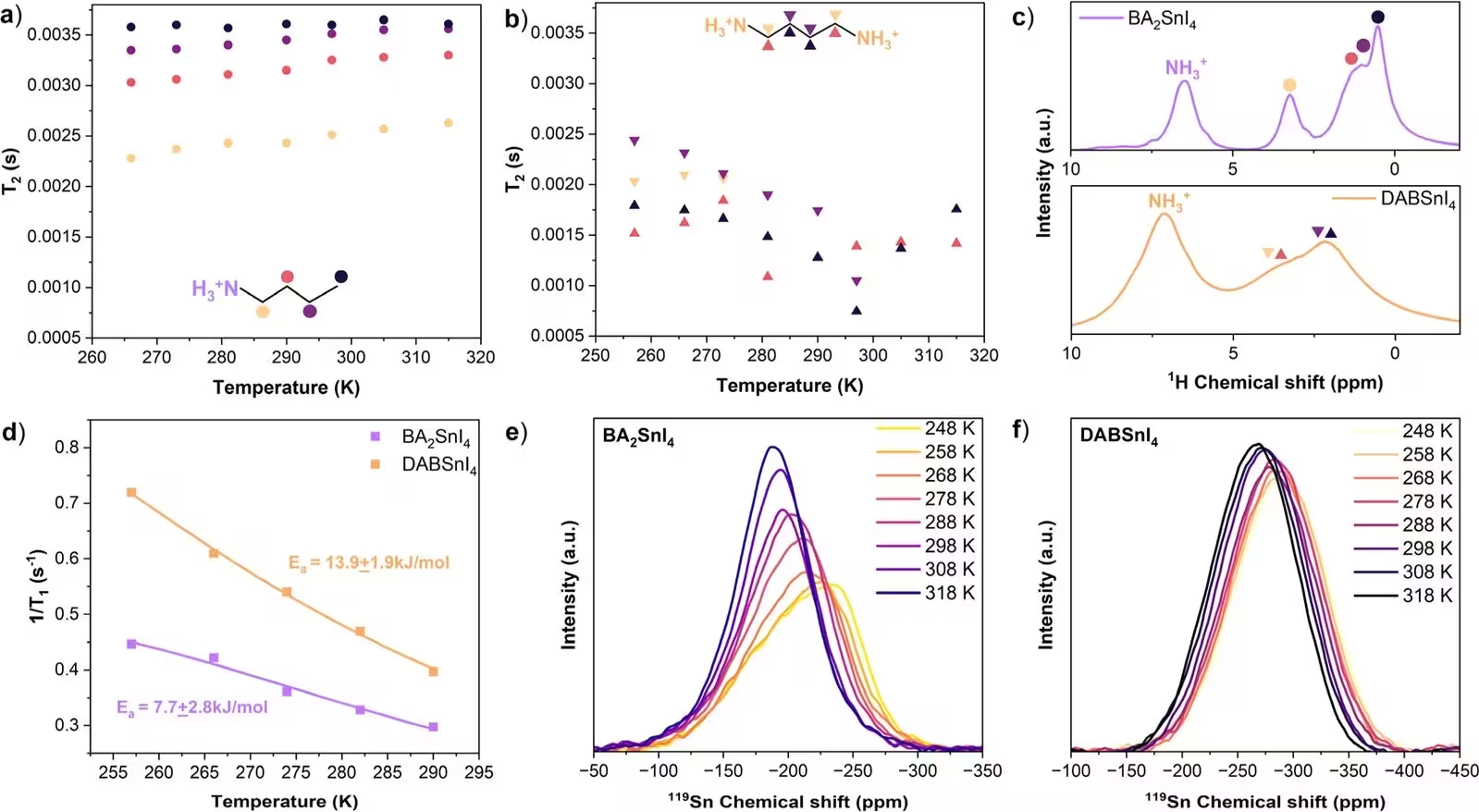
The molecular constraints imposed by the Dion-Jacobson architecture have profound consequences for the material dynamics and photophysical behavior. Solid-state nuclear magnetic resonance transverse and spin-lattice relaxation measurements confirmed that molecular motions are heavily hindered in the bivalent system, yielding a much higher activation energy for thermal motion compared to the butylammonium counterpart. Raman microspectroscopy further verified that this rigidity suppresses low-frequency vibrational modes associated with the inorganic octahedra and organic torsions.
This suppression of vibrational activity directly limits non-radiative decay channels. The researchers calculated a threefold reduction in exciton-phonon coupling strength for the Dion-Jacobson perovskite relative to the Ruddlesden-Popper material. Furthermore, the shorter interlayer spacing of the Dion-Jacobson structure alleviates quantum and dielectric confinement, reducing the exciton binding energy to approximately 46 milli-electron-volts. These combined electronic alterations improve radiative recombination efficiency and reduce the detrimental impact of localized trap states.
Realizing Optical Gain Without Aromatic Spacers
When evaluated under pulsed optical excitation at cryogenic temperatures, the distinct structural traits translated into stark differences in optical gain performance. While the Ruddlesden-Popper films failed to exhibit amplified spontaneous emission even under high fluence conditions, the Dion-Jacobson thin films demonstrated a clear superlinear rise of a narrow emission peak at 615 nanometers above a threshold of roughly 24.8 microjoules per square centimeter. Hyperspectral photoluminescence mapping revealed that waveguiding effects allow the amplified light to leak preferentially along grain boundaries within the tightly packed microcrystalline film.
Crucially, the Dion-Jacobson perovskite sustained amplified spontaneous emission up to 150 kelvin. This milestone marks the first reported observation of optical gain in a two-dimensional perovskite employing a nonaromatic aliphatic ammonium cation. The findings prove that aromatic stacking is not an absolute prerequisite for coherent light emission. Instead, engineering structural rigidity and locking octahedral distortions through ditopic aliphatic cations provides a simple yet powerful design strategy for developing high-performance photonic and optoelectronic devices.
The research was published in Journal of the American Chemical Society on October 21, 2026.
This article has been fact checked for accuracy, with information verified against reputable sources. Learn more about us and our editorial process.
Last reviewed on .
Article history
- Latest version
Reference(s)
- Canestra, Francesca., et al. “Structural Rigidity Enables Amplified Spontaneous Emission in 2D Alkylammonium Tin Perovskites.” Journal of the American Chemical Society, vol. 148, no. 41, October 12, 2026, pp. 44876-44888. American Chemical Society (ACS), doi: 10.1021/jacs.6c14883. <https://doi.org/10.1021/jacs.6c14883>.
Cite this page:
- Posted by John Williams