New Chemistry Insight Reveals How Hybrid Density Functionals Truly Work
A breakthrough study uncovers the hidden role of exchange differences in hybrid functionals, inspiring a simpler and more accurate design for molecular modeling.
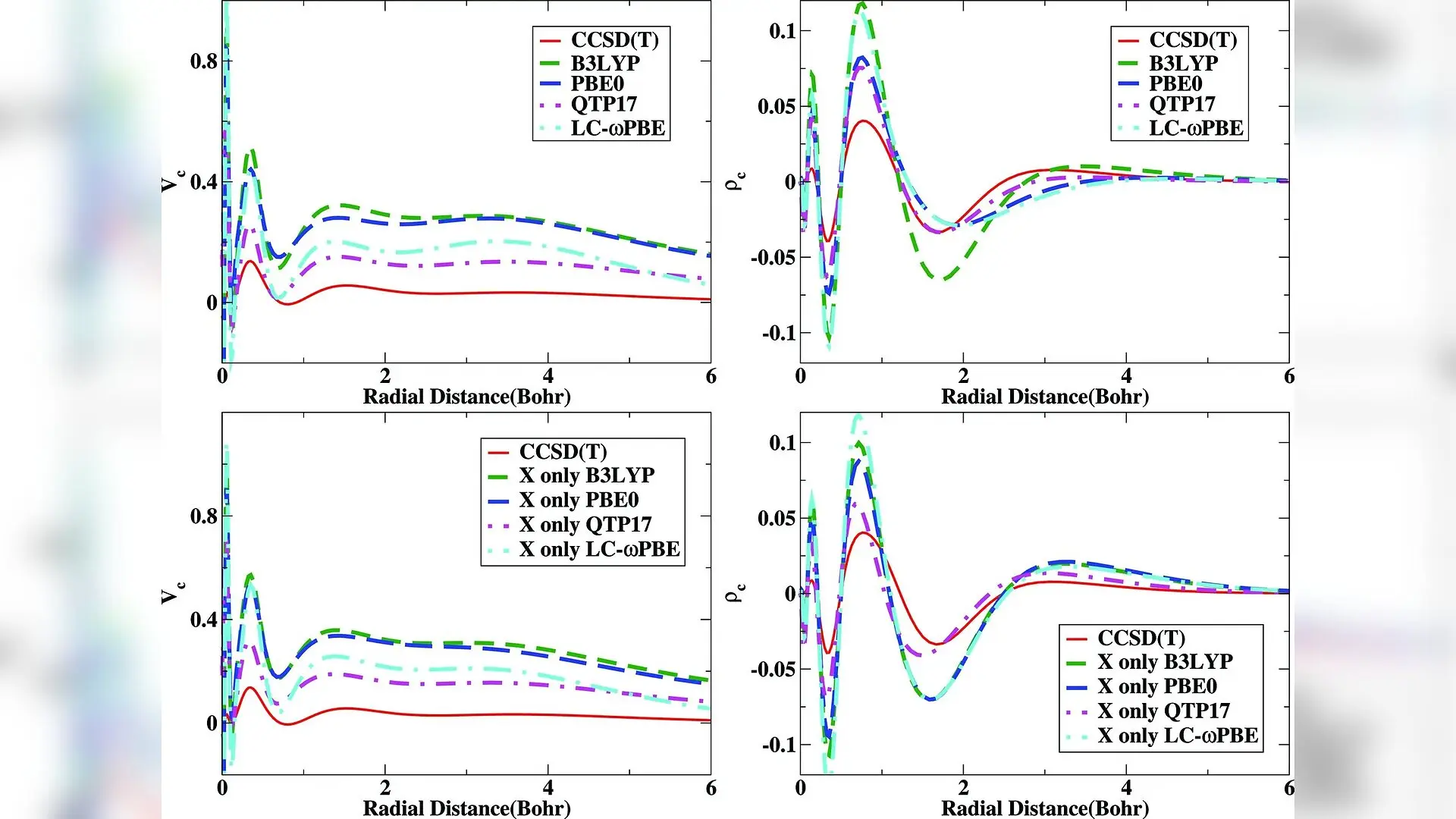
Density functional theory remains a cornerstone of modern computational science, offering a computationally efficient path to modeling complex molecular systems without relying on full wave function calculations. At the heart of this methodology lies the exchange-correlation energy functional, which bridges the gap between independent particle approximations and the reality of many-electron quantum mechanics. Among the various classes of approximations developed over the decades, hybrid density functionals have emerged as the industry standard, balancing high accuracy with manageable computational costs by blending exact Hartree-Fock exchange with semilocal components.
Despite their widespread use, the fundamental physical origins of how these hybrid models capture electronic correlation effects have stayed somewhat opaque. To address this gap, a collaborative group of theoretical chemists and physicists published a detailed investigation published in the Journal of Chemical Theory and Computation. By analyzing Kohn-Sham exchange-correlation potentials, correlated electron densities, and underlying energy components across a diverse set of atomic and molecular benchmarks, the authors illuminated the true mechanical drivers behind hybrid functional success.
Unmasking the Exchange-Difference Engine
When constructing traditional hybrid density functional approximations, researchers typically combine semilocal exchange formulas with specific fractions of exact exchange and standard semilocal correlation. The prevailing assumption has been that the semilocal correlation functional performs the heavy lifting for correlation effects. However, the new analysis demonstrates that the dominant qualitative traits of correlation do not stem from the semilocal correlation term at all.
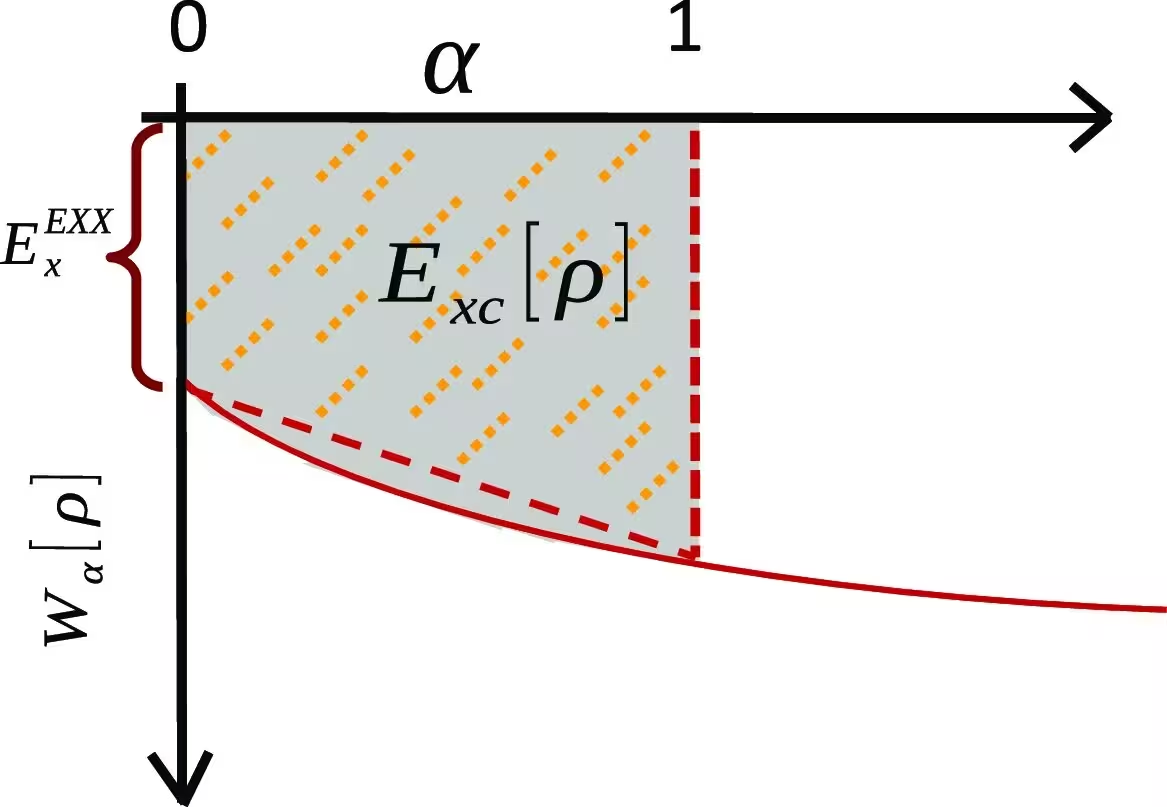
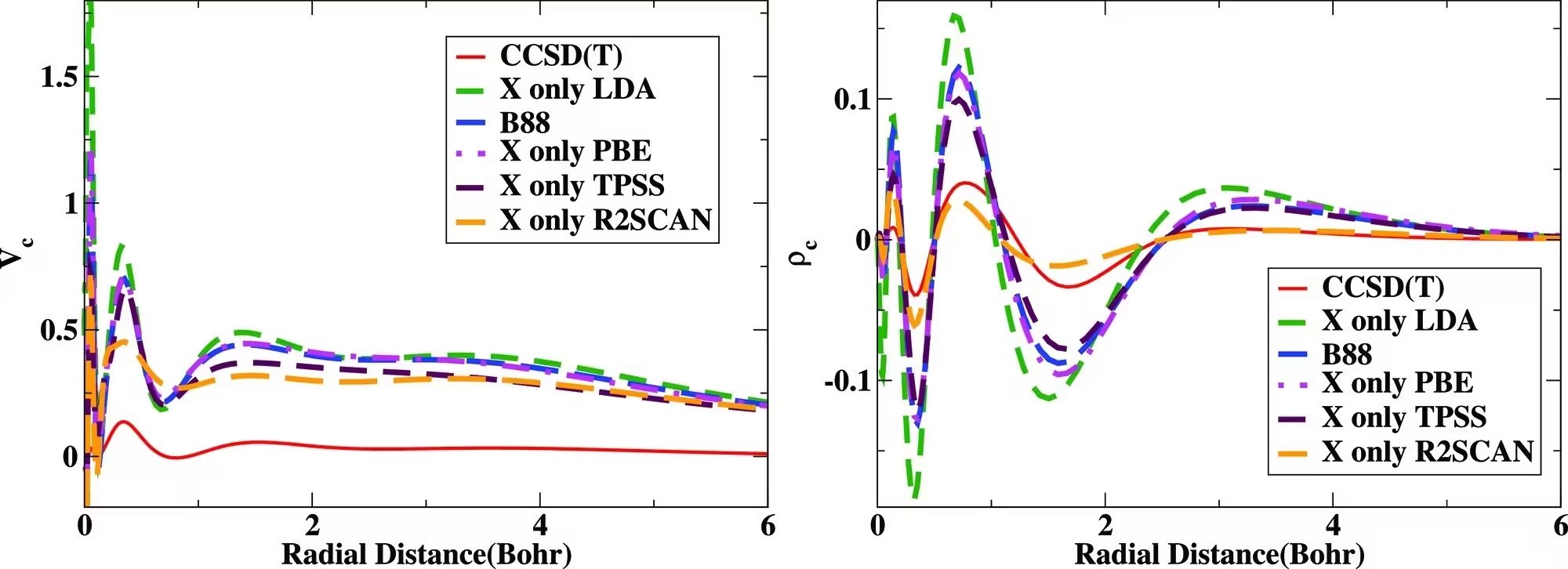
Instead, the researchers showed that correlation behavior is primarily dictated by the mathematical difference between semilocal exchange and exact exchange. This exchange-difference term proves essential for repairing the structural integrity of the correlation component within the exchange-correlation potential and the resulting correlated density. Meanwhile, the conventional semilocal correlation part functions largely as a compensating mechanism in core and valence regions, offsetting the overestimation generated by the exchange difference.
Designing the UMK26 Functional
Armed with this physical insight, the research team formulated a transparent design principle for hybrid functionals. Rather than relying purely on empirical energy fitting, their methodology centers on the controlled scaling of the exchange-difference term. To test this concept, they engineered a new global hybrid functional named UMK26, along with its exchange-only variant UMK26x.
Extensive benchmarking revealed that despite its simple global hybrid structure, UMK26 significantly reduces the overestimation of correlation effects common in traditional models. When applied to ionization potentials and charge-transfer excitations, the functional achieved outstanding accuracy. For instance, UMK26 delivered a very low mean absolute deviation on the GW100 reference set, performing competitively with advanced range-separated hybrids that typically require much greater mathematical complexity.
Furthermore, the UMK26 functional demonstrated exceptional capabilities in handling systems prone to self-interaction errors, such as stretched charged dimers. By mitigating spurious long-range charge delocalization, the functional avoids the unphysical overbinding that plagues many standard approximations.
Future Directions for Molecular Modeling
While UMK26 is not uniformly optimal across every thermochemical subset, its robust performance for total energies and self-interaction-sensitive systems highlights the power of potential-guided functional design. The authors note that their findings provide a clear roadmap for future developments, opening doors to improved global hybrids, range-separated systems, and double-hybrid architectures built upon rigorous physical principles rather than trial-and-error parameterization.
The research was published in Journal of chemical theory and computation on October 13, 2026.
This article has been fact checked for accuracy, with information verified against reputable sources. Learn more about us and our editorial process.
Last reviewed on .
Article history
- Latest version
Reference(s)
- Kumar, Vignesh Balaji., et al. “Primary Role of Semi-Local and Exact-Exchange Difference in the Description of Correlation Effects in Hybrid Functionals.” Journal of Chemical Theory and Computation, vol. 22, no. 19, September 21, 2026, pp. 10036-10051. American Chemical Society (ACS), doi: 10.1021/acs.jctc.6c00843. <https://doi.org/10.1021/acs.jctc.6c00843>.
Cite this page:
- Posted by John Williams