Quantum Simulations Reveal That Hydrogen Bonds Persist in Supercritical Water
Physicists use quantum molecular dynamics to settle a decades-long debate over whether water molecules stay connected under extreme conditions.
Water is arguably the most anomalous liquid on Earth, boasting an unusually high boiling point and a complex local tetrahedral organization that dictates everything from its maximum density at four degrees Celsius to its exceptional heat capacity. At the heart of this macroscopic behavior lies the intermolecular hydrogen bond and the intricate three-dimensional network it forms between individual molecules. Yet, when water is heated and pressurized beyond its critical point, entering the supercritical regime, its familiar identity undergoes a radical transformation. Researchers have long sought to understand what happens to these delicate atomic connections in supercritical water (SCW), a state of matter prized for its ability to dissolve organic pollutants, catalyze green chemical reactions, and serve as an advanced heat-transfer medium.
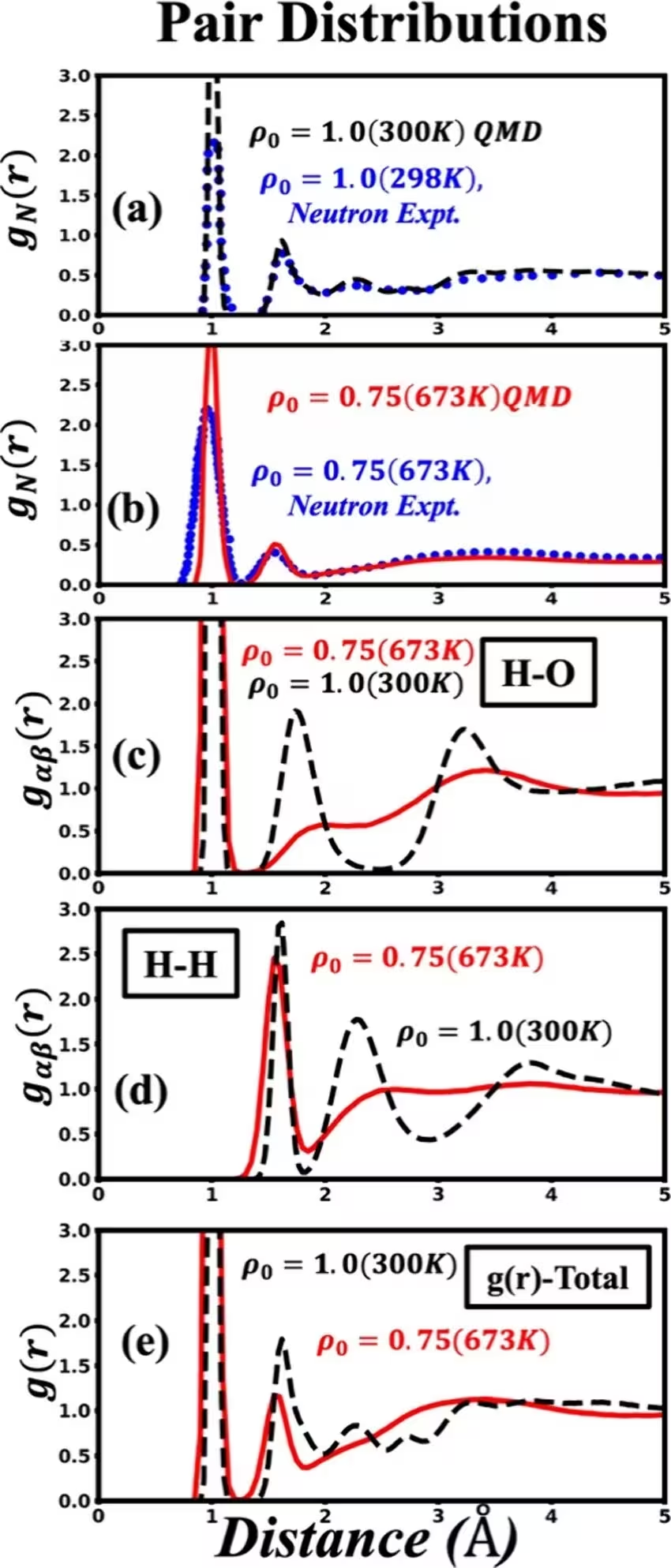
The core scientific debate has centered on whether hydrogen bonds survive in this harsh environment. Early interpretations of neutron diffraction measurements suggested that hydrogen bonding was virtually nonexistent in supercritical water, pointing to a severe structural breakdown. However, subsequent experimental reinterpretations and proton nuclear magnetic resonance studies argued that appreciable hydrogen bonding might still endure at extreme temperatures and pressures. Complicating matters further, X-ray Raman spectroscopy revealed a spatially heterogeneous picture, suggesting the existence of tiny, isolated hydrogen-bonded patches drifting within a sea of non-bonded molecules. These conflicting conclusions arose largely because traditional analytical methods relied on time-averaged pair distribution functions and geometric distance cutoffs that struggle to decouple overlapping atomic signals under extreme thermodynamic stress.
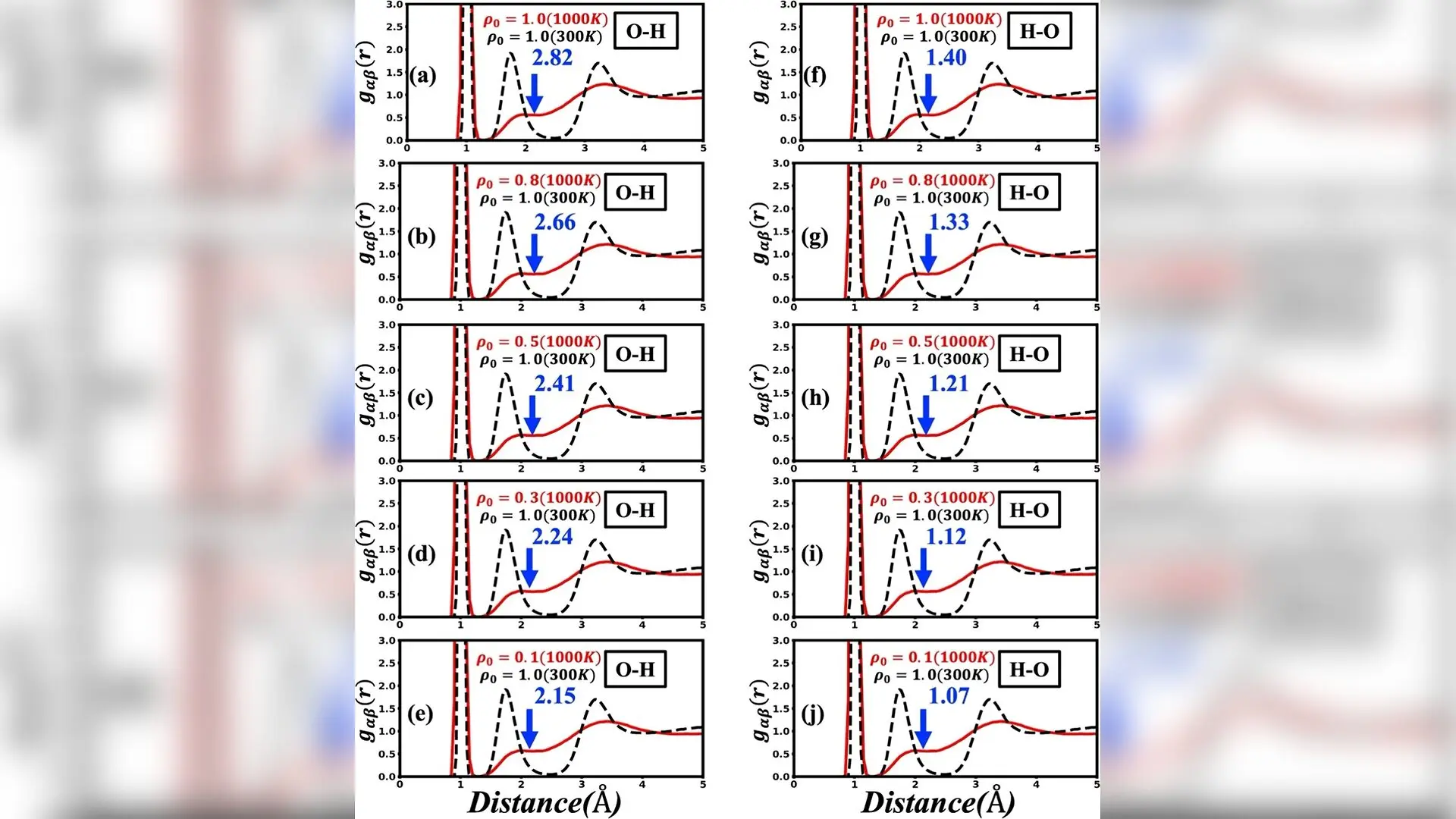
To cut through this methodological ambiguity, the research team published in The Journal of Physical Chemistry Letters a comprehensive computational investigation utilizing quantum molecular dynamics (QMD) simulations combined with density functional theory. The scientists employed the strongly constrained and appropriately normed (SCAN) meta-generalized gradient approximation functional to accurately model exchange and correlation effects. Beginning with a relaxed bulk water configuration containing one hundred eight molecules at room temperature, the system was heated to one thousand Kelvin and systematically stepped down across ten different densities ranging from 0.1 to 1.0 grams per cubic centimeter.
Probing Electronic Overlap Under Extreme Conditions
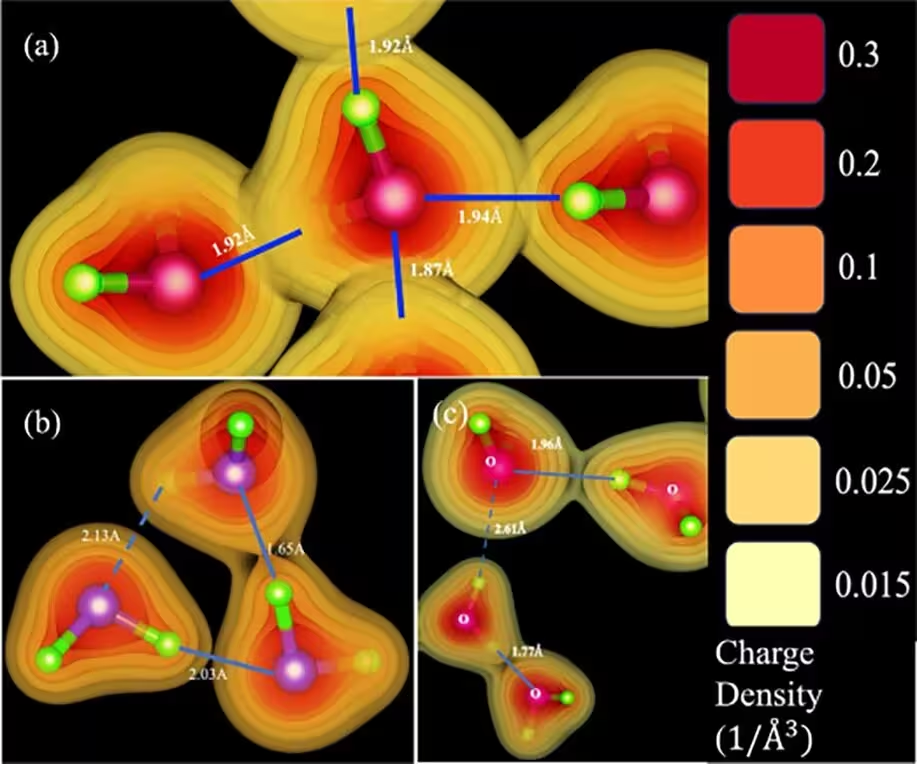
A major breakthrough of this study was the introduction of a first-principles framework based on electronic charge-density overlap to define and identify hydrogen bonds. In standard radial distribution functions, the peak corresponding to intermolecular hydrogen-bonding heavily overlaps with intramolecular hydrogen-hydrogen correlations, masking true structural changes. By directly probing the underlying quantum mechanical electron charge densities, the authors established a robust electronic overlap criterion that remains reliable even when thermal agitation severely perturbs molecular geometry.
The analysis revealed that while the covalent oxygen-hydrogen bonds holding individual water molecules together remain remarkably robust and intact across all tested supercritical states, the intermediate-range structure suffers profound broadening. At an isosurface threshold corresponding to a separation of approximately 2.03 angstroms, the simulations showed that electronic charge-density regions touch to form a valid hydrogen bond. Setting a stringent cutoff at 2.10 angstroms where the overlap drops significantly below standard thresholds, the researchers mapped out the exact population and behavior of surviving bonds.
Lifetimes and Density-Driven Distortions
The results demonstrate that a reduced level of residual hydrogen bonding stubbornly persists across the entire explored envelope of supercritical water. At a density of 1.0 grams per cubic centimeter and one thousand Kelvin, the average number of hydrogen bonds per water molecule drops from 3.6 in ambient liquid water down to 1.62. As the density is further reduced toward gas-like conditions at 0.1 grams per cubic centimeter, the average number of hydrogen bonds per molecule falls further to 0.29.
Furthermore, evaluating population time correlation functions allowed the team to calculate hydrogen bond lifetimes in supercritical water. While room-temperature water exhibits a relatively stable hydrogen bond lifetime of about 1.43 picoseconds, the extreme thermal motion at one thousand Kelvin causes these bonds to break and reform at astonishing speeds, with lifetimes plunging to between 0.04 and 0.09 picoseconds depending on the fluid density. These ultra-short lifetimes highlight just how transient and fleeting intermolecular connections become in the supercritical regime.
Ultimately, this quantum mechanical investigation reconciles decades of contradictory experimental interpretations by providing a unified picture of supercritical water. By proving that weak, highly dynamic hydrogen bonds survive even in highly expanded supercritical fluids, the work supplies foundational data that will aid scientists in designing better machine-learned force fields, optimizing industrial hydrothermal oxidation processes, and understanding planetary interiors where supercritical fluids play a critical geochemical role.
The research was published in The journal of physical chemistry letters on October 15, 2026.
This article has been fact checked for accuracy, with information verified against reputable sources. Learn more about us and our editorial process.
Last reviewed on .
Article history
- Latest version
Reference(s)
- Baradwaj, Nitish., et al. “Hydrogen Bonding in Supercritical Water Using Quantum Molecular Dynamics.” The Journal of Physical Chemistry Letters, vol. 17, no. 41, September 29, 2026, pp. 11760-11768. American Chemical Society (ACS), doi: 10.1021/acs.jpclett.6c02526. <https://doi.org/10.1021/acs.jpclett.6c02526>.
Cite this page:
- Posted by John Williams