New Simulation Links Milky Way Gamma-Ray Excess to Cosmic Ray Fluctuation
Advanced galaxy simulations challenge long-held assumptions about the mysterious gamma-ray glow at the heart of our galaxy.
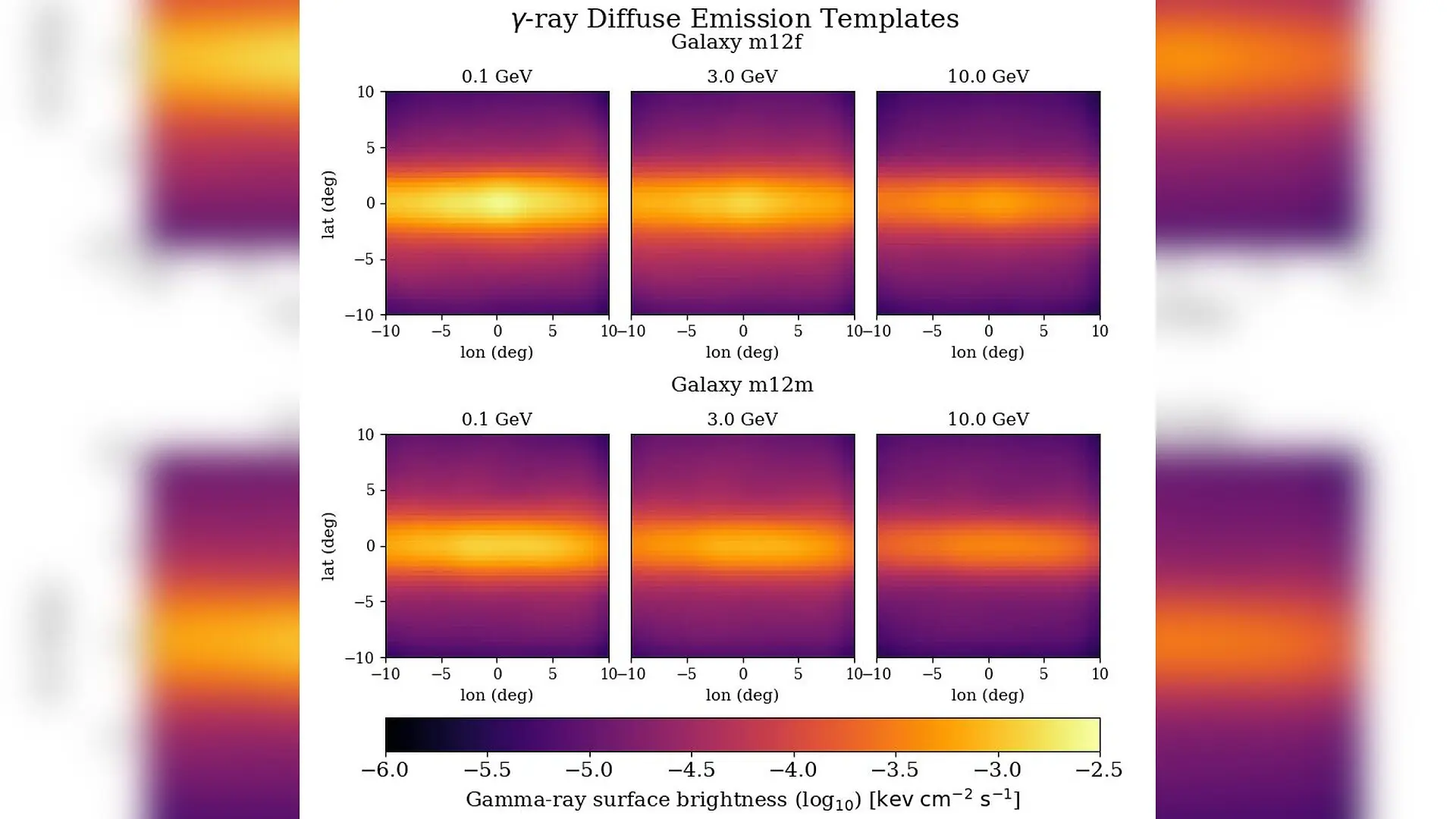
For nearly twenty years, astronomers have puzzled over a mysterious surplus of high-energy gamma-rays radiating from the very heart of our galaxy. Detected by NASA’s Fermi Large Area Telescope, this phenomenon, known as the galactic center excess, has sparked intense debate regarding its true origin. The scientific community has largely been divided between two compelling interpretations: signals left behind by annihilating dark matter particles, or radiation generated by an undiscovered population of unresolved millisecond pulsars tucked away in the crowded stellar bulge. Yet, both of these prevailing hypotheses come with significant theoretical challenges and observational caveats.
A major limitation holding back previous investigations has been the reliance on steady-state cosmic ray propagation models. These traditional frameworks depend on simplistic assumptions, treating cosmic ray distributions as smooth and axisymmetric while ignoring complex, time-dependent behaviors like galactic winds, turbulence, and dynamic gas coupling. To address these shortcomings, researchers Isabel S. Sands and Philip F. Hopkins turned to advanced computer modeling to evaluate whether ordinary astrophysical phenomena could reproduce the elusive signal. Their findings are published on the arXiv preprint server, offering a fresh perspective on how galactic environments shape high-energy emissions.
Recreating the Turbulent Heart of Galaxies
To capture the chaotic nature of stellar neighborhoods, the authors analyzed sophisticated magnetohydrodynamic galaxy simulations featuring spectrally-resolved cosmic rays. These simulations model Milky Way-mass spiral galaxies from cosmological initial conditions down to modern epochs, tracking multi-phase interstellar medium dynamics. Supernovae inject fresh cosmic rays into the system, driving continuous changes in gas density, magnetic fields, and radiation pressure.
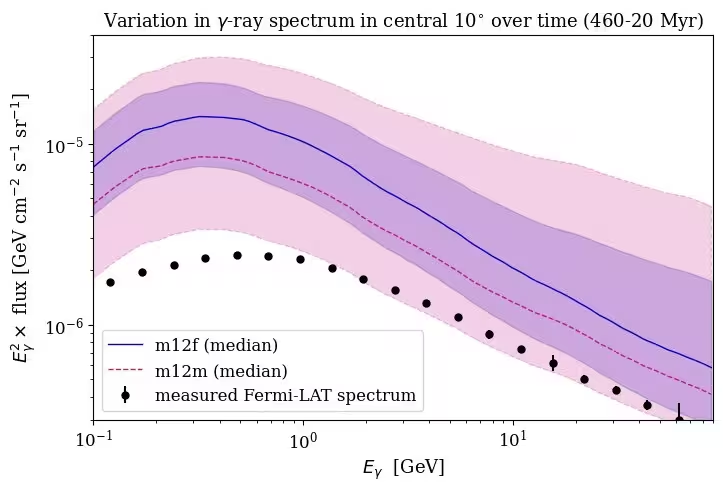
Rather than assuming a static equilibrium, the team compared instantaneous gamma-ray emission snapshots against a baseline template representing a long-term time-averaged state. The results demonstrate that the dynamic interplay between star formation and cosmic ray transport produces dramatic fluctuations. Within relatively short geological timescales, the simulated galactic centers experience transient bumps and deep spectral wiggles across energy channels ranging from 0.1 to 100 GeV.
The Look-Elsewhere Effect in Action
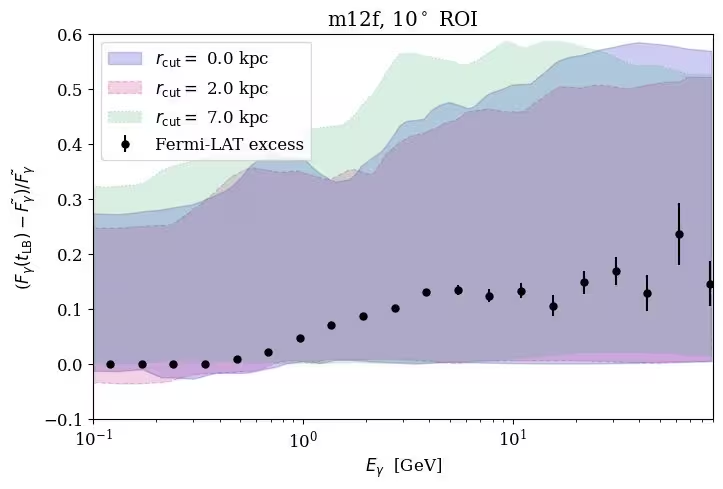
When tracking the spatial morphology and spectral energy distribution of these residuals, the researchers uncovered instances where the simulated gamma-ray emission closely mirrored the Fermi galactic center excess. In these specific snapshots, a complex combination of recent clustered supernova events drove localized variations in cosmic ray loss rates, creating a spherical excess within the central region flanked by disk-plane deficits where gas had been violently swept away.
The authors propose that the galactic center excess observed by Fermi may simply be a manifestation of the look-elsewhere effect. In this scenario, the Milky Way’s core is merely caught at a transitory, energetic moment in its evolution. Because our observatory can examine only one galactic center in such fine detail, it may be a coincidence that our current observational epoch happens to coincide with a transient 1 to 10 GeV fluctuation.
Implications for Future Gamma-Ray Astronomy
The implications of this work suggest that standard data analysis pipelines might significantly underestimate the natural variance driven by mundane stellar mechanics. Because current template-fitting methods smooth out spatial and temporal irregularities, they risk misinterpreting standard cosmic ray variability as exotic physics.
While the simulated galaxies exhibit higher star formation rates than the modern Milky Way’s central molecular zone, the research highlights the critical need to incorporate time-dependent cosmic ray transport into future analytical models. As next-generation instruments such as the Cherenkov Telescope Array Observatory and the Compton Spectrometer and Imager come online, astronomers will soon be able to test these dynamic models across other galactic centers, bringing us closer to resolving one of high-energy astrophysics most enduring mysteries.
The study was posted to the arXiv preprint server on October 23, 2026.
This article has been fact checked for accuracy, with information verified against reputable sources. Learn more about us and our editorial process.
Last reviewed on .
Article history
- Latest version
Reference(s)
- Sands, Isabel. “The Galactic Center Gamma-Ray Excess and the Look-Elsewhere Effect.” arXiv.org <http://arxiv.org/abs/2610.32845v1>.
Cite this page:
- Posted by John Williams