New ALMA Survey Reveals How Dust Discs Evolve Around Young Stars
High-resolution multi-wavelength observations challenge long-held assumptions about radial drift and offer fresh clues into the birth of planetary systems.
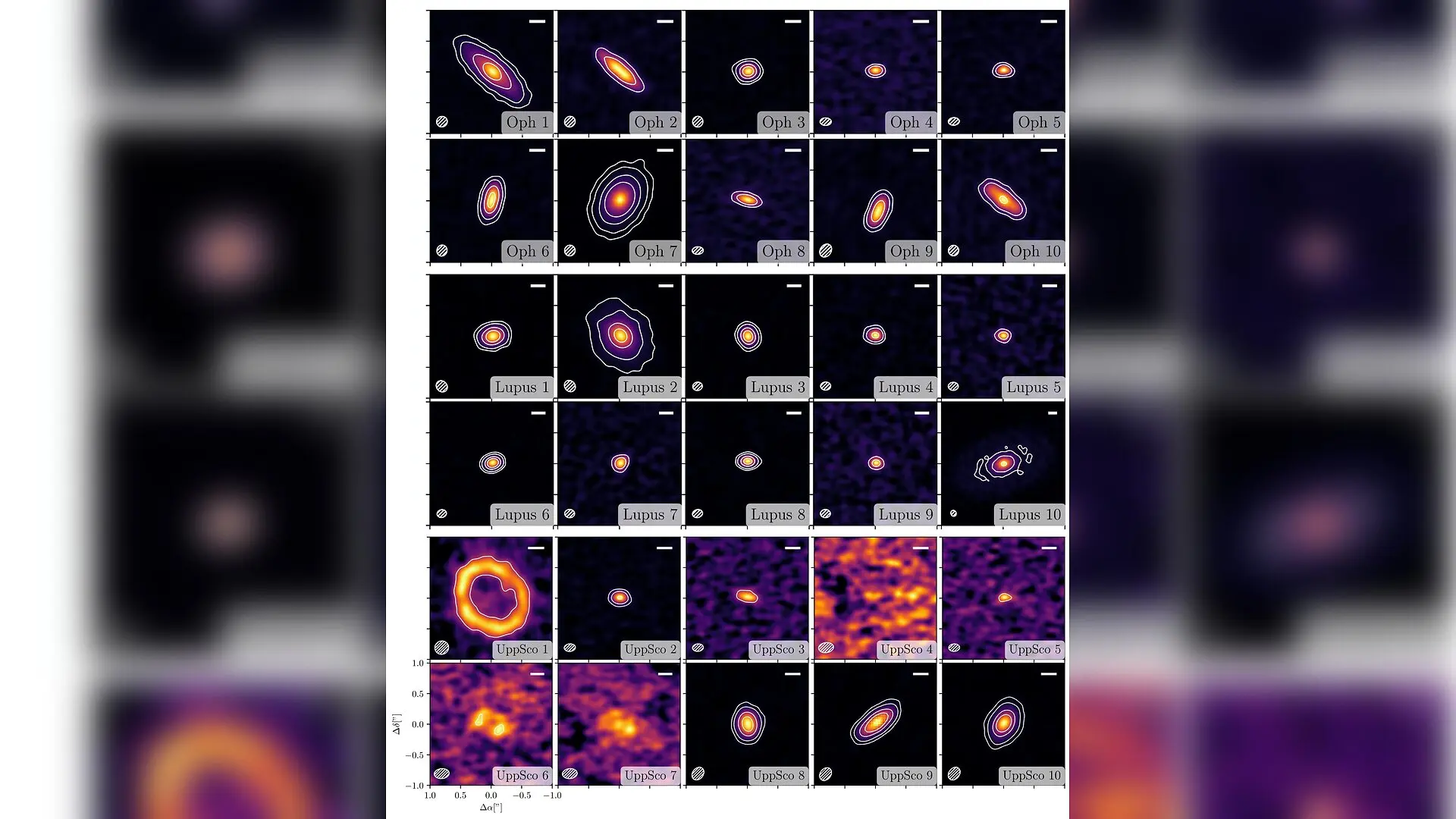
Planet formation begins in dense discs of gas and dust swirling around newborn protostars, where microscopic solid grains gradually aggregate into larger pebbles, planetesimals, and ultimately planetary cores. Reconstructing this evolutionary timeline requires a detailed understanding of how dust properties change over time, yet many previous observational studies relied on single-wavelength assumptions that could underestimate total solid masses. To address these limitations, an extensive international research initiative known as the AGE-PRO program has captured high-resolution continuum data across thirty protoplanetary discs spanning three distinct cosmic ages, from the young Ophiuchus region and middle-aged Lupus discs to the older Upper Scorpius population.
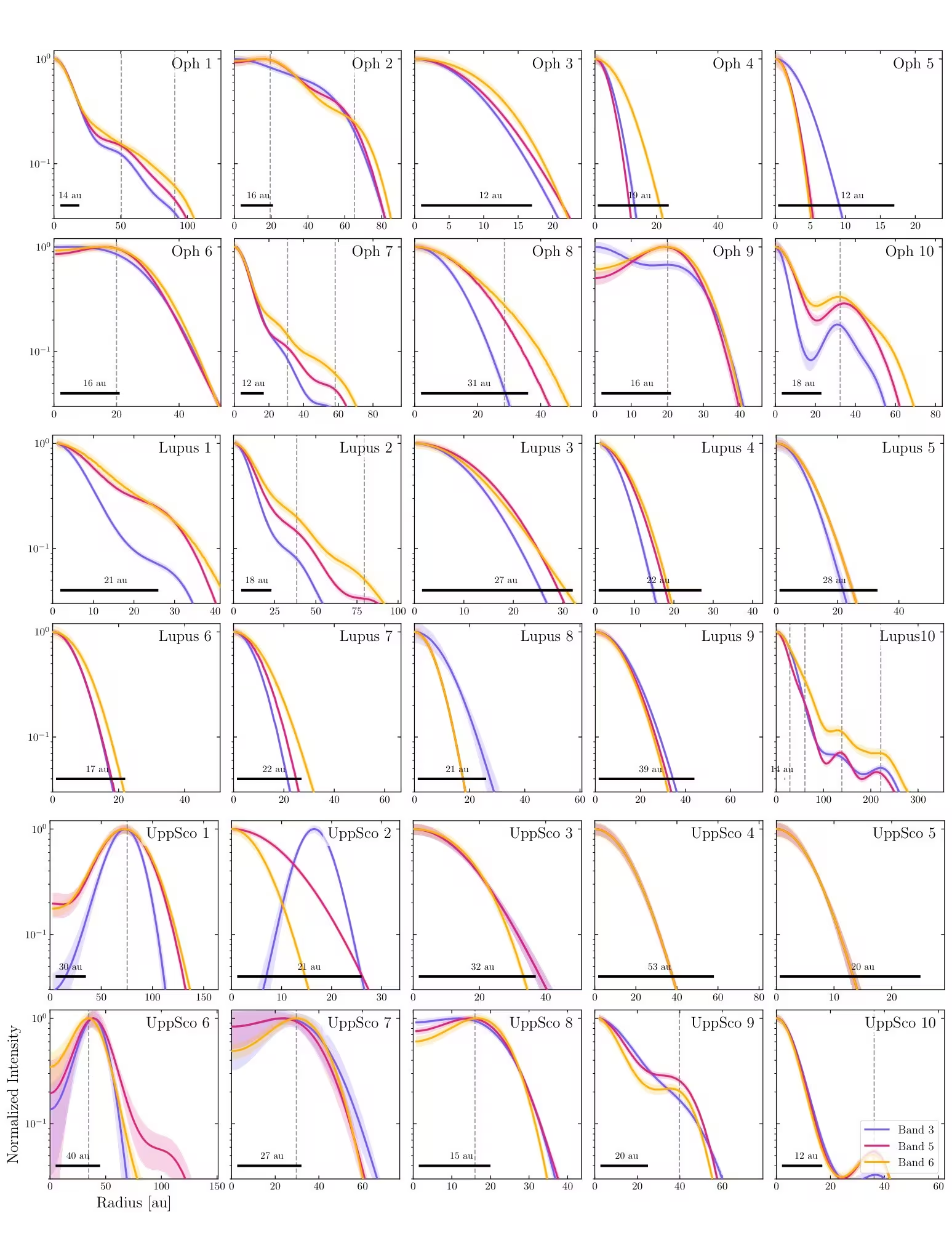
The researchers present their comprehensive findings published in a study available on the arXiv preprint server, utilizing new Atacama Large Millimeter/submillimeter Array (ALMA) observations at 3.1 mm and 1.5 mm (Bands 3 and 5) combined with archival 1.3 mm data. By analyzing the observed visibilities and deriving radial brightness profiles, the team successfully resolved twenty of the targets across multiple wavelengths. This multi-wavelength approach allowed the authors to perform detailed modeling of spectral energy distributions at each radius, constraining dust temperatures, surface densities, and maximum grain sizes without needing to assume optically thin emission.
Challenging Classical Radial Drift Models
One of the most striking results from the survey is the behavior of dust disc sizes across different evolutionary stages. Classical theoretical models predict that in smooth discs, larger particles should rapidly spiral inward toward the central star via radial drift on timescales much shorter than the typical lifetime of a disc. Consequently, older discs should appear significantly more compact than their younger counterparts, and longer wavelengths tracking larger grains should reveal smaller spatial extents. However, the multi-wavelength analysis shows no such evolutionary shrinkage. Instead, the physical radius enclosing ninety percent of the continuum emission remains remarkably constant across the three observed bands and across all age groups.
This absence of radial narrowing strongly suggests that physical mechanisms are actively mitigating radial drift within these systems. The presence of narrower ring-like substructures in longer wavelength observations, coupled with local maxima in dust surface density and maximum grain size at specific ring locations, provides strong observational evidence for dust traps. These localized gas pressure maxima halt the inward migration of drifting pebbles, allowing grains to pile up, concentrate, and grow safely within specific orbital radii. The data imply that the observed millimeter-sized dust extent is frequently regulated by the position of the outermost pressure trap, even in systems younger than one million years.
Unraveling Optical Depths and Mass Trends
The analysis also offers a clearer picture of how disc masses change over time. When comparing targets across the three star-forming regions, the results confirm a clear downward trend in dust disc mass as systems age. Ophiuchus discs generally harbor the largest dust reservoirs, whereas Upper Scorpius systems show heavily depleted dust content. Nevertheless, the absolute values of these masses depend heavily on the chosen opacity model. Utilizing Ricci opacities, which incorporate carbon grains, yields systematically lower mass estimates compared to standard DSHARP opacities due to differences in absorption efficiency and albedo. Despite these opacity-driven uncertainties, the overall evolutionary decline remains robust.
Furthermore, calculations of spectral indices across the sample revealed that a significant fraction of the resolved and unresolved discs exhibit values below two. Detailed optical depth modeling demonstrates that emission from these sources is heavily optically thick across all three observed bands, particularly within the Ophiuchus and Lupus regions. This widespread optical thickness indicates that previous surveys relying on single-wavelength, optically thin assumptions may have systematically underestimated total solid masses. Accounting for these dense, optically thick regimes provides a more accurate foundation for calculating gas-to-dust mass ratios, reinforcing the idea that gas and dust evolve on independent dynamical timescales as protoplanetary systems mature toward planetary birth.
The study was posted to the arXiv preprint server on October 23, 2026.
This article has been fact checked for accuracy, with information verified against reputable sources. Learn more about us and our editorial process.
Last reviewed on .
Article history
- Latest version
Reference(s)
- Pulgarés, Camila. “The ALMA Survey of Gas Evolution of PROtoplanetary disks (AGE-PRO): Evolution of dust properties from multi-wavelength observations.” arXiv.org <http://arxiv.org/abs/2610.32906v1>.
Cite this page:
- Posted by John Williams