New Python Tool Automates Exoplanet Discovery Validation at Massive Scale
A newly introduced open source Python toolkit named exoVetter aims to standardize how astronomers validate exoplanet transit signals across massive datasets.
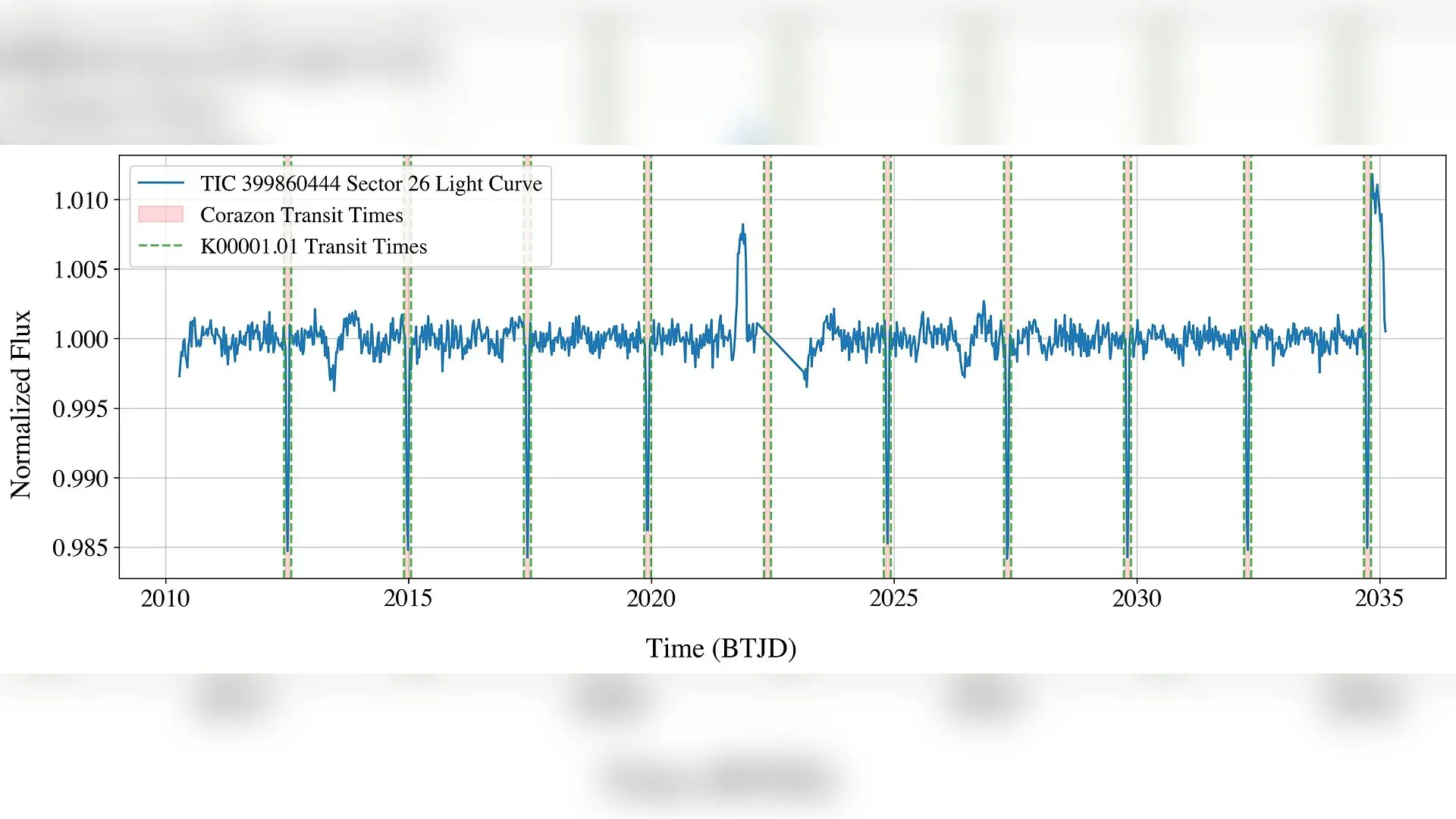
The search for distant worlds beyond our solar system has entered a high-volume era, driven by space-based observatories that continuously monitor millions of stars. When planets pass directly in front of their host stars, they produce tiny, repeating drops in brightness known as transits. Spotting these subtle signals requires powerful algorithms that can comb through massive archives of time-series photometry. Yet, identifying a genuine exoplanet candidate is only half the battle, as researchers must also rule out instrumental anomalies, variable stars, and background eclipsing binaries that mimic true transits.
Historically, different research teams developed independent software packages to evaluate these signals, each relying on distinct dependencies and user interfaces. This fragmentation created a major maintenance burden for the scientific community and made cross-comparison between pipelines difficult. To solve this interoperability challenge, a team of researchers has introduced a comprehensive software solution published in the arXiv preprint server, as detailed in a study available on the arXiv preprint server, offering a unified framework for vetting transit signals.
A Modular Toolkit for Exoplanet Vetting
The new Python package, named exoVetter, acts as a centralized repository for established transit-vetting algorithms originally designed for missions like Kepler, K2, and TESS. Because the package is modular and mission-agnostic, astronomers can run individual vetting tests separately or combine them into custom pipelines tailored to specific scientific goals.
The software supports both flux-level and pixel-level evaluations. Flux-based metrics examine the shape, spacing, and statistical consistency of the transit events to filter out random noise and data systematics. Meanwhile, pixel-level tools incorporate centroid offset analysis to determine whether the transit signal originates from the target star itself or from a blended background star. Additionally, the toolkit includes built-in visualization classes that generate interactive or static plots, allowing scientists to visually inspect individual transit events and folded light curves with ease.
Putting the Software to the Test With TESS and Kepler
To evaluate how well the package performs in a real-world scenario, the authors integrated exoVetter into an automated transit search pipeline and applied it to hundreds of thousands of light curves from the Transiting Exoplanet Survey Satellite. To establish a reliable ground truth, the team focused their demonstration on stars that had also been observed by the more sensitive Kepler space telescope.
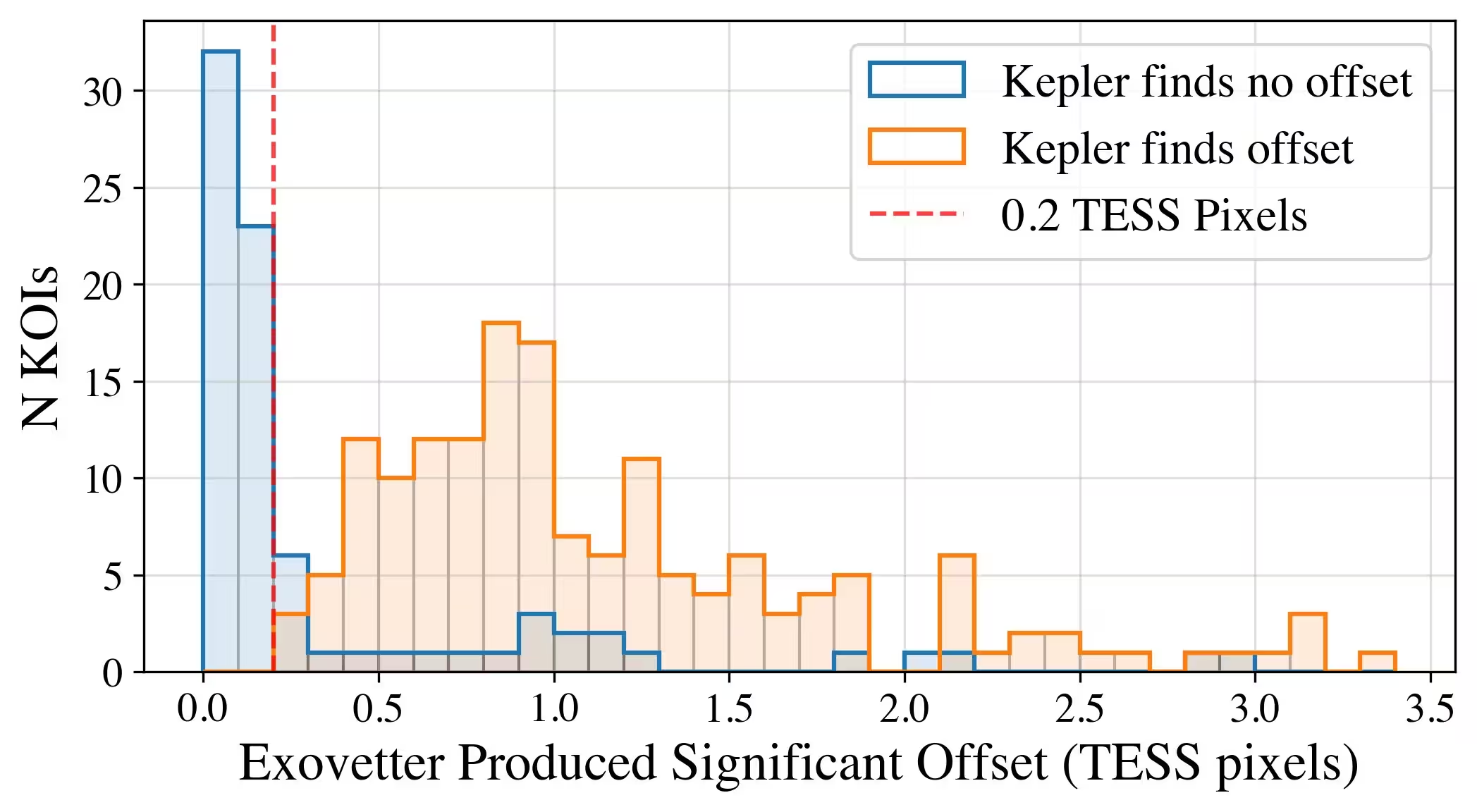
By leveraging calibrated light curves derived from Gaia astrometry, the researchers searched over 300,000 targets spanning various brightness levels. With minimal tuning of metric thresholds, the pipeline successfully retained the vast majority of known planetary signals while rejecting more than 99 percent of false alarms in control samples. The analysis highlighted the software’s ability to handle faint targets, showing that high-precision vetting can be extended to dimmer stars without triggering an overwhelming surge of false positives.
Cloud Computing and Future Prospects
Processing hundreds of thousands of high-cadence light curves demands substantial computing power. To streamline the workflow, the research team executed their transit search directly in the cloud using Amazon Web Services and Dask-based parallel processing clusters located near the data archives. This cloud-native approach allowed them to analyze the entire dataset in under twenty minutes of wall clock time at a minimal cost, bypassing the need to download massive files to local hardware.
As upcoming space missions prepare to launch and survey even larger stellar populations, automated and reproducible validation frameworks will become essential. The introduction of this open source package provides the astronomical community with a flexible foundation to scale up exoplanet discovery efforts, ensuring that future planet catalogs remain robust, reliable, and free from human bias.
The study was posted to the arXiv preprint server on October 23, 2026.
This article has been fact checked for accuracy, with information verified against reputable sources. Learn more about us and our editorial process.
Last reviewed on .
Article history
- Latest version
Reference(s)
- Dallas, Matthew M.., et al. “ExoVetter and a TESS Exoplanet Transit Search of Kepler Stars as Ground Truth.” Publications of the Astronomical Society of the Pacific, vol. 138, no. 10, October 15, 2026, pp. 104504 IOP Publishing, doi: 10.1088/1538-3873/aeab34. <https://doi.org/10.1088/1538-3873/aeab34>.
Cite this page:
- Posted by John Williams