Keck and Gemini Reveal Evolution of Interstellar Comet 3I/ATLAS
An extensive multi-facility campaign maps the behavior, gas production, and dust dynamics of only the third confirmed interstellar visitor.
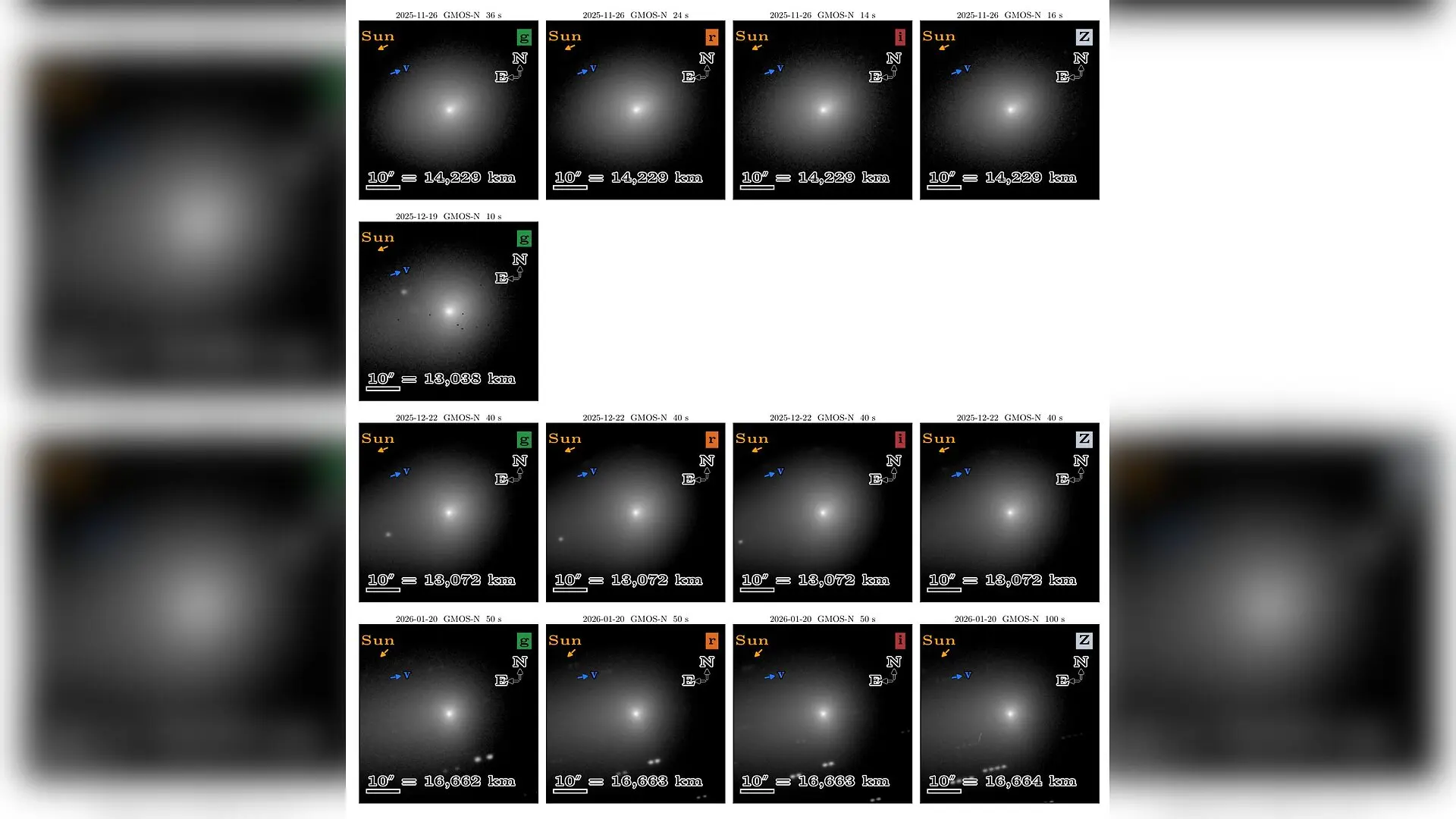
When interstellar wanderers pass through our planetary neighborhood, they carry pristine chemical signatures forged in the cradles of other star systems. The discovery of 3I/ATLAS launched a global observing campaign to track its evolution under solar heating. To map these shifts, the research team gathered 14 optical imaging epochs and eight optical spectroscopic epochs using Keck/LRIS and Gemini/GMOS, supported by near-infrared observations from Keck/MOSFIRE and Gemini/Flamingos-2 and GNIRS, published on the arXiv preprint server, spanning from July 2025 through May 2026.
Tracking Morphological Shifts and Dust Activity
Early observations revealed a concentrated coma accompanied by a compact sunward feature and an antisolar tail. Over subsequent months, solar radiation pressure and ongoing dust release reshaped these features, causing the coma to broaden into an asymmetric envelope and a persistent tail. By analyzing transverse widths and sunward profiles, the authors tracked how dust grains of various sizes accelerate away from the nucleus under the influence of solar radiation pressure.
The observational data allowed researchers to quantify total mass loss. For grains ranging from one micrometer to one millimeter, the team calculated dust losses of approximately 2.7 multiplied by ten to the ninth power kilograms and 1.0 multiplied by ten to the tenth power kilograms across the observed baseline. Assuming a nucleus density of 500 kilograms per cubic meter, these mass outputs correspond to a global equivalent surface erosion layer roughly 0.3 to 1 meter deep.
Gas Production and Chemical Compositions
Spectroscopic analysis provided vital clues regarding the volatile inventory of 3I/ATLAS. The team detected emission from multiple molecular species, including cyanogen (CN), carbon chains (C3 and C2), and atomic nickel (Ni I). Notably, the production rate of molecular carbon approximately doubled between September and November 2025, pointing toward an increasing gas contribution as the comet drew closer to the Sun.
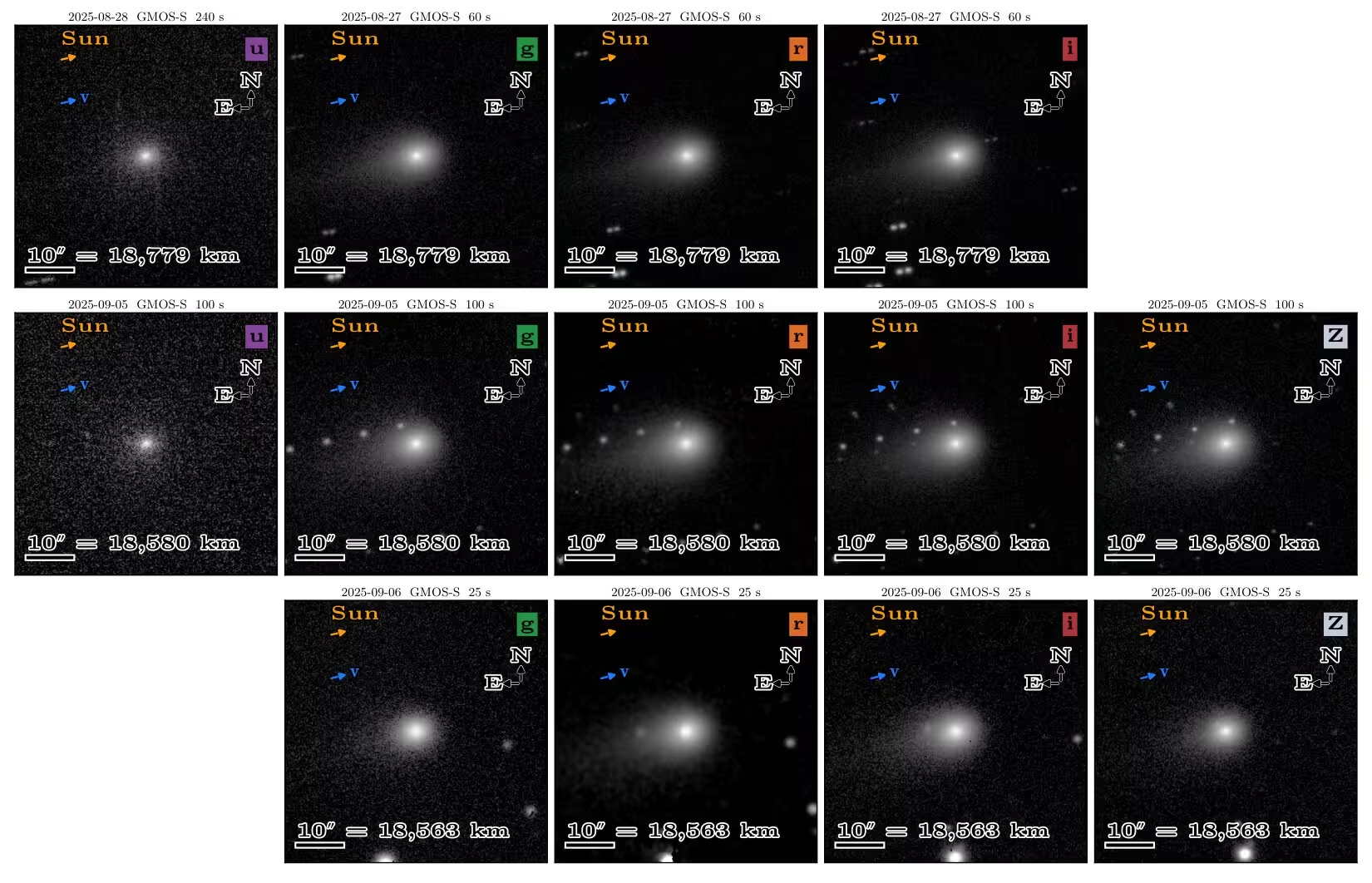
Despite these evolving gas dynamics and structural transformations, the object maintained relatively stable optical colors across matched epochs. Near-infrared spectra and photometry further constrained the characteristics of the surface and coma, showing neutral to weakly blue continuum behaviors while placing strict upper limits on the abundance of exposed water ice within the targeted inner apertures.
Context Within the Interstellar Population
Compared to its predecessors, 3I/ATLAS shares more behavioral traits with the active comet 2I/Borisov than with the largely inert and highly elongated 1I/’Oumuamua. However, its estimated size and distinct volatile behavior highlight the vast diversity present among interstellar planetesimals. Continued analysis of these rare interstellar visitors helps astronomers decouple the intrinsic properties of alien planetary systems from the thermal and physical weathering they experience upon encountering our Sun.
The study was posted to the arXiv preprint server on October 23, 2026.
This article has been fact checked for accuracy, with information verified against reputable sources. Learn more about us and our editorial process.
Last reviewed on .
Article history
- Latest version
Reference(s)
- Bolin, Bryce. “Comprehensive Visible and Near-infrared Keck and Gemini Monitoring and Characterization of Interstellar Comet 3I/ATLAS during its Encounter with the Solar System.” arXiv.org <http://arxiv.org/abs/2610.32972v1>.
Cite this page:
- Posted by John Williams