New Model Explains Mysterious Odd Radio Circles in Space
Researchers simulate how colossal shock waves interacting with fossil radio bubbles might account for the rare celestial rings discovered by modern telescopes.
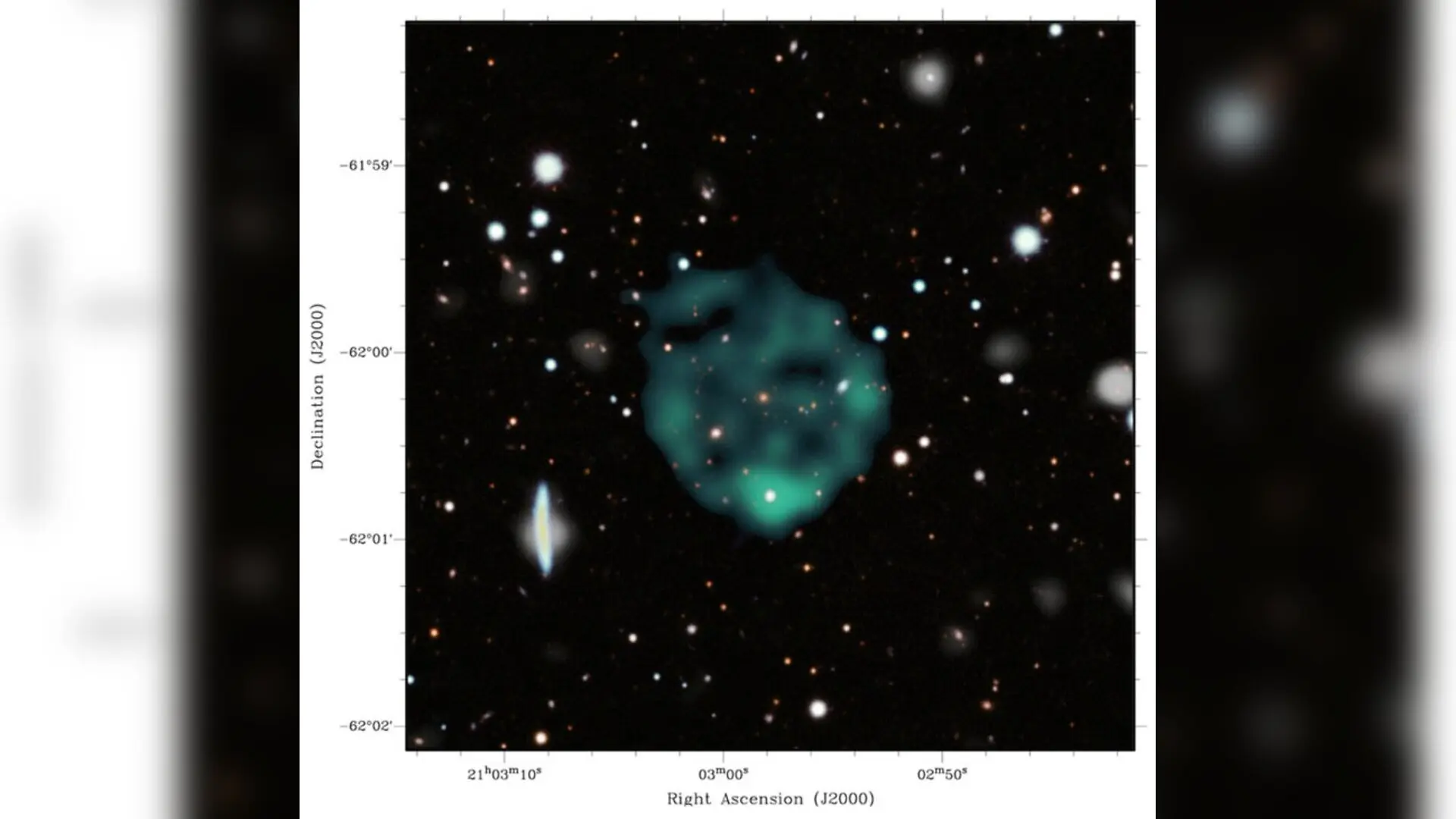
Odd Radio Circles (ORCs) represent one of the most puzzling discoveries in modern observational astronomy. Appearing as faint, edge-brightened rings of diffuse radio emission with angular diameters around one arcminute, these objects defy straightforward explanation through standard models of radio galaxies, supernova remnants, or intergalactic accretion shocks. First identified in data from the Australian Square Kilometre Array Pathfinder, only a few dozen candidates have been confirmed across sensitive wide-field radio surveys, keeping their underlying astrophysical mechanisms shrouded in mystery.
To investigate whether these elusive structures could originate from energetic cosmic collisions, the study published on the arXiv preprint server outlines a comprehensive population-synthesis framework. Authored by Yiting Wang, Sebastian Heinz, and Alexander Tchekhovskoy, the research models how ancient radio bubbles left behind by active galactic nuclei (AGN) can be violently compressed and re-energized by passing shock waves.
Tracing the Life Cycle of Cosmic Bubbles
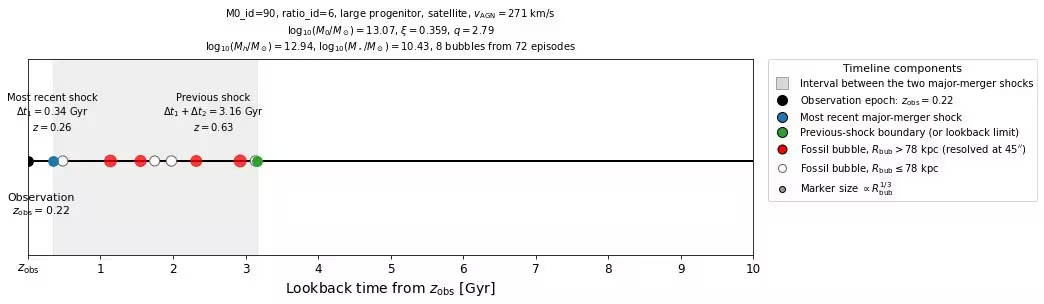
The proposed physical mechanism, known as Shock-Bubble Interaction (SBI), relies on a complex chain of astrophysical events. Supermassive black holes in massive galaxies periodically launch powerful jets of plasma that inflate giant, low-density bubbles into the surrounding halo gas. After the active jet phase subsides, these fossil lobes drift and evolve passively within the intergalactic or group environment until a major dark-matter halo merger generates a colossal shock wave.
When the shock front overtakes a fossil radio bubble, it compresses the cavity into a vortex ring. This process triggers particle acceleration via adiabatic compression, first-order Fermi mechanisms, and turbulent re-acceleration, causing the old plasma to light up brightly in synchrotron radiation. Viewed from favorable geometric angles, these compressed cavities emerge as striking circular rings.
To determine if this sequence happens frequently enough to match observations, the authors built an elaborate Monte Carlo model. The simulation integrates local galaxy stellar mass functions, empirical radio-AGN incidence rates, dark-matter halo merger trees, and detailed magnetohydrodynamic simulations of shock-bubble dynamics. Every simulated bubble is tracked through its inflation phase, buoyant rise, and survival against disruptive fluid instabilities before encountering a modeled shock wave.
Survey Predictions and Abundance Matching
When applying survey-specific selection criteria matching the ASKAP-EMU Pilot Survey operating at 944 MHz, the model predicts approximately 2.7 detectable ORCs within the surveyed volume. This theoretical expectation aligns closely with the three sources discovered during the actual pilot observations. Similarly, running the simulation through the parameters of the LOFAR Two-metre Sky Survey (LoTSS) at 144 MHz yields an expected population of around 268 detectable rings, underscoring how low-frequency observations are exceptionally sensitive to these aged, steep-spectrum structures.
The analysis reveals that the primary hosts for these phenomena are predominantly central galaxies residing within group-scale halos with masses near ten billion solar masses. Because these environments feature optimal gas densities and merger frequencies, they provide the ideal staging ground for shock-re-energized radio relics.
Resolving Discrepancies and Future Outlook
Despite its successes in matching overall source counts and angular sizes, the model highlights a notable tension regarding host galaxy redshifts. While the simulation predicts relatively nearby rings with a median redshift below 0.1, the putative host galaxies identified for known ORCs often sit at much higher redshifts between 0.2 and 0.6. The study’s authors propose several interpretations for this mismatch, including the possibility that some observed systems represent nearby floating bubbles projected against distant background galaxies, or that more energetic jet models and stronger magnetic fields are required to produce larger physical structures.
Ultimately, the work demonstrates that shock-bubble interactions provide a viable pathway for generating odd radio circles at rates consistent with current observational constraints. As next-generation radio telescopes continue scanning the cosmos with greater sensitivity and resolution, upcoming wide-field surveys will put these theoretical predictions to the ultimate test.
The study was posted to the arXiv preprint server on October 23, 2026.
This article has been fact checked for accuracy, with information verified against reputable sources. Learn more about us and our editorial process.
Last reviewed on .
Article history
- Latest version
Reference(s)
- Wang, Yiting. “A Population Synthesis Model for Odd Radio Circles Produced by Shock-Bubble Interactions.” arXiv.org <http://arxiv.org/abs/2610.32916v1>.
Cite this page:
- Posted by John Williams