Astronomers Reveal Exceptionally Luminous Gamma-Ray Burst With Extreme Energy
An international team of researchers has analyzed GRB 260924A, uncovering record-breaking energetics and intense broadband afterglow emission.
A colossal cosmic explosion detected across the cosmos has given astrophysicists an unprecedented look into the inner workings of extreme stellar deaths. Designated as GRB 260924A, the powerful transient event has been scrutinized by a team of researchers who combined space telescope data with extensive ground-based follow-up observations to map its evolution from its prompt gamma-ray flash to its fading afterglow.
The study, available on the arXiv preprint server, details how this cataclysmic event unfolded at a redshift of 3.51, placing its origin deep in the early Universe. The collaboration utilized data gathered by NASA’s Swift observatory and the Fermi Gamma-ray Space Telescope, alongside numerous optical and near-infrared facilities around the world, to construct a complete multiwavelength picture of the explosion.
Record-Breaking Energetics and Prompt Emission
According to the authors, the isotropic-equivalent gamma-ray energy of GRB 260924A reaches approximately 9.79 times 10 to the 54th power ergs. This staggering energy output places the burst near the absolute peak of the known gamma-ray burst population, putting it in a comparable energy tier to other hyper-luminous events such as the record-breaking GRB 221009A.
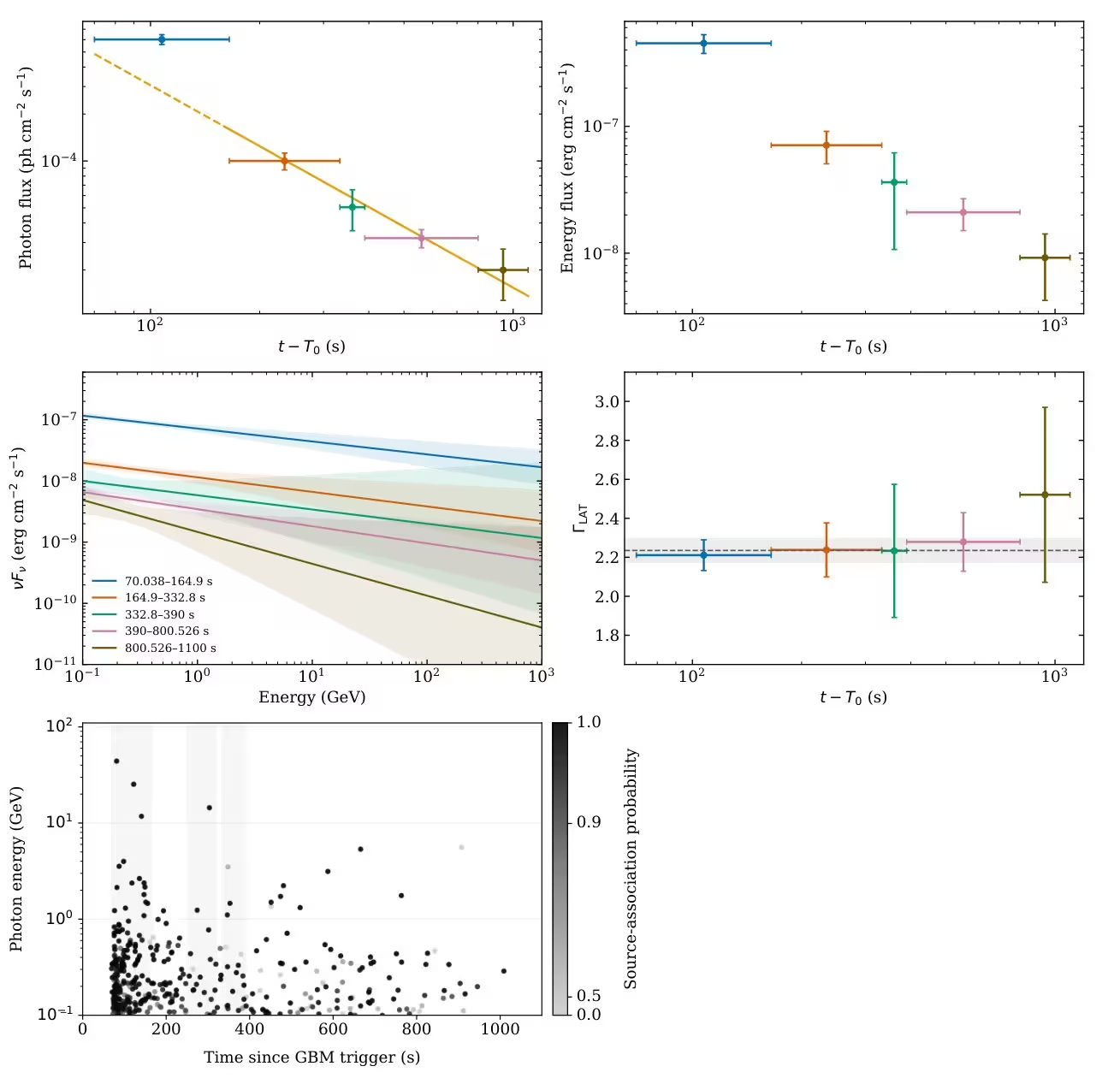
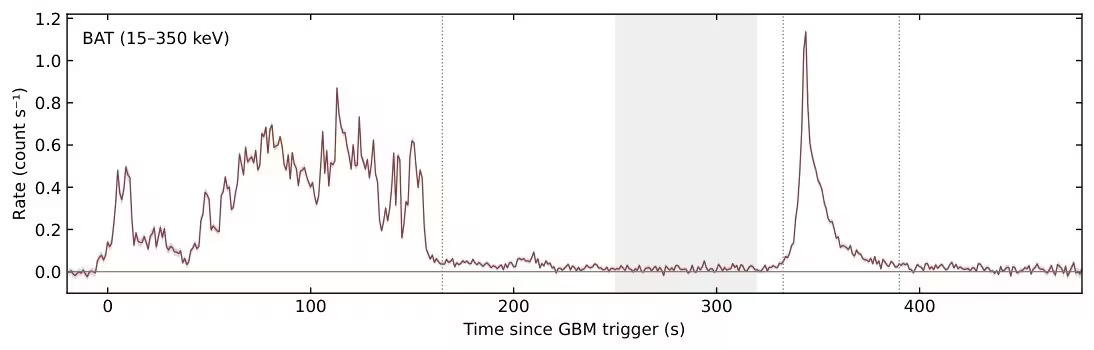
The prompt phase of the explosion was characterized by two exceptionally bright episodes separated by a lull in activity. During these high-energy phases, instruments detected rapid variability and hard spectra, accompanied by energetic gamma-rays stretching into the gigaelectronvolt regime. Notably, the Fermi Large Area Telescope captured high-energy emission extending past 1,000 seconds, including a remarkable 43.3 GeV photon arriving shortly after the initial trigger, as well as a 14.2 GeV photon emitted during the quieter interval between the main pulses.
A Luminous Afterglow and Complex Shock Physics
Following the prompt phase, both the X-ray and optical afterglows displayed extraordinary brightness. When transformed to a standard reference redshift, the optical afterglow significantly outshone typical long gamma-ray bursts, while the X-ray emission ranked among the most luminous observed at equivalent post-burst epochs. The researchers modeled these lingering emissions using external shock physics, incorporating both forward and reverse shock components.
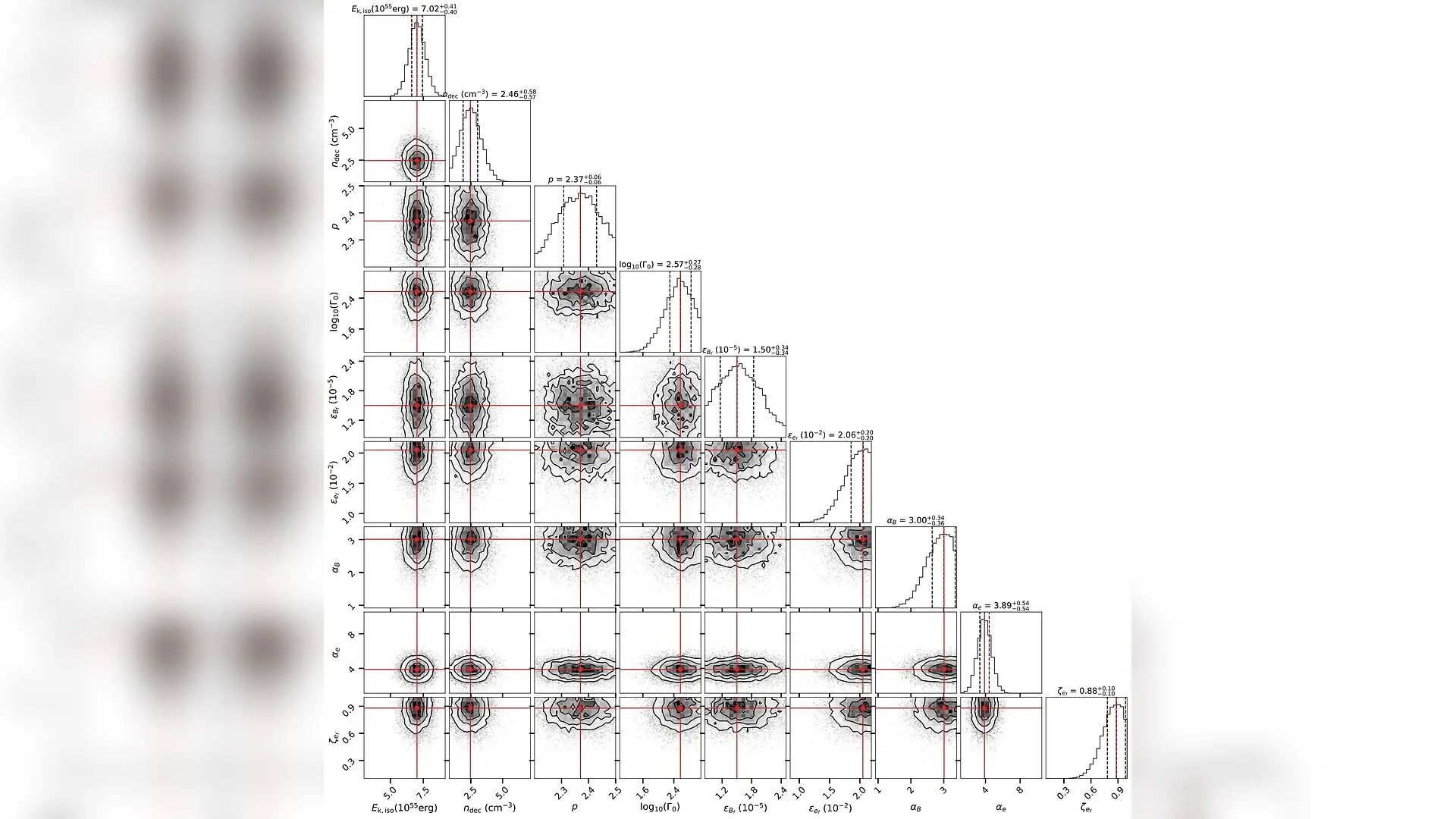
To account for an early excess in high-energy gamma-rays, the team applied a reverse-shock synchrotron self-Compton model. Furthermore, to explain a pronounced X-ray rebrightening observed several thousand seconds after the initial trigger, the authors invoked a scenario involving energy injection from slower trailing ejecta catching up with the primary blast wave, combined with evolving microphysical shock parameters.
Probing the Circumburst Environment
The multiwavelength data also allowed the researchers to probe the density structure of the gas surrounding the progenitor star. The temporal and spectral indices derived from the late-time optical and X-ray data favor an intermediate density gradient, which the team modeled as a stratified medium rather than a uniform interstellar cloud or a standard stellar wind. This environment, combined with a large underlying kinetic energy reservoir, indicates that the extreme apparent brightness of GRB 260924A stems from a combination of immense intrinsic power and favorable shock dynamics rather than an impossibly high radiative efficiency.
Although the data do not yield a definitive jet-break signature that would allow researchers to measure the exact opening angle of the relativistic outflow, the comprehensive dataset establishes GRB 260924A as a vital laboratory for understanding particle acceleration and magnetic field amplification in relativistic shocks. The findings reinforce how massive energy reserves, complex circumburst environments, and evolving shock microphysics jointly shape the fleeting glows of the universe’s most violent explosions.
The study was posted to the arXiv preprint server on October 23, 2026.
This article has been fact checked for accuracy, with information verified against reputable sources. Learn more about us and our editorial process.
Last reviewed on .
Article history
- Latest version
Reference(s)
- Fraija, Nissim. “GRB 260924A: Extreme Energetics, Bright GeV Emission, and Exceptional X-ray and Optical Luminosity.” arXiv.org <http://arxiv.org/abs/2610.32861v1>.
Cite this page:
- Posted by John Williams