Cavity Coupling Can Undermine Quantum Coherence in Molecules
Physicists discover that strong light-matter coupling can paradoxically destroy memory-assisted quantum protection in structured molecular environments.
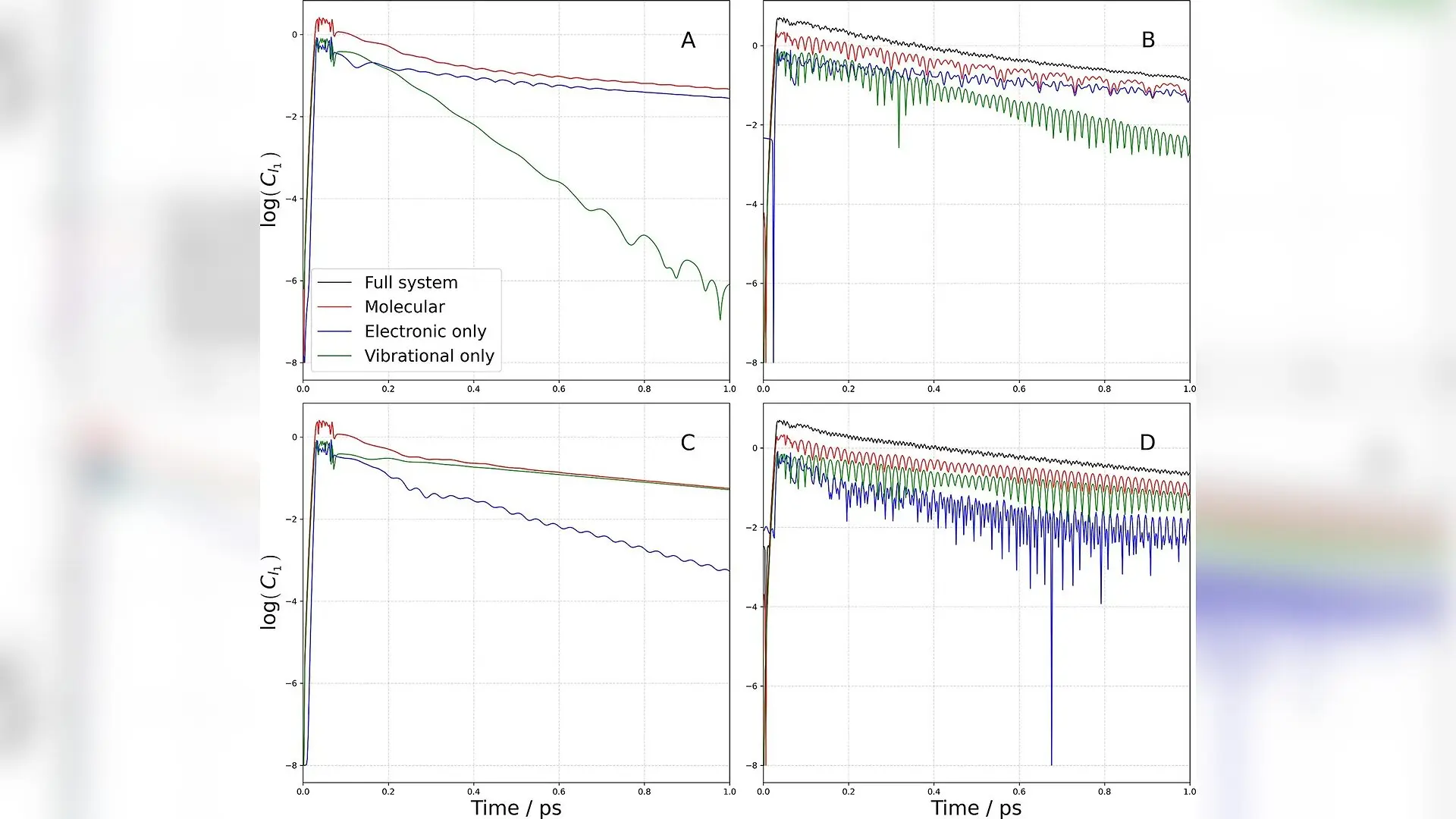
Placing molecules inside optical cavities has emerged as a central strategy in modern physical chemistry for controlling chemical reactions, altering photophysics, and protecting quantum states through light-matter hybridization. When confined within a cavity, molecules form hybrid polaritonic states that can decouple from environmental noise and slow down decoherence. At the same time, open-quantum-systems theory highlights that structured vibrational environments possess environmental memory, known as non-Markovianity, which allows information to flow back from the bath to the system and revive lost quantum coherence. Yet, how these two powerful mechanisms interact when combined has remained an open and challenging question for researchers.
To address this puzzle, a team of scientists published in The Journal of Physical Chemistry Letters investigated the direct competition between vibrational bath recurrence and polaritonic restructuring. Led by researchers exploring molecular cavity quantum electrodynamics, the team modeled an open quantum vibronic molecule featuring two electronic states separated by an energy gap of 16,000 cm⁻¹, each coupled to an intramolecular vibration of frequency 350 cm⁻¹. This molecular system was placed inside a single quantized optical cavity resonant with the electronic transition, operating firmly within the strong-coupling regime with a coupling strength of 1,000 cm⁻¹.
Deciphering Environmental Memory and Coherence Dynamics
To quantify how information is exchanged between the molecule and its environment, the authors utilized the hierarchical equations of motion to treat structured vibrational baths numerically and exactly across different damping regimes. They tracked system coherence using the l₁ norm of coherence, while environmental memory was evaluated using the Breuer-Laine-Piilo measure of non-Markovianity. By analyzing both overdamped and underdamped spectral densities, the team systematically mapped how cavity coupling modifies information backflow and alters decoherence rates.
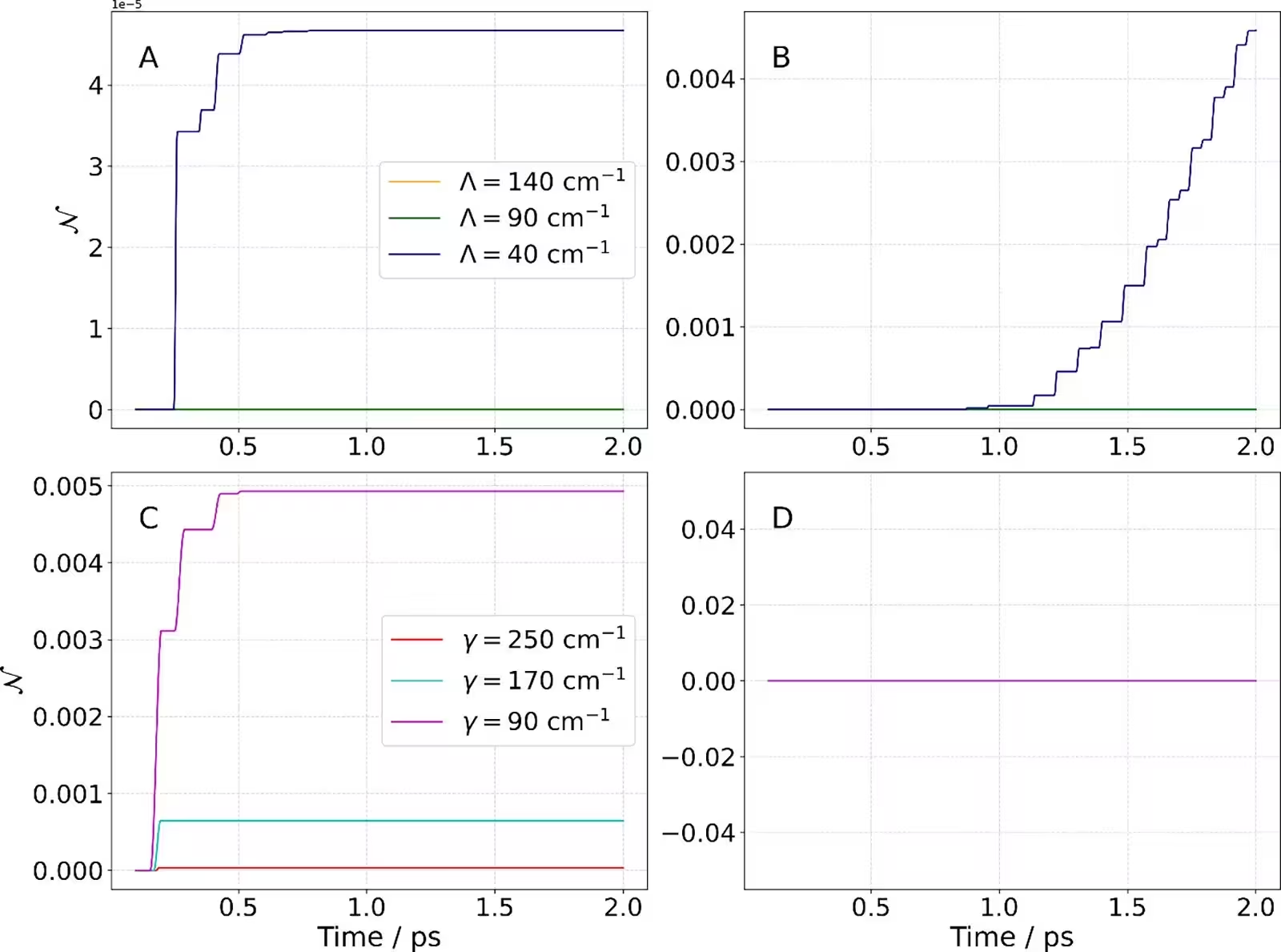
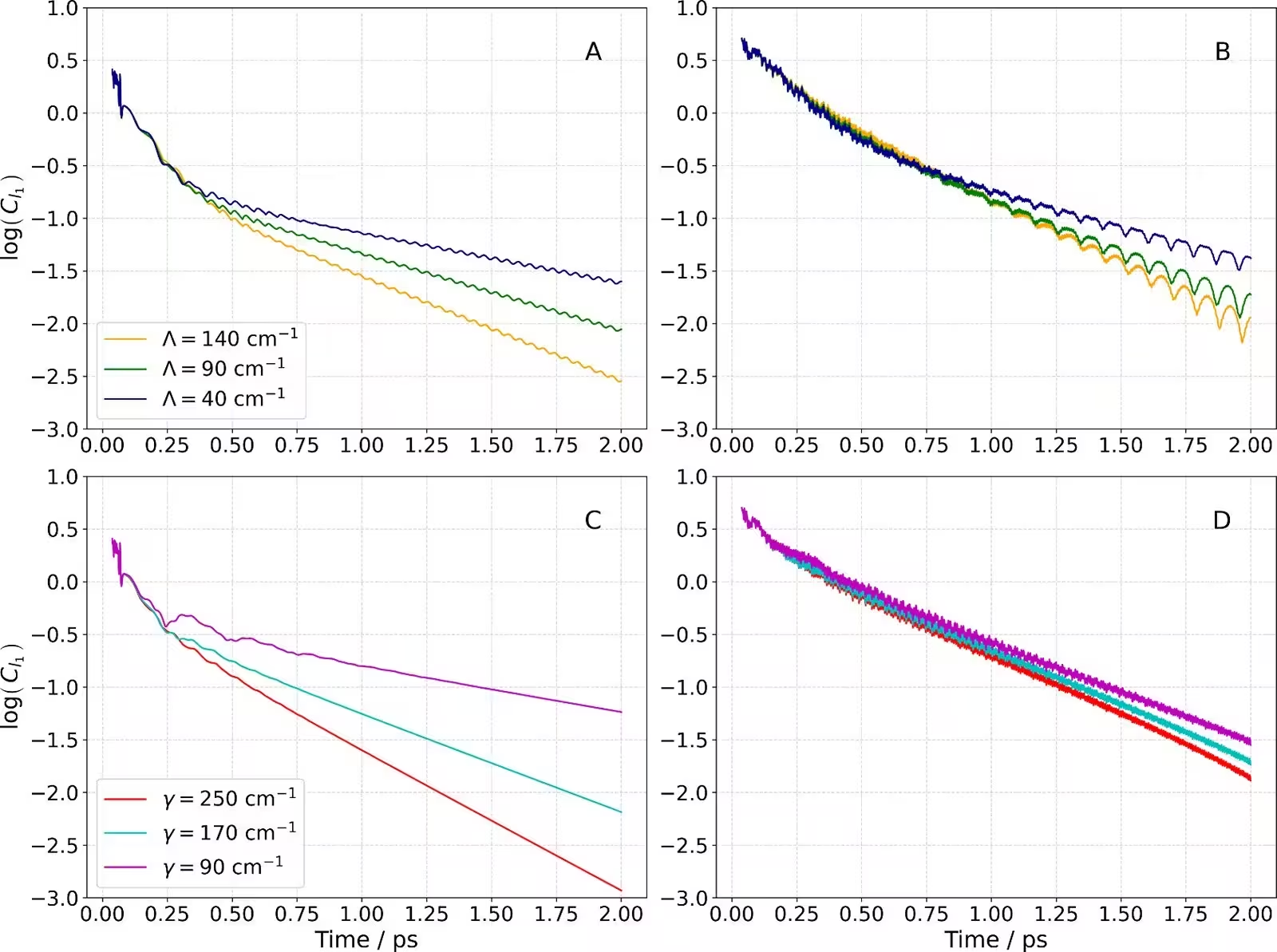
The results reveal a stark contrast depending on the nature of the environmental bath. In overdamped environments, where memory effects are relatively weak, strong cavity coupling enhances the accumulated information backflow and slows down overall decoherence. Here, the cavity acts as a protective shield, detuning the system from broad spectral densities and extending polaritonic lifetimes.
However, the behavior changes dramatically in structured underdamped environments where the bath is resonant with the molecular vibrations. In these regimes, the uncoupled molecule naturally benefits from persistent, in-phase information backflow that sustains quantum coherence over extended time scales. When a cavity is introduced, light-matter hybridization shifts the system eigenstructure through polaritonic splitting, detuning the vibrational modes away from the resonant peak. This resonance mismatch disrupts the constructive information backflow, suppressing memory-assisted coherence and accelerating decoherence even when photon loss from the cavity mirrors is virtually nonexistent.
Implications for Polaritonic Chemistry
Further systematic sweeps of the light-matter coupling strength demonstrated that weak cavity coupling immediately interrupts environmental memory by shifting internal frequencies away from resonance. As coupling strength increases further, the system enters a polaritonic shielding regime where electronic splitting drives the polaritonic branches entirely out of the bath’s Lorentzian peak, ultimately rescuing coherence at higher coupling values.
These insights carry significant implications for the growing field of polaritonic chemistry and plasmonic nanocavities. While the study focuses on the single-molecule limit, the findings provide a foundational framework for understanding collective strong-coupling regimes involving multiple molecules. In multi-molecule ensembles, bright polaritonic states experience collective Rabi splitting that pushes them even further from local vibrational resonances, suggesting that the suppression of environmentally assisted coherence could persist or intensify for bright manifolds. Ultimately, the work proves that cavity coupling is not a universal shield for quantum states, but rather a complex modulator of system-bath dynamics that must be carefully tuned based on the underlying environmental structure.
The research was published in The journal of physical chemistry letters on October 15, 2026.
This article has been fact checked for accuracy, with information verified against reputable sources. Learn more about us and our editorial process.
Last reviewed on .
Article history
- Latest version
Reference(s)
- Kinslow, Joshua C.., et al. “Limits of Memory-Assisted Coherence in Cavity-Embedded Molecules.” The Journal of Physical Chemistry Letters, vol. 17, no. 41, October 5, 2026, pp. 11723-11730. American Chemical Society (ACS), doi: 10.1021/acs.jpclett.6c02396. <https://doi.org/10.1021/acs.jpclett.6c02396>.
Cite this page:
- Posted by John Williams