Optically Tracked Reversible Single-Atomic-Monolayer Redox in Plasmonic Nanocavities
Scientists track reversible redox switching in an atomic monolayer trapped inside a plasmonic nanocavity, pointing toward highly energy-efficient nanoelectronics.
Controlling reduction-oxidation reactions within ever-smaller active volumes represents a central pillar in the development of next-generation memory, logic, and neuromorphic computing systems. Memristors and resistive random-access memories rely on nanoscale conductive pathways formed between electrodes, yet their active switching regions traditionally span tens of nanometers or suffer from poorly controlled geometries. Scaling these operational structures down to the atomic level introduces complex fabrication and observation hurdles, primarily because conventional characterization techniques often alter or destroy the delicate nonambient conditions required for precise tracking.
To address these obstacles, a team of researchers published in Nano Letters an in situ plasmonic-electrochemical platform designed to probe redox processes within extreme subnanometer gaps. By utilizing a nanoparticle-on-mirror architecture, the investigators created a dual-purpose system that functions simultaneously as a confined plasmonic cavity and a localized electrochemical reactor. This geometry leverages the power of surface-enhanced Raman spectroscopy to deliver real-time, chemically specific monitoring of atomic-scale transformations without destroying the sample.
Precision Growth and Confinement
The fabrication process begins with template-stripped, atomically smooth gold films onto which an atomic monolayer of palladium is deposited using underpotential deposition. Cyclic voltammetry confirms the precision of this growth, displaying clear signatures of underpotential deposition and metal stripping behavior. Monolithic gold nanoparticles measuring eighty nanometers in diameter are subsequently drop-cast at low concentrations onto the film, creating isolated nanoparticle-on-mirror configurations.
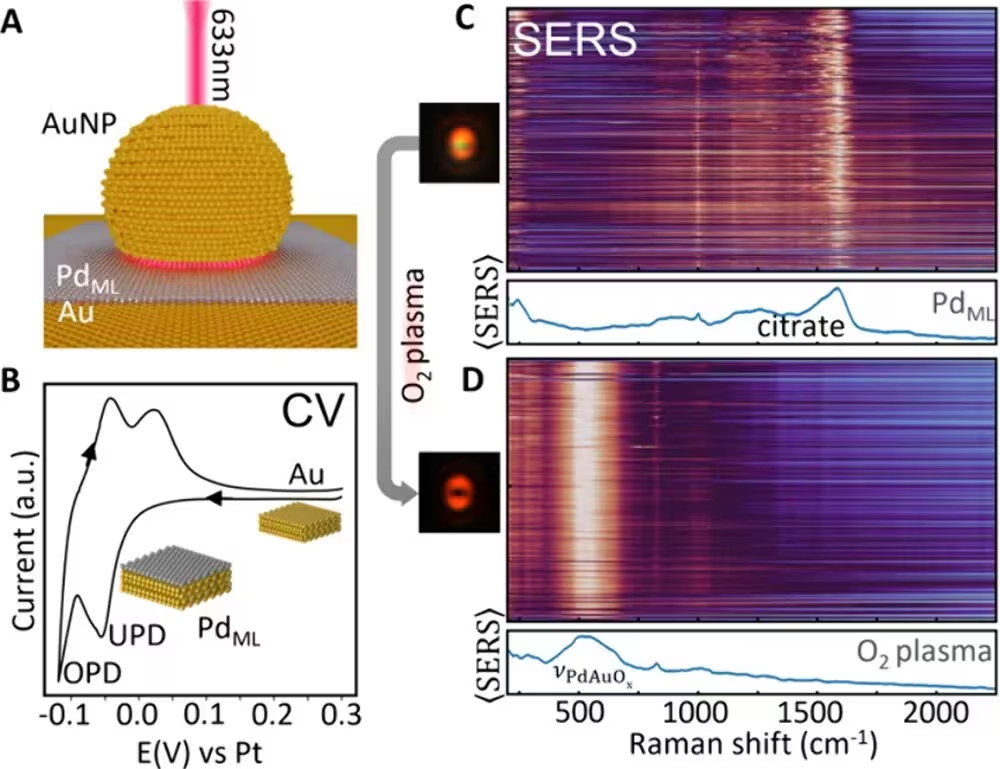
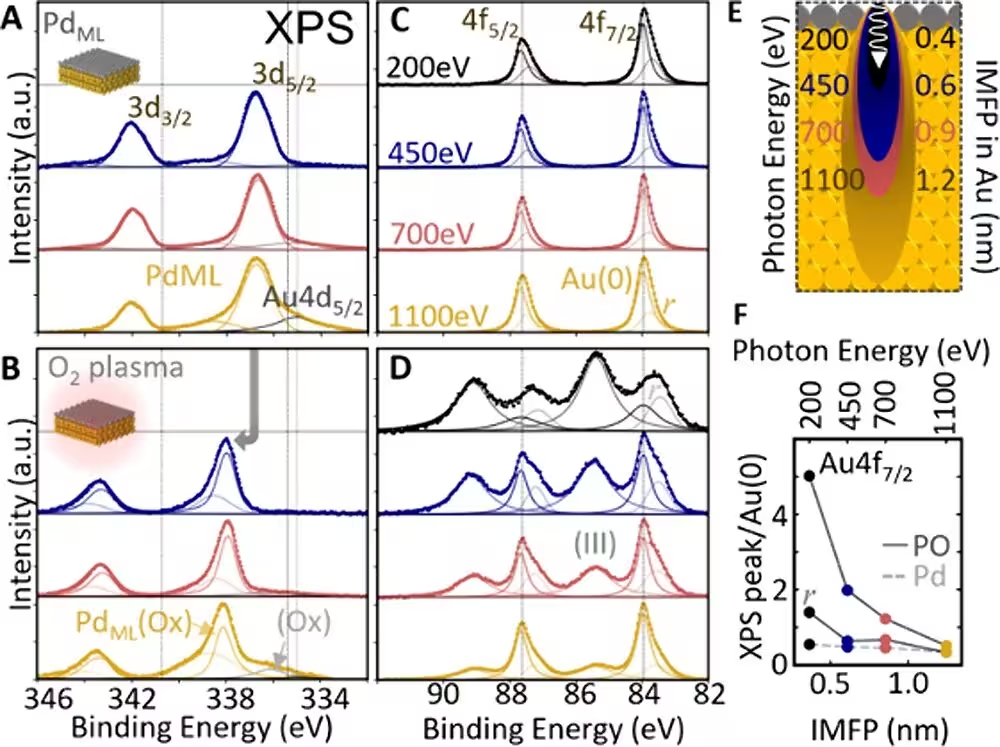
To initiate and track oxidation, the researchers employed both oxygen plasma cleaning and electrochemical gating within a customized spectro-electrochemical cell. When subjected to potential sweeps in a potassium phosphate buffer, the system demonstrated repeatable transformations between metallic and oxidized states. Spectroscopic tracking revealed that the palladium monolayer effectively protects the underlying gold substrate from unwanted oxidation, confirming complete and uniform coverage across the active area.
Real-Time Optical Tracking and Energy Efficiency
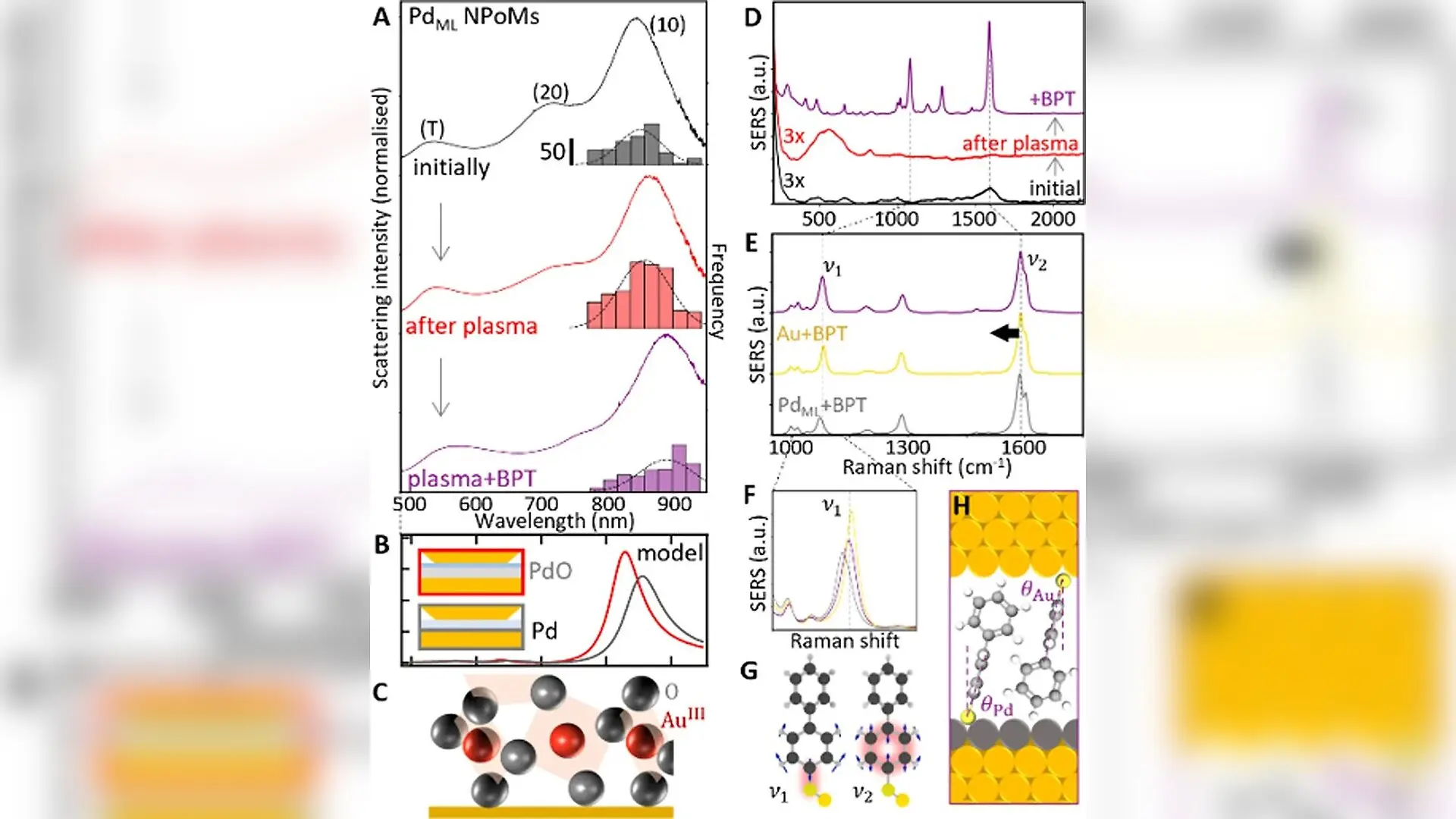
Monitoring the system via dark-field scattering spectroscopy and surface-enhanced Raman spectroscopy allowed the team to map subtle shifts in the plasmonic resonance and vibrational modes during redox cycling. The confined plasmonic nanocavity concentrates optical fields far below the diffraction limit, amplifying sensitivity to electronic and vibrational changes. The experimental data demonstrated rapid, reversible transitions occurring in under a second under ambient conditions.
Because the active switching volume is restricted to a single atomic monolayer, the thermodynamic lower bound for the charge-transfer cost drops to approximately one femtojoule per gap. This substantial reduction in energy requirements highlights the viability of atomic-scale metallic layers for future low-power electronics. Furthermore, the introduction of thiolated molecules into the nanogaps confirmed that molecular layers can stably penetrate and interact with the cavity across multiple redox cycles.
Ultimately, this platform establishes a robust experimental framework for investigating atomic-scale electrochemistry. By demonstrating that ultrathin metal layers can undergo repeatable, reversible redox transformations within optical hotspots, the work opens new avenues for creating highly tunable, energy-efficient nanodevices and neuromorphic hardware architectures.
The research was published in Nano letters on October 7, 2026.
This article has been fact checked for accuracy, with information verified against reputable sources. Learn more about us and our editorial process.
Last reviewed on .
Article history
- Latest version
Reference(s)
- Goerlitzer, Eric S. A.., et al. “Optically Tracked Reversible Single-Atomic-Monolayer Redox in Plasmonic Nanocavities.” Nano Letters, vol. 26, no. 39, September 21, 2026, pp. 13272-13278. American Chemical Society (ACS), doi: 10.1021/acs.nanolett.6c02438. <https://doi.org/10.1021/acs.nanolett.6c02438>.
Cite this page:
- Posted by John Williams