Ultra-Precise Furan Structure Mapped Using 44 Isotopologues
A massive spectroscopic undertaking charts 44 isotopologues of furan, yielding an unprecedented atomic-scale geometry and sharpening models for organic ring systems.
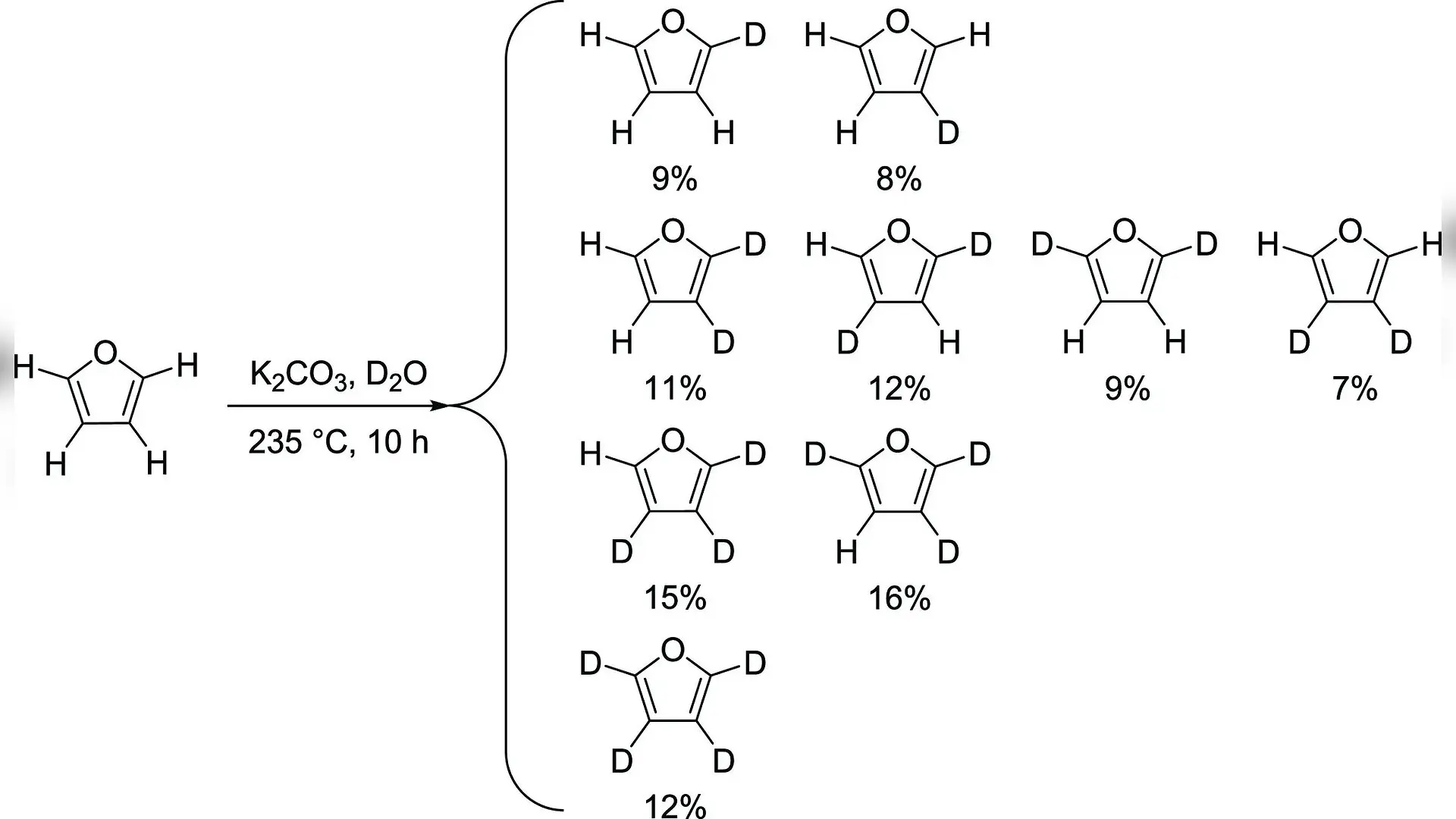
A team of physical chemists has established a remarkably accurate semi-experimental equilibrium structure for furan, pushing the boundaries of molecular spectroscopy and resolving persistent gaps between theoretical models and empirical measurements. By investigating an unprecedented array of 44 isotopic variants, the researchers achieved sub-milliangstrom precision in bond lengths and sub-degree precision in bond angles, offering a definitive structural blueprint for this fundamental aromatic heterocycle.
The work, published in The Journal of Physical Chemistry A, addresses a long-standing challenge in molecular physics. While furan has been studied for decades due to its significance in organic chemistry and its status as a prime candidate for astrochemical detection in the interstellar medium, precisely determining its equilibrium structure has remained difficult. Small discrepancies between theoretical equilibrium geometries and semi-experimental structures have routinely surfaced across various ring molecules, frustrating attempts to fully validate high-level quantum chemical computations.
Overcoming Spectroscopic Hurdles with 44 Isotopologues
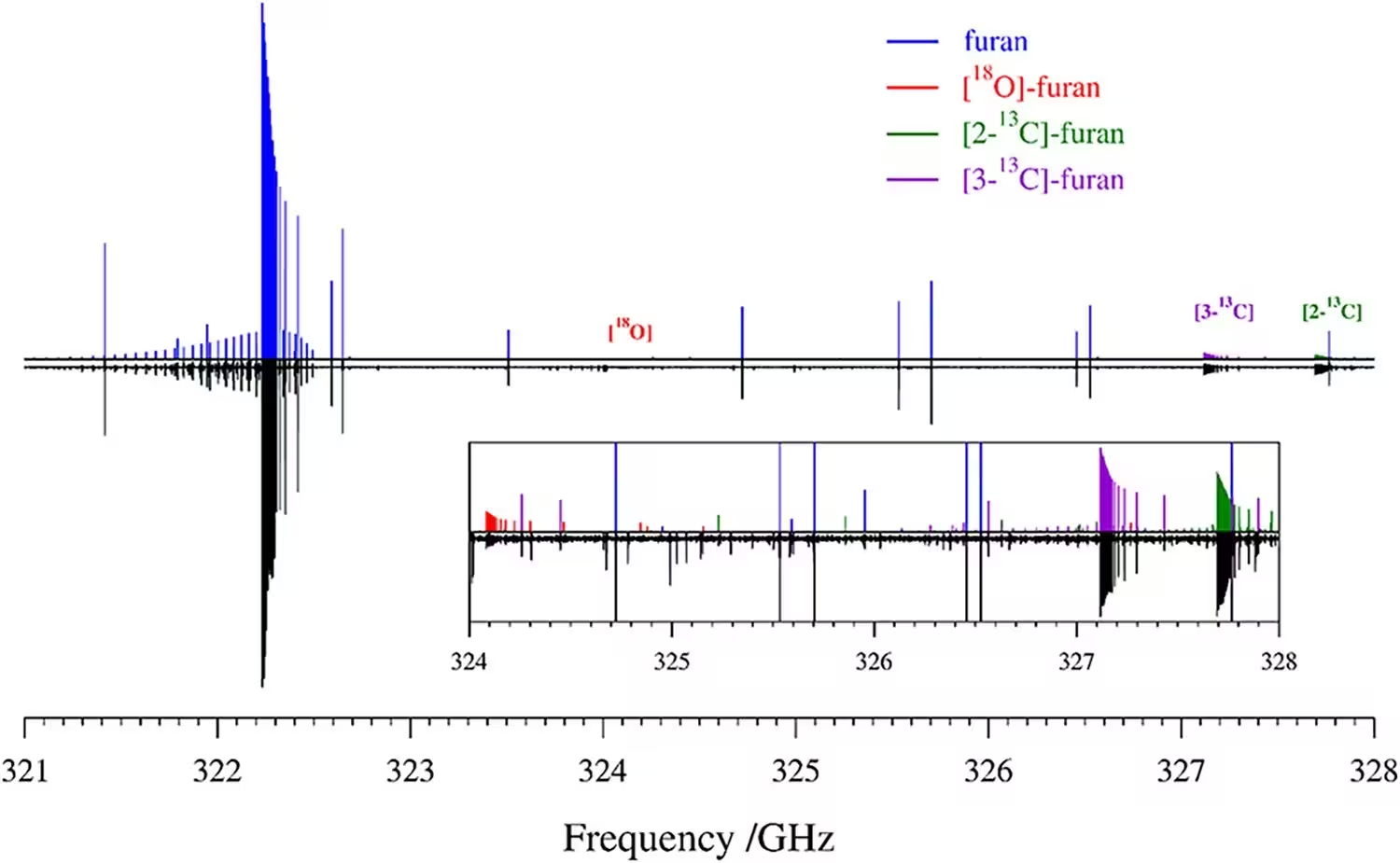
To capture enough structural constraints to overcome these errors, the researchers utilized high-temperature, high-pressure base-catalyzed hydrogen-deuterium exchange in heavy water. This procedure generated a complex mixture containing every possible deuterium-substituted furan variant, known as furan-dx isotopologues. Combined with commercially available samples and natural-abundance heavy-atom substitutions involving carbon-13 and oxygen-18, the team recorded and analyzed thousands of rotational transitions across a massive frequency range stretching from 6 to 750 GHz.
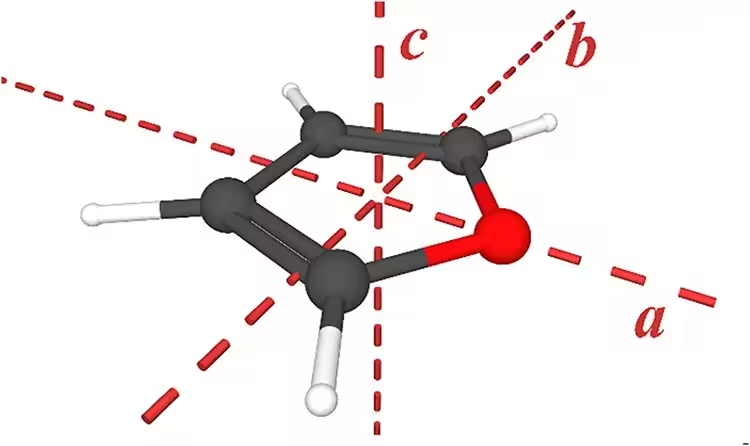
The measurements relied on advanced instrumentation across multiple laboratories, including continuous broadband spectrometers and chirped-pulse Fourier transform microwave setups paired with supersonic jet expansions. Out of the 44 isotopologues successfully incorporated into the final analysis, 35 had never been observed or analyzed in a rotational study before. This massive expansion in dataset size allowed the team to dramatically overdetermine furan’s structural parameters.
Correcting Axis Rotation and Vibrational Interactions
A primary breakthrough in the new study involved correcting a subtle flaw that has plagued previous semi-experimental structure determinations. When isotopic substitution occurs in near-oblate asymmetric top molecules like furan, the principal inertial axes rotate relative to the parent molecule. If left unaccounted for, this axis rotation distorts the computed vibration-rotation interaction corrections, introducing systematic errors into the derived bond lengths and angles.
The research team applied a refined methodology that recalculated the anharmonic force constants and vibration-rotation interactions directly at the semi-experimental geometry rather than relying solely on standard theoretical baseline geometries. This adjustment eliminated large residual errors that had previously affected specific carbon-13 and deuterium-substituted isotopologues, bringing the standard deviations of the rotational constant residuals down by a factor of four. The resulting structural parameters display a smooth, asymptotic convergence as more isotopologues are added to the calculation.
Implications for Astrobiology and Comparative Chemistry
The newly refined structural parameters reveal bond distances with 2sigma uncertainties down to 0.0003 Ångstroms and bond angles precise to within 0.02 degrees. Although most structural features align well with the team’s best theoretical estimates calculated via coupled-cluster theory at the basis set limit, a few parameters such as specific carbon-hydrogen and oxygen-carbon bonds fall just outside the tight experimental uncertainty limits, pointing to remaining theoretical limitations in evaluating higher-order vibration-rotation terms or core-electron correlations.
Beyond fundamental physical chemistry, the comprehensive set of high-precision spectroscopic constants provides invaluable rest frequencies for radio astronomers and astrobiologists searching for complex organic molecules in cold molecular clouds and planetary comets. Furthermore, direct comparison between furan and its sulfur-containing analogue, thiophene, highlights distinct electronic and geometric adjustments across five-membered aromatic rings, deepening our understanding of how heteroatom substitution influences molecular architecture.
The research was published in The journal of physical chemistry. A on October 1, 2026.
This article has been fact checked for accuracy, with information verified against reputable sources. Learn more about us and our editorial process.
Last reviewed on .
Article history
- Latest version
Reference(s)
- Mehalko, Kolton T.., et al. “Structure of Furan from 44 Isotopologues─Resolving Differences in the Theoretical ( r e ) and Semi-Experimental Equilibrium ( re SE) Structures.” The Journal of Physical Chemistry A, vol. 130, no. 39, September 16, 2026, pp. 7783-7800. American Chemical Society (ACS), doi: 10.1021/acs.jpca.6c04036. <https://doi.org/10.1021/acs.jpca.6c04036>.
Cite this page:
- Posted by John Williams