New Molecular Design Strategy Yields Record-Stable Monolayers for Organic Electronics
Combining phosphonic acid anchoring with a rigid tripodal architecture pushes the thermal and chemical limits of ultrathin organic films on oxide surfaces.
The fabrication of high-performance organic field-effect transistors, organic light-emitting devices, and advanced solar cells relies heavily on precise surface modification. Engineers routinely employ self-assembled monolayers to govern the critical interface between organic semiconductors and underlying metal oxide gate dielectrics. Because the active conduction channel in these devices is often only a few nanometers thick, optimizing interface morphology and suppressing charge trapping can drastically improve key electrical metrics, such as charge mobility, threshold voltage, and on/off ratios. To function effectively in electronic architectures, these interfacial organic films must fulfill several stringent criteria. They need to feature upright-oriented aromatic structures that promote the orderly growth of high-mobility organic semiconductors like pentacene, possess minimal thickness to maximize capacitance and current at low operating voltages, withstand rigorous device fabrication and operational heating, and accommodate tailored functional groups to control interfacial dipoles.
While long-chain aliphatic monolayers on naturally oxidized aluminum serve as useful model dielectrics, their thickness and electrical properties limit their utility for gate electrode engineering. Aromatic monolayers offer a much more promising solution, yet their stability remains a difficult challenge. A new study published in The Journal of Physical Chemistry Letters addresses this limitation by examining the formation, structural characteristics, thermal resilience, and chemical robustness of ultrathin aromatic monolayers anchored to naturally oxidized aluminum substrates.
Comparing Anchoring Groups and Bonding Geometries
To pinpoint the structural features that maximize monolayer durability, the research team investigated molecules featuring either phenyl backbones (yielding monopodal attachment) or rigid, propeller-shaped triptycene frameworks consisting of three phenyl rings configured for tripodal binding. These molecular backbones were paired with either carboxylic acid or phosphonic acid anchoring groups. This dual approach allowed the investigators to decouple and evaluate the individual and combined effects of anchoring chemistry and bonding multiplicity.
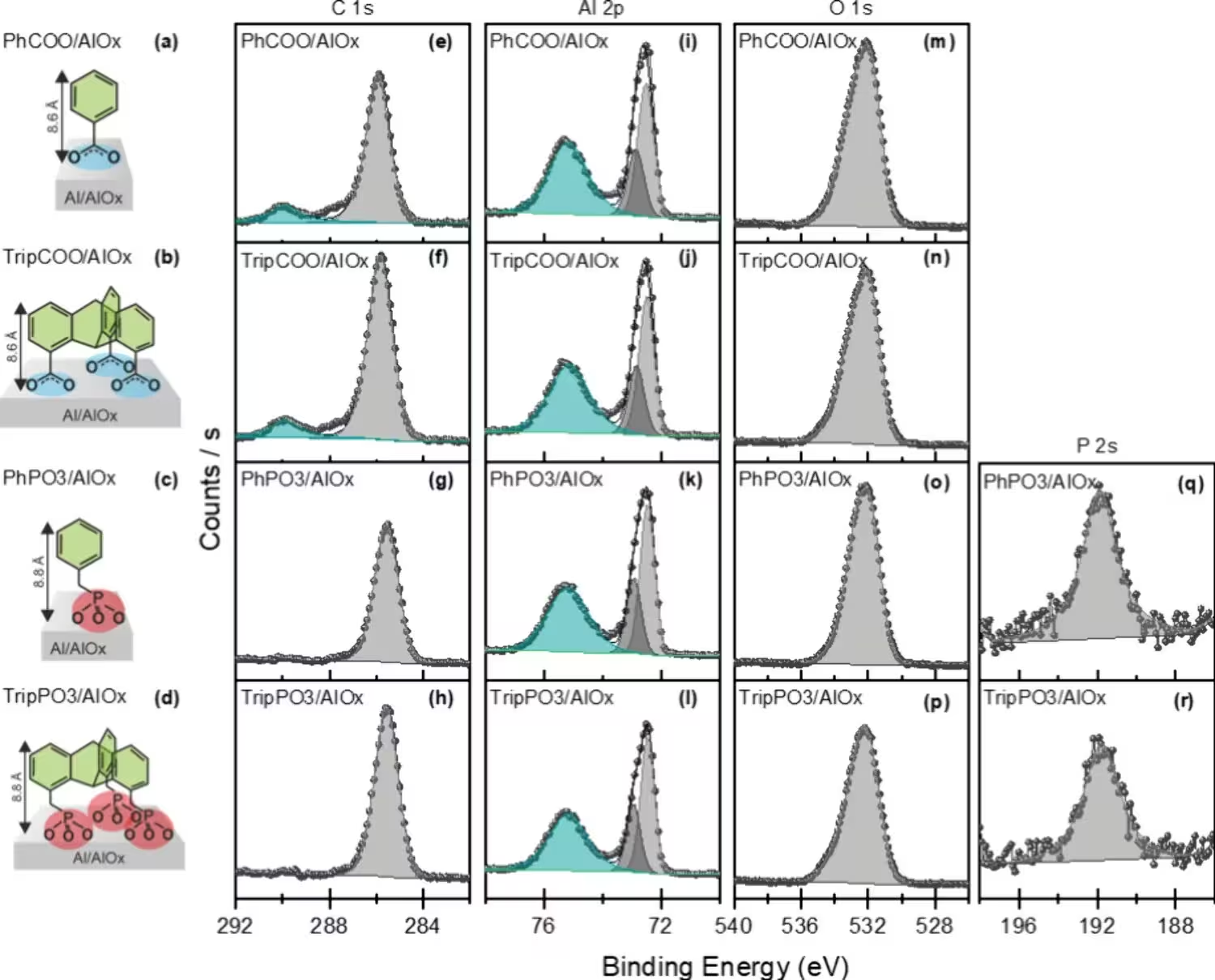
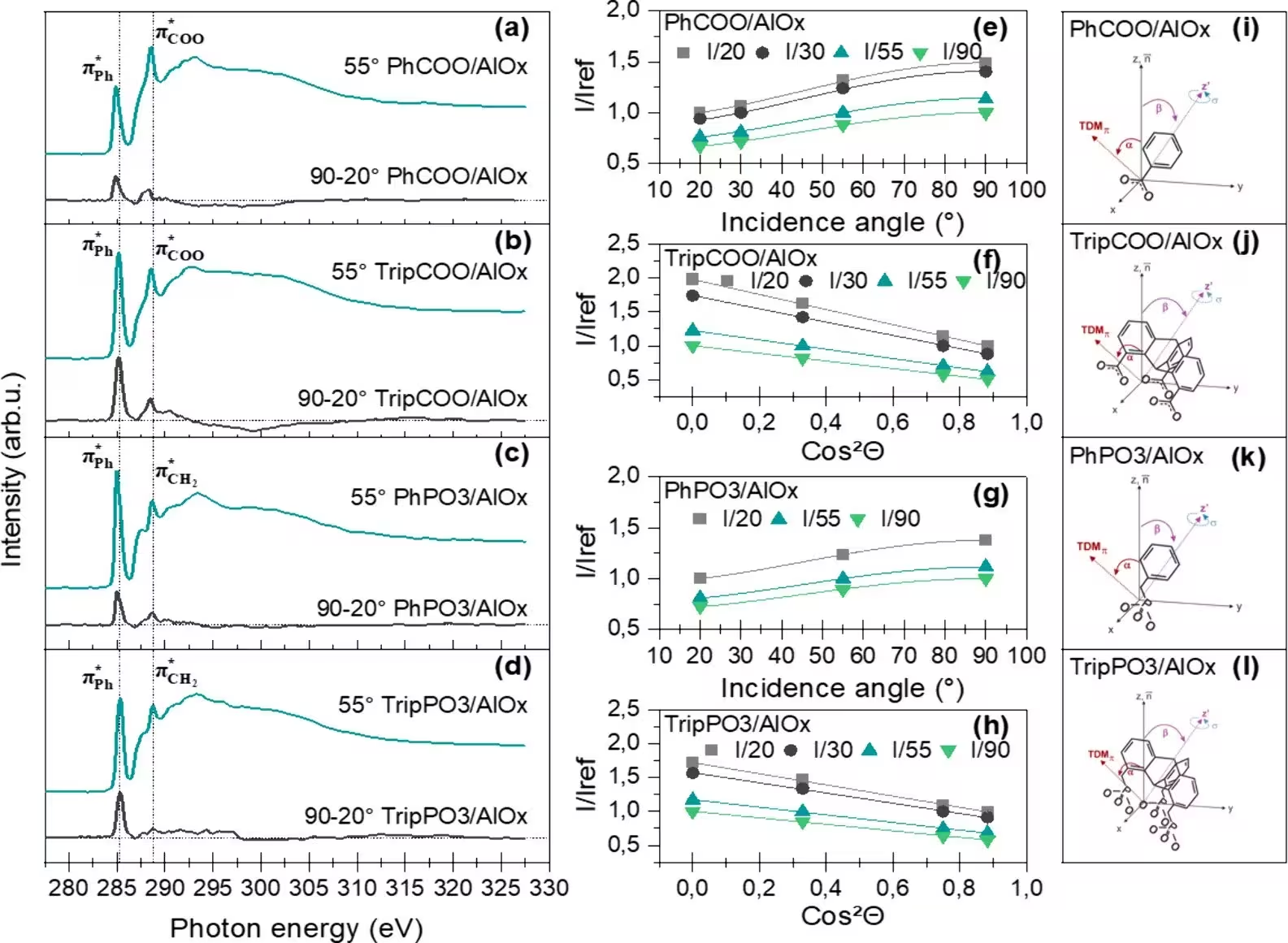
Using advanced analytical techniques including X-ray photoelectron spectroscopy and near-edge X-ray absorption fine structure spectroscopy, the investigators confirmed that all tested molecular architectures successfully formed densely packed, upright-oriented monolayers measuring approximately one nanometer in thickness. Despite these similar physical dimensions, thermal and chemical stability varied dramatically depending on the chosen chemical architecture.
Thermal Desorption and Chemical Resistance Benchmarks
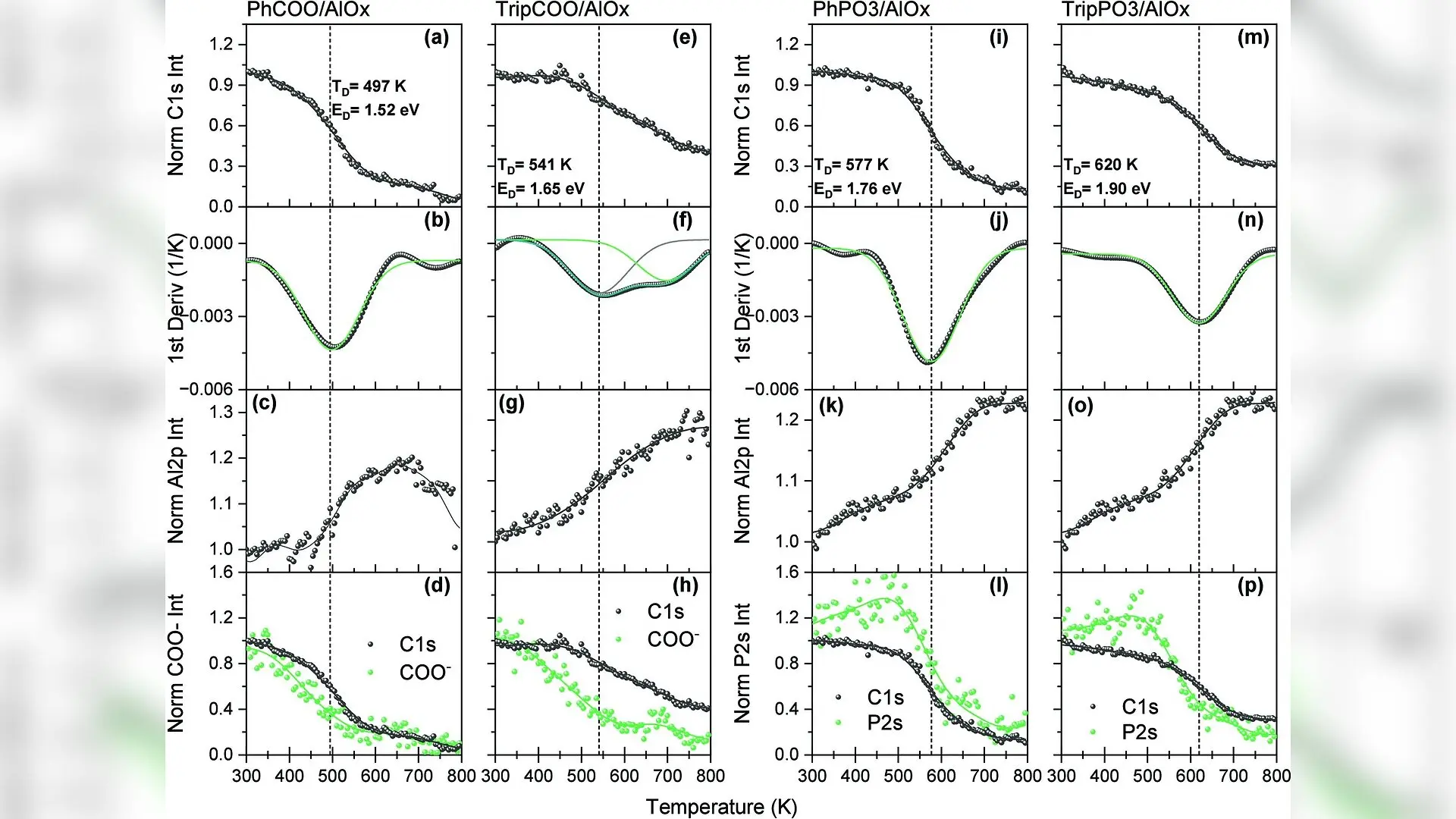
Quantitative thermal stability assessments via thermally programmed X-ray photoelectron spectroscopy revealed striking differences among the configurations. Monolayers anchored with phosphonic acid consistently demonstrated substantially higher desorption temperatures and desorption energies compared to their carboxylic acid counterparts, regardless of whether the molecular backbone was phenyl-based or triptycene-based. Specifically, phosphonic acid anchoring elevated desorption energies by approximately 0.2 electron volts.
Furthermore, adopting a tripodal binding mode via the triptycene framework provided an additional stability enhancement, further raising desorption energies. The combination of phosphonic acid anchoring and tripodal binding culminated in a record-high desorption energy of roughly 1.9 electron volts for the triptycene phosphonate system on aluminum oxide. This performance places the ultrathin film on par with some of the most thermally stable carbene-based monolayers known on gold substrates.
Chemical exchange experiments reinforced these findings by probing the resistance of the monolayers to displacement by competing molecules in solution. While carboxylic acid-anchored films exhibited high susceptibility to exchange, phosphonic acid-based systems demonstrated extraordinary resistance. Notably, the tripodal phosphonate architecture displayed virtually no measurable molecular exchange, underscoring its exceptional chemical robustness.
Implications for Next-Generation Electronics
These insights establish a clear, systematic blueprint for engineering robust, ultrathin aromatic interfaces on technologically relevant metal oxide surfaces. The remarkable thermal stability and chemical resilience of tripodal phosphonate monolayers make them exceptionally well-suited for demanding applications such as gate electrode engineering in organic transistors. Meanwhile, carboxylic acid-based triptycene systems offer unique versatility for processes requiring simultaneous functionalization of both metal and oxide electrodes. By illuminating how anchoring chemistry and multipodal bonding govern monolayer integrity, this research paves the way for more reliable, durable, and efficient organic electronic devices.
The research was published in The journal of physical chemistry letters on October 1, 2026.
This article has been fact checked for accuracy, with information verified against reputable sources. Learn more about us and our editorial process.
Last reviewed on .
Article history
- Latest version
Reference(s)
- Rojek, Anna., et al. “Ultrathin and Stable Aromatic Monolayers on Naturally Oxidized Aluminum: The Role of Type and Number of Anchoring Groups.” The Journal of Physical Chemistry Letters, vol. 17, no. 39, September 16, 2026, pp. 11261-11270. American Chemical Society (ACS), doi: 10.1021/acs.jpclett.6c02547. <https://doi.org/10.1021/acs.jpclett.6c02547>.
Cite this page:
- Posted by John Williams