Dying Black Hole Vibrations Could Reveal Hidden Matter We Never Knew Existed
A new scientific framework suggests that hidden black hole hair could leave unique fingerprints in gravitational waves, potentially revealing mysterious matter.
When two black holes spiral inward and merge, they leave behind a violent, fading ripple in the fabric of spacetime. This final stage, known as the ringdown, serves as a gravitational echo that encodes the fundamental nature of the newly formed object. New research suggests that this echo may hold the key to uncovering “hair”—the invisible signatures of surrounding matter or exotic physics that deviate from Einstein’s standard gravitational models.
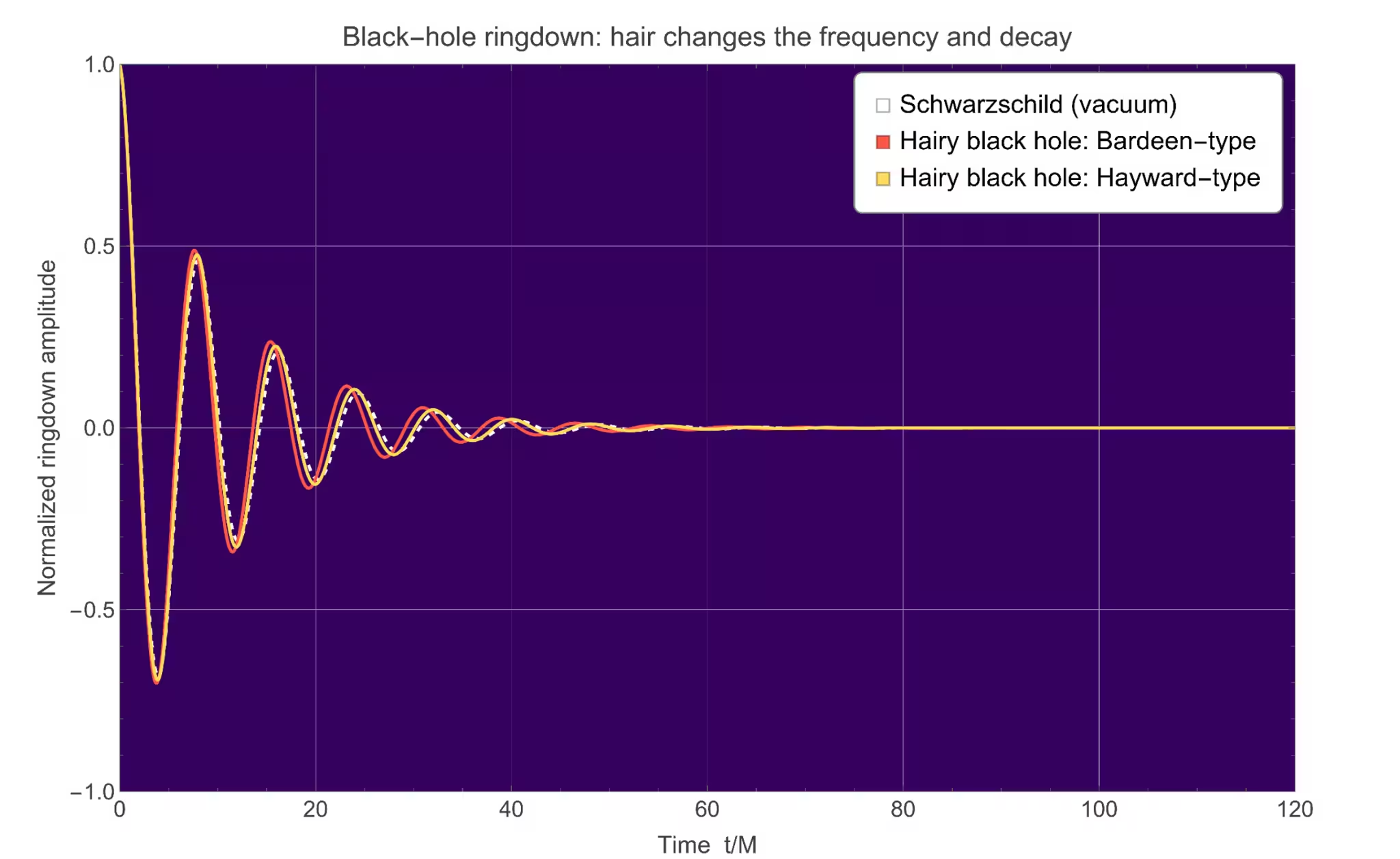
A team at Nagoya University has developed a mathematical framework that links the characteristics of these dying vibrations to the properties of matter potentially lurking near a black hole. Their findings, published in the Journal of Cosmology and Astroparticle Physics, demonstrate that the oscillation frequency and the damping rate of a ringdown respond to hidden material in distinct, measurable ways.

“The ringdown waves may not only show that something extra is affecting the black hole; the way the signal changes could also give us clues about what this hidden matter is actually like,” explains lead author Ariadna Uxue Palomino Ylla.
Decoding the Cosmic Bell
According to general relativity, an isolated rotating black hole is a simple, predictable entity defined solely by its mass and angular momentum. When nudged, it undergoes quasinormal modes—vibrations that oscillate at specific frequencies and decay at specific rates. By measuring these, astronomers can perform “black hole spectroscopy,” testing whether these cosmic giants strictly follow Einsteinian predictions.
The Nagoya team modeled deviations from this ideal picture by surrounding black holes with an effective anisotropic fluid. This fluid serves as a theoretical proxy for complex phenomena such as dark-sector fields, exotic matter, or corrections to gravity itself.
The Role of Unstable Photon Orbits
Calculating the exact ringdown for every conceivable hairy black hole is a computationally daunting task. To simplify this, the researchers utilized the link between quasinormal modes and unstable photon orbits. Near a black hole, light can briefly circle in unstable paths; the frequency of these orbits aligns with the oscillation of the ringdown, while the rate at which these orbits break down—the Lyapunov exponent—mirrors the decay of the gravitational-wave signal.
By incorporating this relationship into Einstein’s field equations, the team was able to map how specific densities and pressures of surrounding material shift the ringdown fingerprint.
Dissecting the Frequency-Damping Relationship
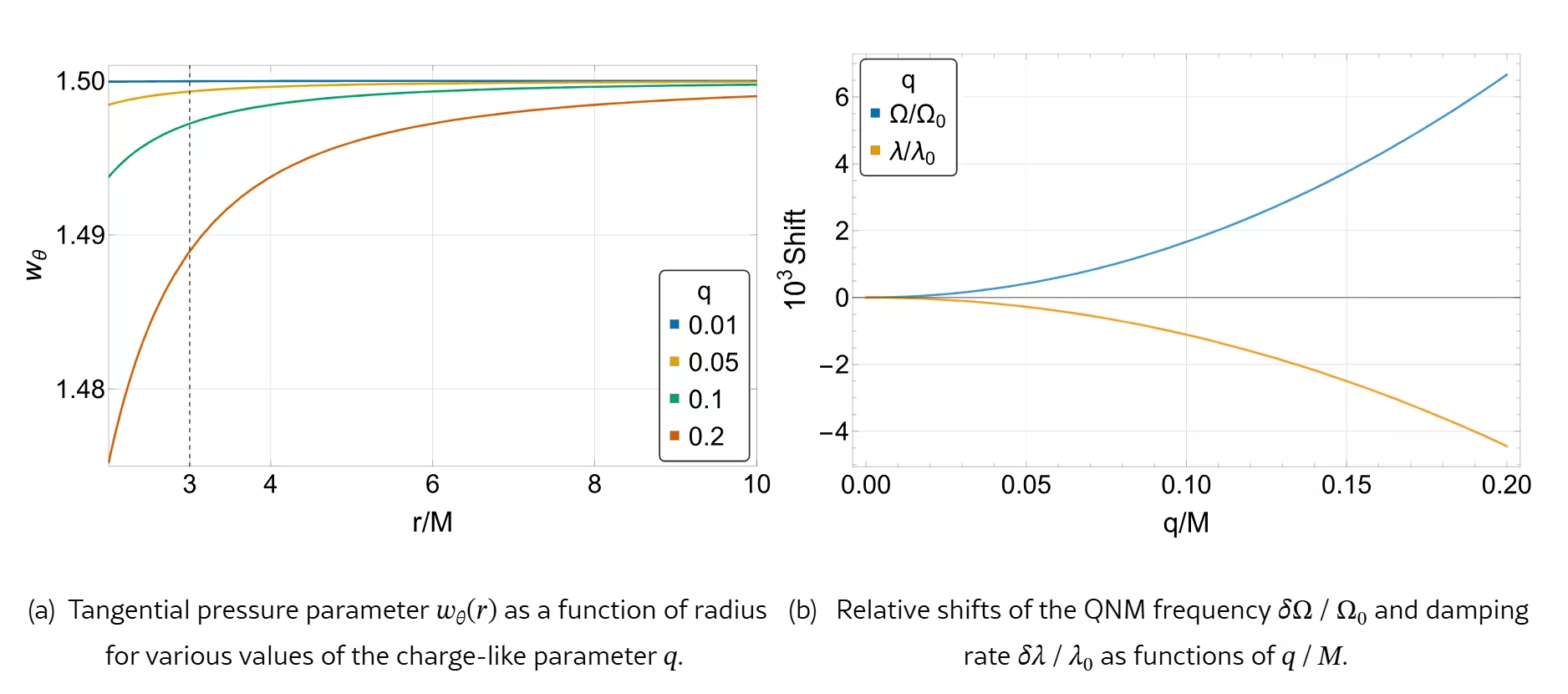
The study reveals that “hair” affects frequency and damping independently. For static black holes, the variation between these two parameters provides information regarding the energy density and tangential pressure near the photon orbit. This creates a diagnostic tool: if detectors observe a ringdown, comparing the relative shift between frequency and decay time could potentially distinguish between different types of surrounding matter or modified gravity models.
Symmetry Breaking in Rotating Black Holes
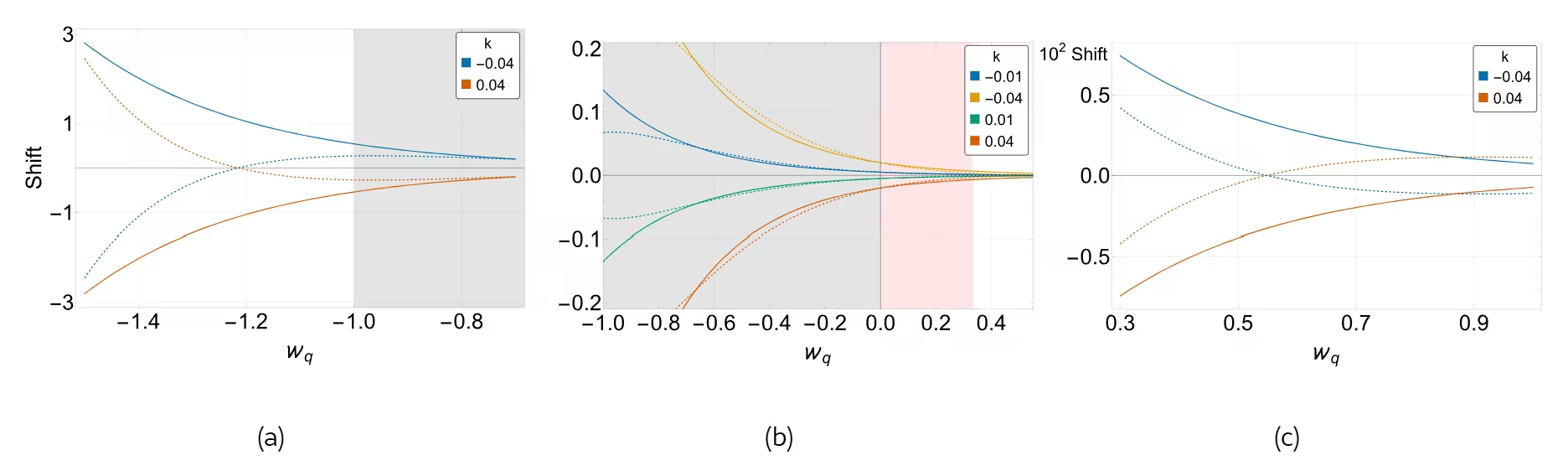
In real-world astrophysical settings, black holes rotate, which introduces a new layer of complexity. Rotation breaks the symmetry of light paths, meaning that gravitational waves traveling with the spin and those moving against it respond differently to the surrounding environment. The researchers found that “hair” creates an asymmetric signature in these two branches, offering a potential observational pathway to distinguish exotic rotating objects from standard Kerr black holes.
![(a) Trajectory in the complex plane of a QNM frequency for k = −0.04 evaluated across [−2, −1] values of the equation-of-state parameter w_q. (b) Trajectory in the complex plane of a QNM frequency for k = −0.04 evaluated across [−1, 1] values of the equation-of-state parameter w_q.](https://www.bioscience.com.pk/images/ce0ad1b5ca.avif)
While this framework provides a vital roadmap for future gravitational-wave spectroscopy, the authors caution that it remains theoretical. The current approximation is most accurate for high-frequency modes, whereas current detectors like LIGO and Virgo primarily capture lower-order signals. Nevertheless, as detector sensitivity improves, this roadmap could eventually determine whether the vacuum surrounding a black hole is truly void, or if it carries the subtle imprint of unseen physics.
![(a) Trajectory in the complex plane of a QNM frequency for k = −0.04 evaluated across [1, 2] values of the equation-of-state parameter w_q. (b) Trajectory of QNM frequencies in the complex plane under varying anisotropic fluid parameter k = −0.10, −0.05, 0.05, 0.10, illustrating how the real and imaginary components of the QNM frequency shift relative to the reference point {Ω₀, λ₀} at k = 0.](https://www.bioscience.com.pk/images/00f4132c2f.avif)
Additional Resources
- Black hole spectroscopy: from theory to experiment (Classical and Quantum Gravity, 2026)
- Black hole spectroscopy: status report (General Relativity and Gravitation, 2025)
- Black hole spectroscopy with nonlinear quasinormal modes (Physical Review D, 2025)
This article has been fact checked for accuracy, with information verified against reputable sources. Learn more about us and our editorial process.
Last reviewed on .
Article history
- Latest version
Reference(s)
- Berti, Emanuele. “Black hole spectroscopy: from theory to experiment.”, June 28, 2026, doi: 10.1088/1361-6382/ae59e2. <https://www.repository.cam.ac.uk/handle/1810/405150>.
- Carullo, Gregorio. “Black hole spectroscopy: status report.” General Relativity and Gravitation, vol. 57, no. 5, April 29, 2025 Springer Science and Business Media LLC, doi: 10.1007/s10714-025-03408-y. <https://link.springer.com/article/10.1007/s10714-025-03408-y>.
- Lagos, Macarena., et al. “Black hole spectroscopy with nonlinear quasinormal modes.” Physical Review D, vol. 111, no. 2, January 6, 2025 American Physical Society (APS), doi: 10.1103/PhysRevD.111.024018. <https://journals.aps.org/prd/abstract/10.1103/PhysRevD.111.024018>.
Cite this page:
- Posted by Aisha Ahmed