Scientists May Have Found a Way to Detect Hidden Matter Around Black Holes
Scientists have discovered a new way to decode black hole signals, uncovering mysterious patterns that challenge our understanding of the universe.
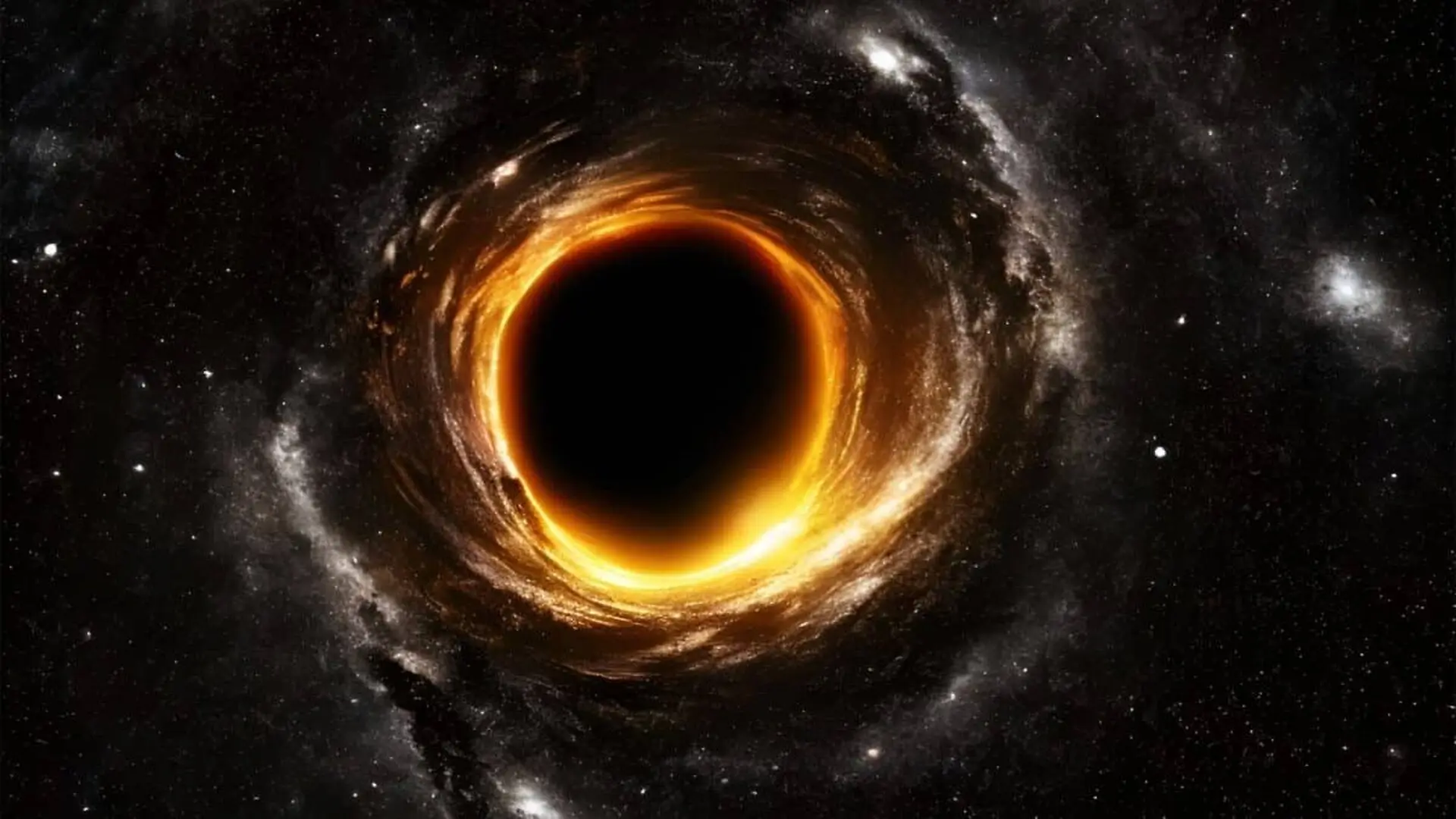
Physicists are closing in on a potential method to detect “black hole hair,” a theoretical phenomenon that could challenge our fundamental understanding of gravity. A team of researchers from Nagoya University has developed a new diagnostic framework to hunt for these hidden structures by analyzing the faint, decaying echoes of gravitational waves that follow the collision of two black holes.
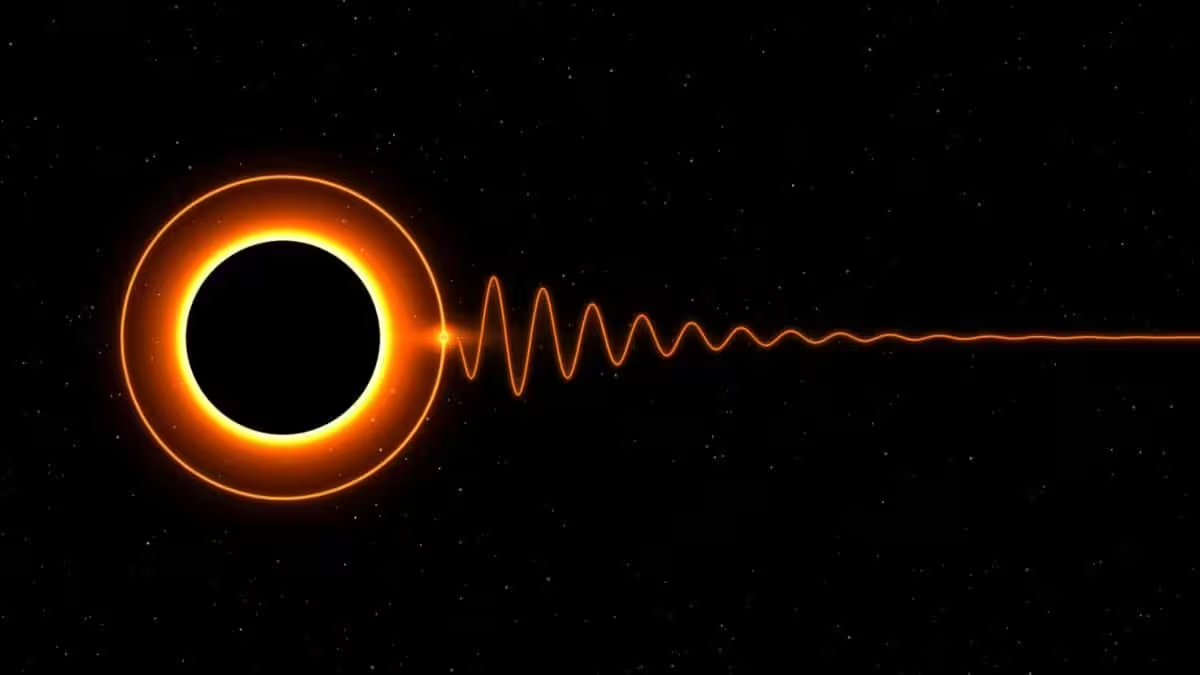
When binary black holes merge, the resulting object enters a brief, turbulent phase known as the “ringdown.” Much like a bell settling into silence after being struck, the newly formed black hole emits gravitational waves as it stabilizes. While Einstein’s theory of general relativity posits that these black holes are simple objects defined primarily by their mass and rotation, theorists have long speculated that unknown physics or hidden matter might exist in their immediate vicinity. This hypothetical, complex environment is what scientists refer to as “black hole hair.”
Decoding the Ringdown Echoes
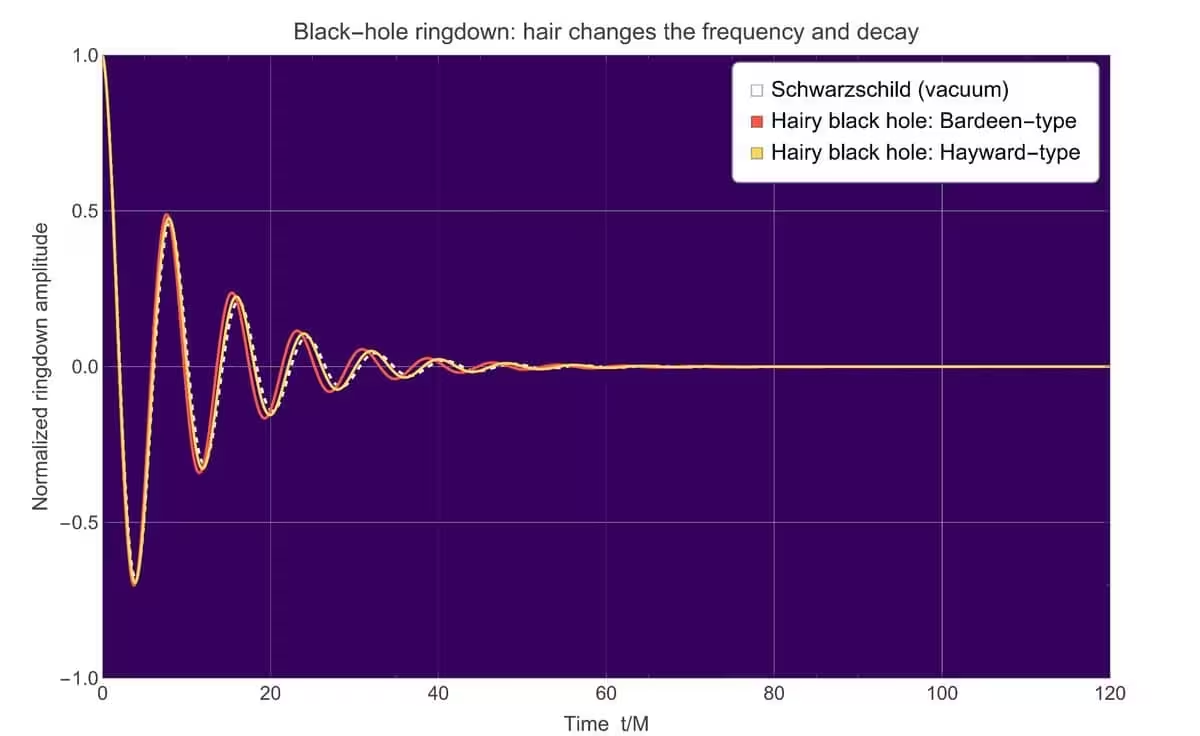
The ringdown phase is a goldmine of information for astrophysicists. According to standard models derived from Einstein’s field equations, the gravitational wave signature emitted during this time should be dictated solely by the mass and spin of the final black hole. However, the presence of surrounding matter—or “hair”—would theoretically introduce subtle distortions to this signal.
The research, published in the Journal of Cosmology and Astroparticle Physics, suggests that this hidden material would leave a distinct fingerprint on the waves. Specifically, the frequency of the gravitational oscillations and the rate at which they dissipate would change in predictable ways depending on the distribution and pressure of the surrounding matter. For rotating black holes, these effects become even more complex, with the signal shifting depending on whether the gravitational waves travel in alignment with or in opposition to the spin of the object.
Testing the Limits of General Relativity
The quest to identify this “hair” is essentially a stress test for Einstein’s theory of general relativity. Because black holes represent the most extreme gravitational environments in the cosmos, they serve as the ultimate laboratories for testing whether our current equations hold up under pressure or if they require new physics to account for deviations.
To build their model, the researchers leveraged existing mathematical relationships between the behavior of light around a black hole and the characteristics of gravitational wave ringdowns. By injecting variables representing hidden matter into their simulations, they were able to calculate how these deviations would manifest in the signals detected by instruments on Earth. Ariadna Uxue Palomino Ylla, a doctoral candidate at Nagoya University and the study’s lead author, emphasizes that these signatures could provide a vital window into extreme physics.
“Black hole hair may represent matter surrounding the black hole or deviations from the simplest kind of black hole predicted by general relativity. Because these may slightly change the ringdown signal, detecting or ruling out these changes could give us a new way to test gravity in this extreme region.”
From Speculation to Observation
Rather than modeling every individual configuration of black hole hair, this new approach offers a generalized framework to distinguish between standard black holes and those influenced by exotic surroundings. By identifying anomalous patterns in future gravitational wave data, astronomers might eventually be able to infer the presence and nature of otherwise invisible material.
“The ringdown waves may not only show that something extra is affecting the black hole; the way the signal changes could also give us clues about what this hidden matter is actually like,” said Ariadna Uxue Palomino Ylla.
While this research remains theoretical, it provides a crucial analytical roadmap for the next generation of gravitational wave observatories. The team notes that the primary goal is not to confirm the existence of such structures, but to provide the scientific community with the necessary tools to rigorously investigate whether the universe contains features that defy our current gravitational paradigm.
This article has been fact checked for accuracy, with information verified against reputable sources. Learn more about us and our editorial process.
Last reviewed on .
Article history
- Latest version
Reference(s)
- “Ariadna Uxue Palomino Ylla: Wolfram Summer School Alumni 2021.” <https://education.wolfram.com/summer-research-institute/alumni/2021/ariadna-uxue-palomino-ylla/>.
Cite this page:
- Posted by Aisha Ahmed