Astronomers Just Captured a Giant Planet Actively Shaping Its Birthplace
Astronomers have captured direct evidence of a gas giant planet currently forming within its natal disk, offering a rare glimpse into planetary evolution.
Astronomers have achieved an unprecedented look at a gas giant in the midst of its development, providing a clear window into how massive planets leave their mark on the environments where they are born. Using the Atacama Large Millimeter/submillimeter Array (ALMA) in Chile, an international research team led by Myriam Benisty of the Max Planck Institute for Astronomy has imaged the direct interactions between a young planet and the primordial gas and dust of its cradle.
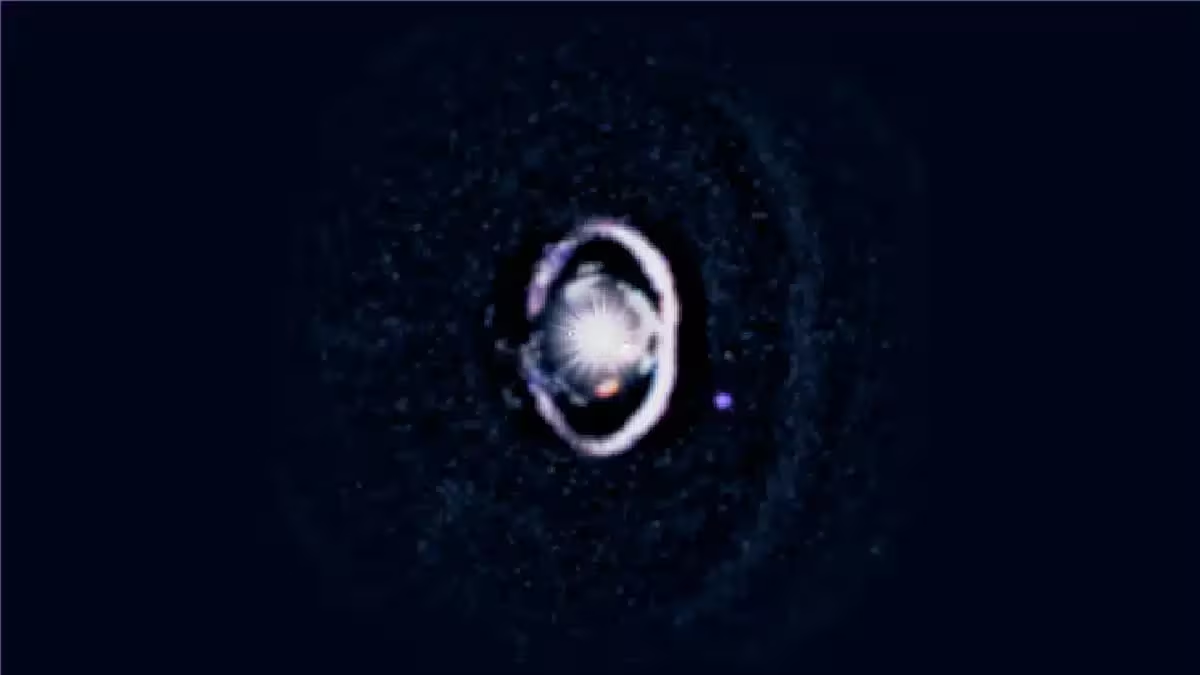
The subject of this study, WISPIT 2b, is a gas giant with roughly five times the mass of Jupiter. Located approximately 430 light-years away, it belongs to an elite group of planets known to remain actively tethered to the material from which they are accreting mass. This proximity to its birth material makes the WISPIT 2 system a high-fidelity laboratory for observing the mechanical processes of planetary growth, gap formation, and the structural evolution of young solar systems.
Mapping the Origins of Giant Worlds
Planets typically emerge from protoplanetary disks—massive, rotating structures of dust and gas swirling around infant stars. Within these disks, dust grains collide and aggregate into pebbles, eventually forming planetesimals. Once these cores reach a critical mass, they begin to siphon off large quantities of hydrogen and helium, ballooning into the gas giants observed in mature solar systems like our own.
While early observations of systems like PDS 70 offered a glimpse of young planets, those worlds appear to have already cleared significant portions of their surrounding gas. WISPIT 2b offers a more dynamic view, as it remains embedded in a region still actively fueling its growth. The system was originally detected through the WIde Separation Planets In Time (WISPIT) survey using the SPHERE instrument on the Very Large Telescope (VLT) and the Magellan Clay Telescope. Subsequent follow-ups identified a second planet, WISPIT 2c, and confirmed that the central “star” is actually a pair of stars locked in a tight, binary orbit, adding layers of gravitational complexity to the system’s development.
Validating Theoretical Models of Planet Formation
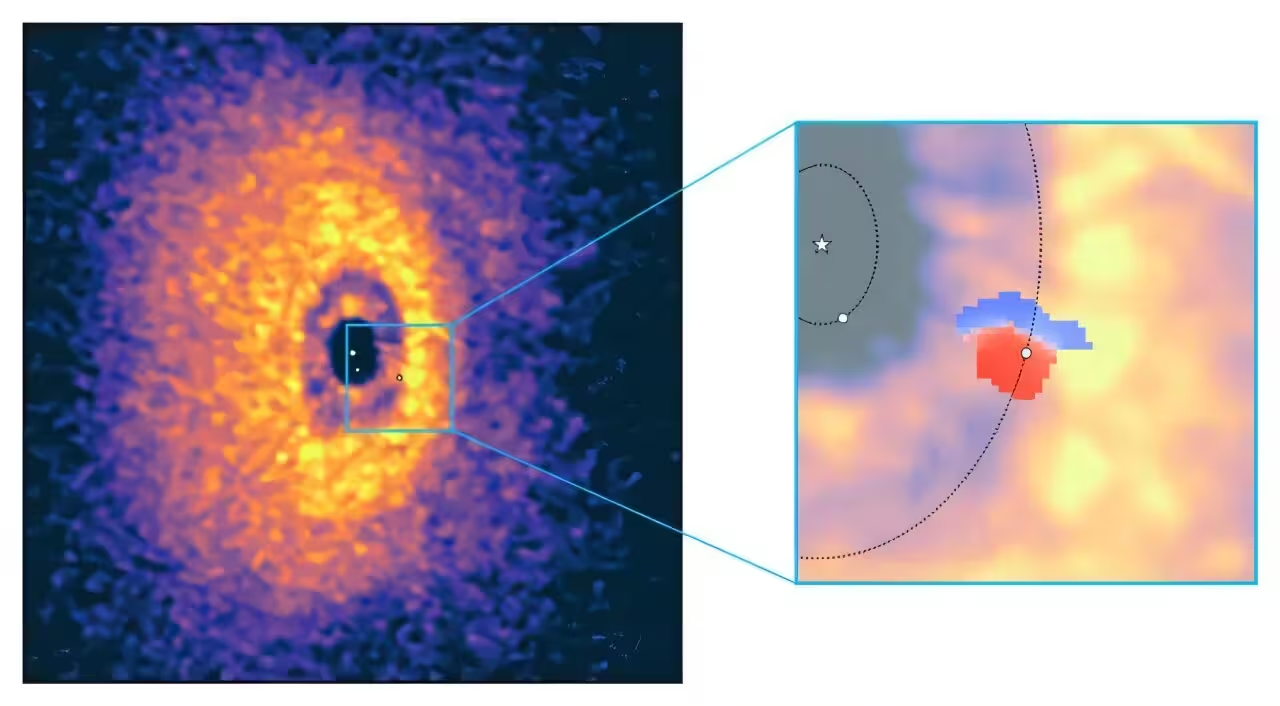
The high-resolution data from ALMA—which utilizes an array of 66 antennas to simulate a single massive telescope—allowed researchers to visualize gas dynamics in the vicinity of WISPIT 2b that were previously only theoretical. Specifically, the images show swirling patterns of gas consistent with models of how giant planets ingest material from their disks. These findings, detailed in research led by Stefano Facchini of the University of Milan and published via the arXiv preprint server (paper one) and the second paper, provide crucial empirical support for current formation theories.
By observing both WISPIT 2b and 2c, astronomers can now clearly differentiate between the structural gaps caused by planets and those caused by other, non-planetary disk processes. WISPIT 2b resides approximately 57 astronomical units from its host stars, a distance significantly farther out than that of the gas giants in our own solar system. This positioning provides a rare opportunity to study how such massive objects form at the frigid outer reaches of their parent systems.
As telescope technology continues to advance, researchers hope that upcoming upgrades to ALMA and the future deployment of the European Southern Observatory’s 39-meter Extremely Large Telescope will allow for even more precise imaging. Ultimately, the ability to observe these systems in real-time is transforming planetary science from a field of retrospective modeling into one of direct observation, allowing us to watch the architecture of future solar systems being assembled.
This article has been fact checked for accuracy, with information verified against reputable sources. Learn more about us and our editorial process.
Last reviewed on .
Article history
- Latest version
Reference(s)
- Benisty, Myriam. “Mapping the WISPIT2 Planet-Hosting Cavity at Sub-Hill-Radius scales.” arXiv.org <https://arxiv.org/abs/2609.04946>.
- Bürgy, Cade. “A closer look at the WISPIT 2 host star. Evidence for a spectroscopic binary.” arXiv.org <https://arxiv.org/abs/2607.22405>.
Cite this page:
- Posted by Aisha Ahmed