June 29 Strawberry Moon: Spot The Year’s Final Micro Moon Low On The Horizon
June’s Strawberry Moon, the final micro moon of 2026, offers a rare full moon that appears smaller and lower in the night sky.

In late June, the night sky will showcase a full Moon that is both dimmer and closer to the horizon than usual. This occurrence, known as the Strawberry Moon, will also be the last micro‑moon of 2026, offering skywatchers a chance to observe a slightly smaller, low‑lying lunar disc as it climbs above the eastern horizon.
What Makes This Full Moon Unique
The June full Moon carries the traditional name Strawberry Moon, a label tied to the early‑summer strawberry harvest in parts of North America rather than to any reddish hue. The moniker reflects a cultural calendar that has been passed down for generations, marking the transition into summer.
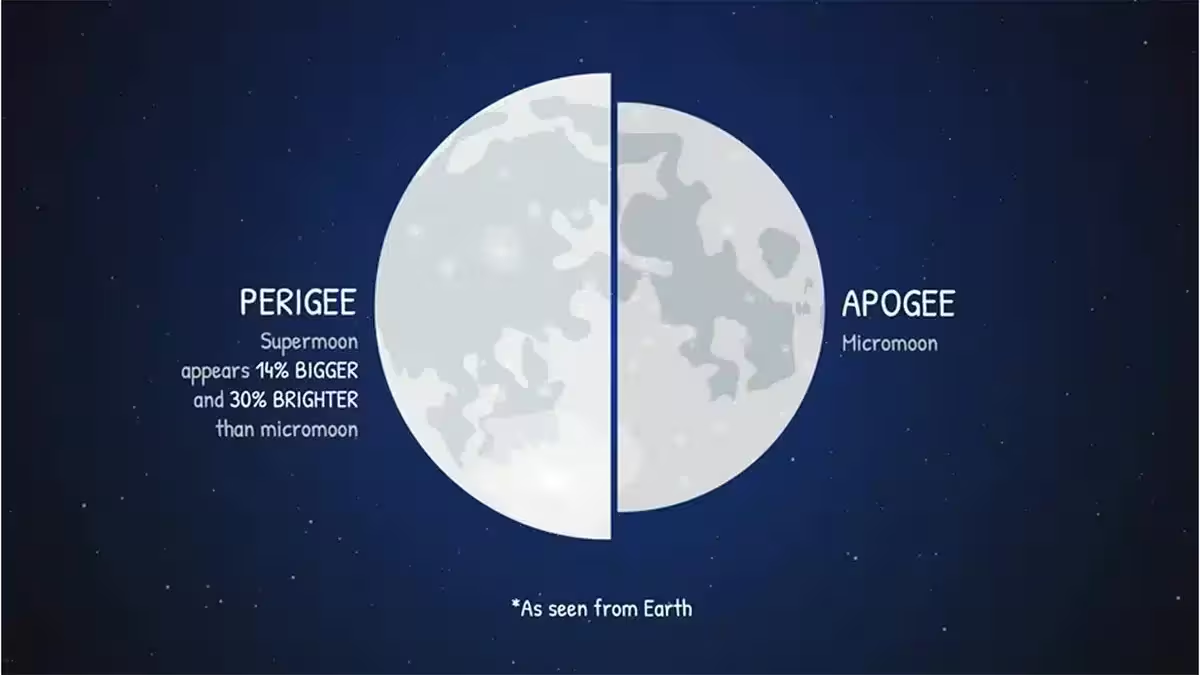
This year’s edition is especially noteworthy because it qualifies as a micro moon. A micro moon appears when the Moon reaches full phase near apogee, the farthest point in its elliptical orbit around Earth. At apogee the Moon’s apparent diameter shrinks by roughly seven percent compared with a typical full Moon, a difference that is subtle to casual observers but measurable by astronomers. The effect becomes more pronounced when contrasted with a supermoon, which is larger due to a perigee alignment.
According to Time and Date, the peak brightness of the Strawberry Moon occurs at 7:56 p.m. ET on June 29, 2026. In most of North America this timing falls just before nightfall, so the optimal window for observation will be after the Sun has set. The Moon will remain fully illuminated throughout the night, rising in the southeast and staying low as it tracks across the sky.
Why the Moon Stays Near the Horizon
June full Moons typically follow a lower arc across the sky, a result of the same axial tilt that creates the summer solstice. When the Northern Hemisphere leans toward the Sun, daylight extends and the Sun climbs higher, while the full Moon, positioned opposite the Sun, traces a correspondingly low path.
Consequently, observers will see the Strawberry Moon emerge in the southeastern sky shortly after sunset, glide across the southern horizon, and set in the southwest before dawn. Urban environments, foliage, or elevated terrain may obstruct the view, but the Moon’s brightness should make it easy to locate once a clear line of sight is found.
A Quiet but Meaningful Astronomical Moment
Although the event lacks dramatic color shifts or eclipses, its significance lies in the convergence of several uncommon factors: it is the final micro moon of the year, one of the lowest full Moons of the season, and a cultural marker heralding the start of summer in the Northern Hemisphere.
For those who pause to watch the Moon rise on June 29, the subtle reduction in size and the unusually low trajectory will illustrate the dynamic relationship between Earth and its satellite. Even familiar celestial objects can reveal nuanced variations from month to month, reminding observers of the intricate orbital mechanics that shape our night sky.
This article has been fact checked for accuracy, with information verified against reputable sources. Learn more about us and our editorial process.
Last reviewed on .
Article history
- Latest version
Cite this page:
- Posted by Aisha Ahmed