NASA’s Juno Reveals How Jupiter’s Magnetic Shield Violently Rebuilds Itself
NASA’s Juno mission has uncovered how Jupiter’s massive magnetic shield uses plasma-wave harmonics to absorb solar wind and heat particles in space.
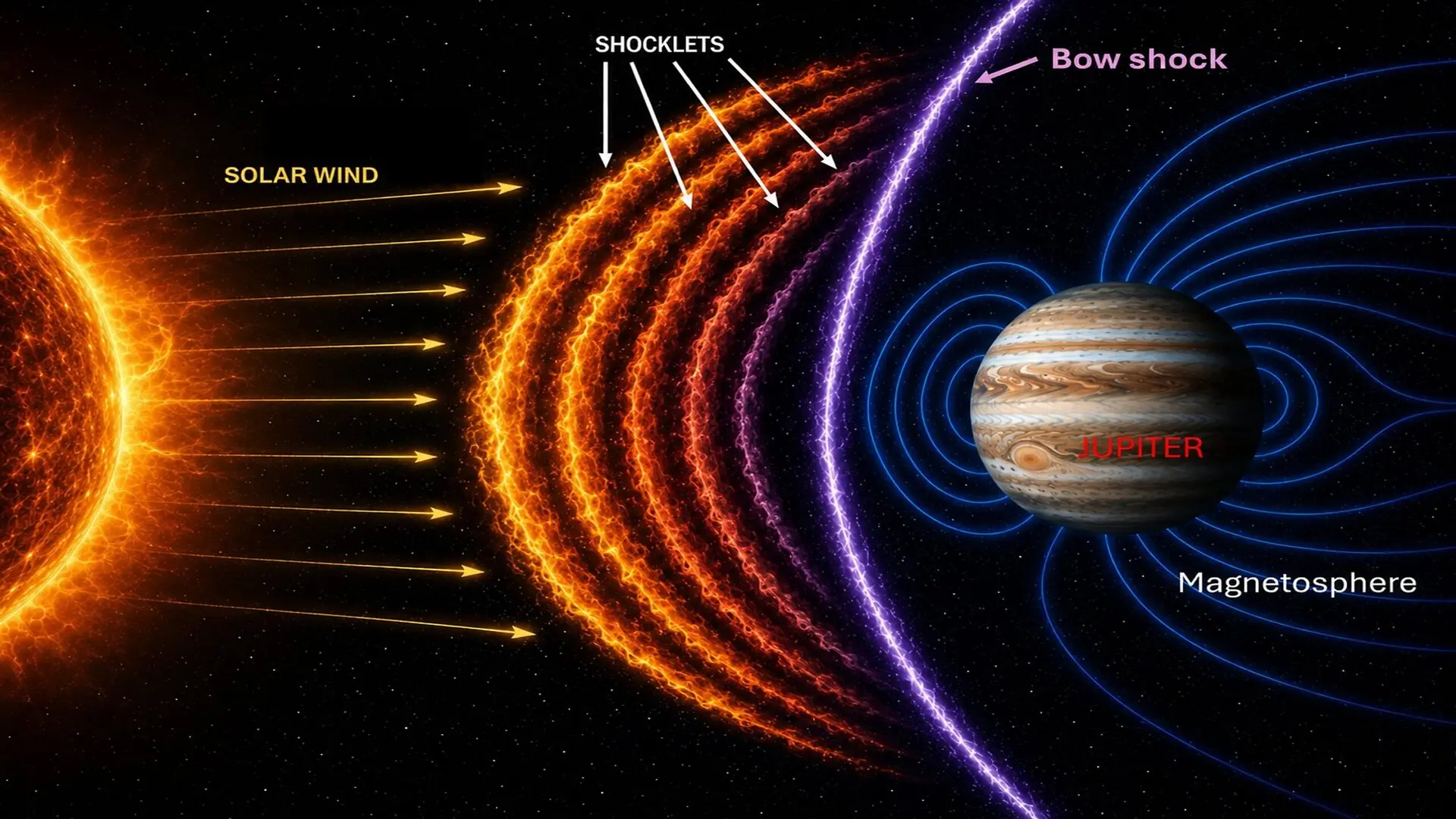
An invisible, high-energy barrier surrounding Jupiter is providing scientists with a rare window into the mechanics of space weather. NASA’s Juno spacecraft recently captured unprecedented measurements of the Jovian bow shock, revealing a chaotic environment where intense plasma waves and repeating magnetic structures manage the immense energy of the solar wind.
The findings, detailed in Nature Communications by an international team led by researchers at the University of Iowa, highlight how Jupiter functions as a massive, natural laboratory for studying “collisionless” shocks—phenomena that are notoriously difficult to observe in the vast, sparse reaches of deep space.
Managing the Solar Wind’s Unrelenting Force
The solar wind is a constant, supersonic stream of charged particles pouring out from the Sun. When this stream encounters the immense, magnetized sphere of Jupiter, it cannot simply pass through. Instead, it hits a “bow shock,” a boundary where particles must abruptly slow down, change direction, and heat up. Unlike atmospheric shock waves on Earth, which dissipate energy through physical collisions between molecules, the plasma around planets is so thin that particles rarely touch. Instead, electromagnetic fields and plasma waves act as the primary engines for heating and energy conversion.
While Earth’s own bow shock has been extensively studied, Jupiter’s extreme environment—characterized by a much larger magnetic field—reveals a more complex, nonlinear version of these processes. “Jupiter has found its own way to deal with the solar wind, through plasma waves that are stronger and exhibit richer harmonic structures,” explains lead author Jayasri Joseph.
High-Resolution Insights from Juno
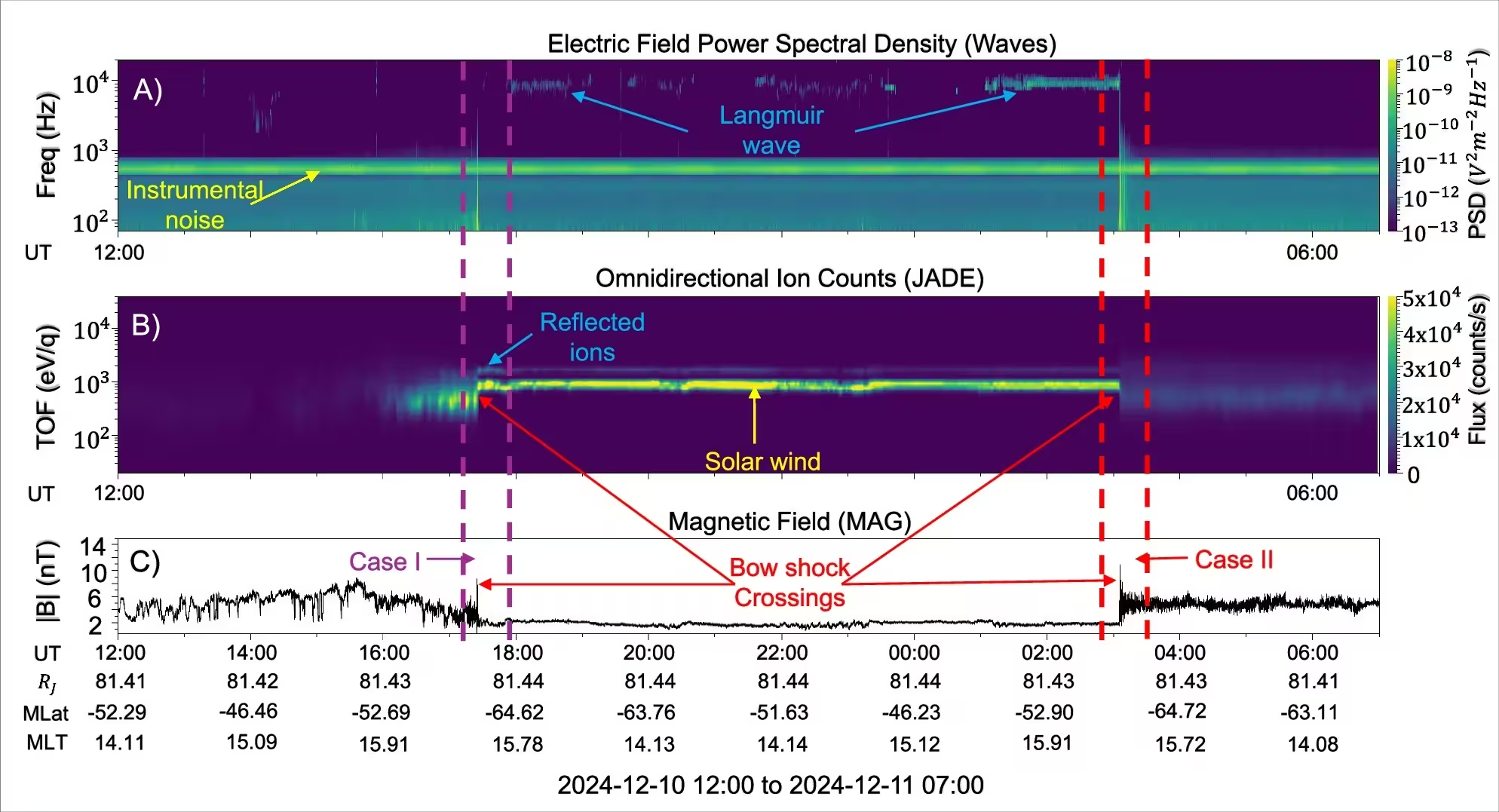
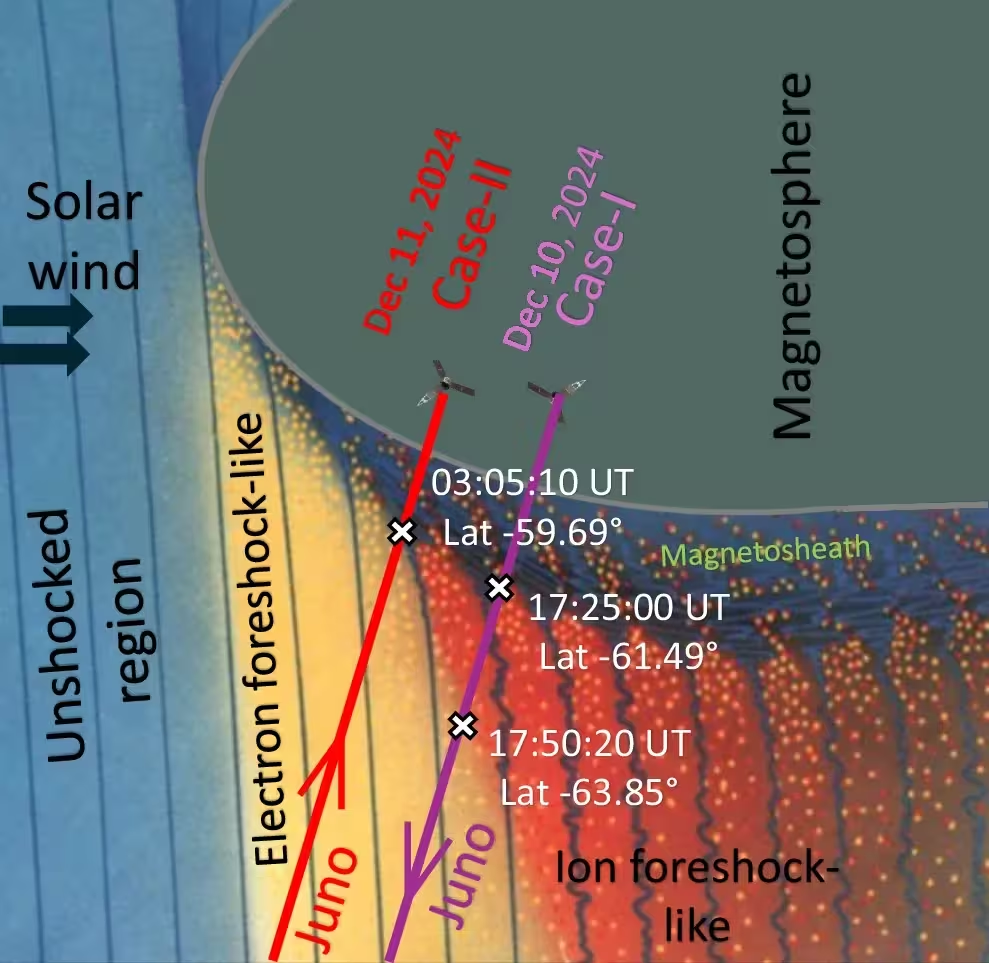
During two specific crossings in December 2024, Juno used its onboard instruments to record electric-field waveforms with remarkable precision—50,000 samples per second. This high-fidelity data allowed researchers to move beyond general observations and analyze the fine-scale behavior of plasma waves, including ion-acoustic waves and electron cyclotron drift instability (ECDI).
The data revealed that these waves are far more intricate than previously observed at Earth. Specifically, Juno detected ion-acoustic waves that did not merely pulse at a single frequency; they generated multiple “harmonics.” This musical analogy suggests a greater efficiency in energy transfer: just as a guitar chord contains multiple notes, these multi-frequency waves can interact with a broader spectrum of particle velocities, effectively heating more material as the solar wind slams into the planet’s magnetic shield.
A Shock That Constantly Reinvents Itself
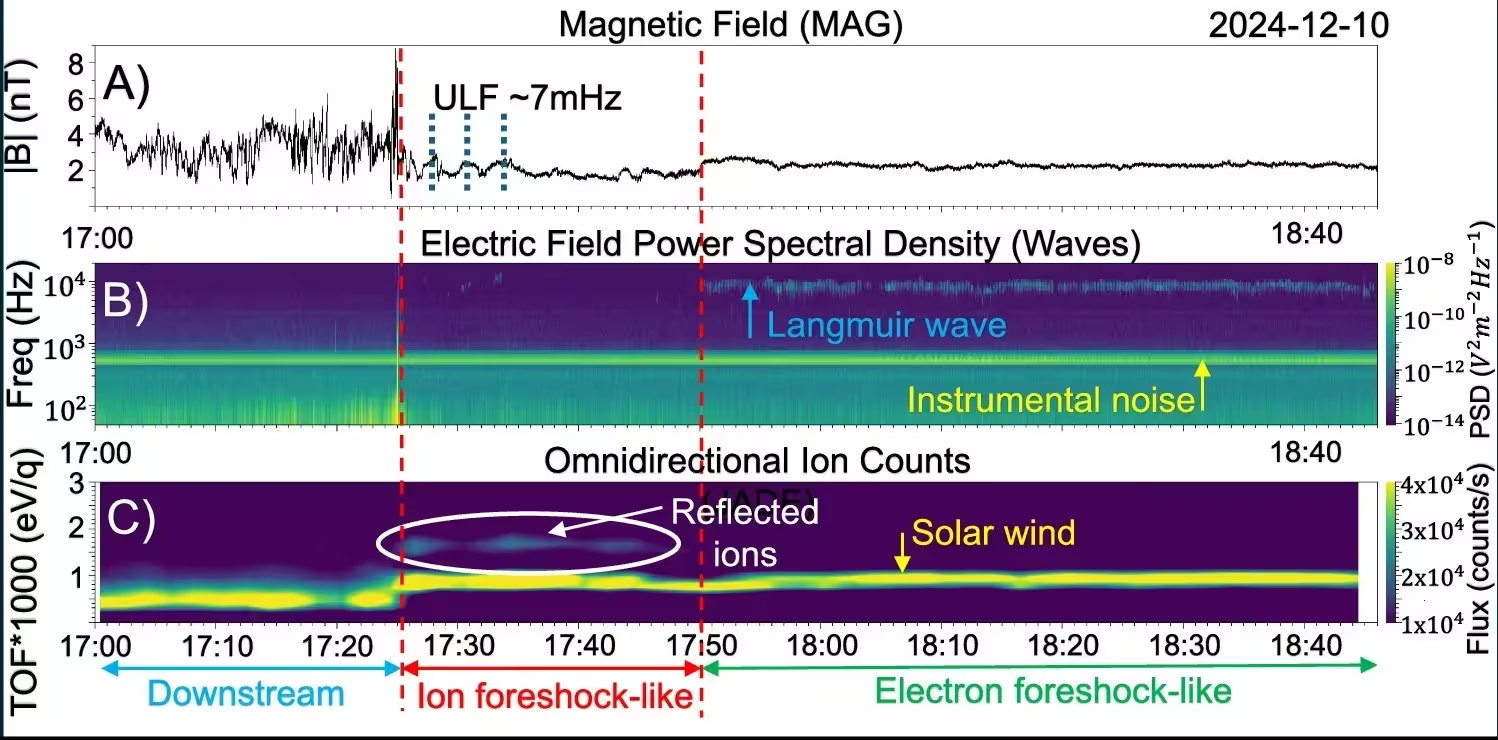
Perhaps the most startling observation occurred during Juno’s second passage through the shock, where the spacecraft detected magnetic fluctuations recurring every 8.3 seconds. This rhythmic signature is a telltale sign of “shock reformation”—a process where the boundary layer effectively breaks down and rebuilds itself under the pressure of the solar wind.
This cyclic behavior, occurring on a timescale linked to the orbital motion of protons, suggests that the shock is a dynamic, living structure rather than a static wall. Because these patterns are more pronounced at Jupiter than at other planets, the gas giant provides a clearer view of how such processes might function in even more violent astrophysical settings, such as the shocks surrounding supernova remnants.
For physicists, these results confirm that while Juno cannot venture to distant star systems to study the origin of cosmic rays or high-energy particles directly, it has turned Jupiter into the ultimate accessible test chamber. By placing high-precision sensors directly within the shock front, researchers are finally beginning to map the microscopic physics that govern the most energetic environments in the universe.
Recommended Reading on Plasma Physics and Planetary Shocks
- Relativistic electron acceleration at the bow shock of Jupiter and beyond(Nature, 2026)
- Quasiperpendicular High Mach Number Shocks(Physical Review Letters, 2015)
- Quantified energy dissipation rates in the terrestrial bow shock: 2. Waves and dissipation(Journal of Geophysical Research: Space Physics, 2014)
- Fundamentals of collisionless shocks for astrophysical application, 1. Non-relativistic shocks(The Astronomy and Astrophysics Review, 2009)
- Comparison of plasma wave measurements in the bow shocks at Earth, Jupiter, Saturn, Uranus and Neptune(Geophysical Research Letters, 1990)
This article has been fact checked for accuracy, with information verified against reputable sources. Learn more about us and our editorial process.
Last reviewed on .
Article history
- Latest version
Reference(s)
- Joseph, J.. “Plasma wave observations from Juno spacecraft at the Jovian bow shock - Nature Communications.”, vol. 17, no. 1, July 31, 2026, pp. 9263 Nature, doi: 10.1038/s41467-026-76223-x. <https://www.nature.com/articles/s41467-026-76223-x>.
- “The University of Iowa | The University of Iowa.”, October 2, 2026 The University of Iowa <https://uiowa.edu/>.
- Raptis, Savvas., et al. “Relativistic electron acceleration at the bow shock of Jupiter and beyond.” Nature, vol. 654, no. 8117, June 3, 2026, pp. 47-51. Springer Science and Business Media LLC, doi: 10.1038/s41586-026-10473-z. <https://doi.org/10.1038/s41586-026-10473-z>.
- Sulaiman, A. H.., et al. “Quasiperpendicular High Mach Number Shocks.” Physical Review Letters, vol. 115, no. 12, September 16, 2015 American Physical Society (APS), doi: 10.1103/PhysRevLett.115.125001. <https://doi.org/10.1103/PhysRevLett.115.125001>.
- Wilson, L. B.., et al. “Quantified energy dissipation rates in the terrestrial bow shock: 2. Waves and dissipation.” Journal of Geophysical Research: Space Physics, vol. 119, no. 8, August 25, 2014, pp. 6475-6495. American Geophysical Union (AGU), doi: 10.1002/2014JA019930. <https://doi.org/10.1002/2014JA019930>.
- Treumann, R. A.. “Fundamentals of collisionless shocks for astrophysical application, 1. Non-relativistic shocks.” The Astronomy and Astrophysics Review, vol. 17, no. 4, September 16, 2009, pp. 409-535. Springer Science and Business Media LLC, doi: 10.1007/s00159-009-0024-2. <https://doi.org/10.1007/s00159-009-0024-2>.
- Moses, S. L.., et al. “Comparison of plasma wave measurements in the bow shocks at Earth, Jupiter, Saturn, Uranus and Neptune.” Geophysical Research Letters, vol. 17, no. 10, December 7, 2012, pp. 1653-1656. American Geophysical Union (AGU), doi: 10.1029/GL017i010p01653. <https://doi.org/10.1029/GL017i010p01653>.
Cite this page:
- Posted by Aisha Ahmed